This bill redesignates the Geospatial Learning Center in the Next NGA West facility in St. Louis, Missouri, as the Senator Roy Blunt Geospatial Learning Center.
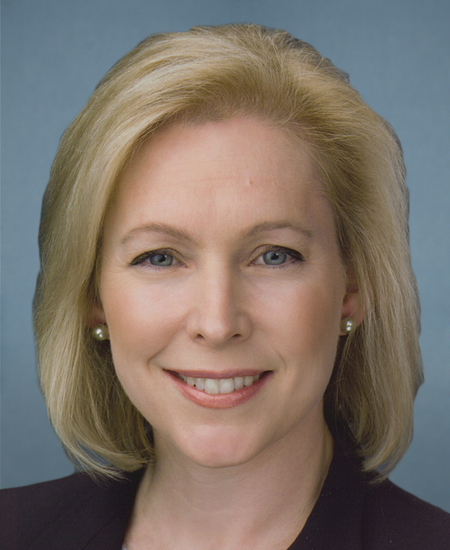
Sen. Kirsten E. Gillibrand
Sponsored bills
Transformation to Competitive Integrated Employment Act This bill addresses employment standards for people with disabilities. First, the Department of Labor must award grants to states and certain eligible entities to assist them in transforming their business and program models to support people with disabilities by providing competitive integrated employment, assisting them in finding and retaining work in such employment, providing them with integrated employment and integrated community participation and wraparound services, and ensuring that such services comply with federal regulations for individuals receiving home and community-based services. The bill also prohibits the issuance of new special certificates that allow payment of subminimum wages to people with disabilities and phases out existing certificates over a five-year period. Further, Labor's Office of Disability Employment must award grants for technical assistance and other strategic support to employers transitioning from special certificates to competitive integrated employment for people with disabilities. Labor must contract with a nonprofit entity to conduct an evaluation of the impact of these transitions.
Bolstering Infectious Outbreaks Preparedness Workforce Act of 2021 or the BIO Preparedness Workforce Act of 2021 This bill establishes a student loan repayment program for health care and related professionals who are engaged in either bio-preparedness and response activities or infectious disease care in underserved communities. For each year that a professional meets the work requirements of the program, the Health Resources and Services Administration may pay up to $50,000 of the professional's student loan principal and interest, up to a maximum amount of $150,000.
Protecting America's First Responders Act of 2021 This bill makes changes to the Public Safety Officers' Benefits (PSOB) program. The PSOB program provides death, disability, and education benefits to public safety officers and survivors of public safety officers who are killed in the line of duty or permanently disabled as a result of catastrophic injuries sustained in the line of duty. Among the changes, the bill expands the public safety officers eligible for coverage under the PSOB program to include firefighters whose primary duty during an emergency response is to secure the scene or manage traffic and cadets or trainees in candidate-officer training; extends coverage under the PSOB program to certain public safety officers responding outside their jurisdiction; increases the interim benefit amount payable on a claim for death benefits and requires the interim amount to be adjusted annually for inflation; increases the benefit amount payable on a death or disability claim that has been pending for more than 365 days on the date of the final determination; allows the Department of Justice (DOJ) to use investigative tools, including subpoenas, to expedite the processing of claims and obtain information or documentation from third parties (e.g., public agencies); specifies that an injury resulting from a neurocognitive disorder qualifies as a catastrophic injury for the purposes of disability benefits; requires (currently, authorizes) DOJ to provide retroactive education benefits to qualifying children and spouses; specifies that hearing officers appointed to review claims are special government employees (i.e., employees who perform temporary duties for a limited period of time) and are authorized to conduct examinations; allows responders to the World Trade Center or their surviving family members to file claims for death or disability benefits in certain circumstances; and extends the period during which public safety officers who die or become injured as a result of COVID-19 are eligible for benefits.
Access to Birth Control Act This bill requires pharmacies to comply with certain rules related to ensuring access to contraceptives. Specifically, pharmacies must provide without delay a customer with any contraceptive or related medication that is in stock. If the contraceptive is not in stock, the pharmacy must immediately inform the customer and either order the contraceptive or refer the customer to a pharmacy that has it in stock. Laws in some states provide pharmacists with the right to refuse to dispense contraceptive-related drugs on religious or conscience grounds. Pharmacies may refuse to provide a contraceptive to a customer (1) if the customer lacks a valid prescription for a prescription contraceptive or is unable to pay for the contraceptive, or (2) based on a pharmacy employee's professional clinical judgment. The bill also establishes a private cause of action and civil monetary penalties for violations of the bill.
WIC Healthy Beginnings Act of 2021 This bill requires the Department of Agriculture (USDA) to maintain a publicly available, searchable database that contains solicitations for infant formula bids under the Special Supplemental Nutrition Program for Women, Infants, and Children (WIC). Under current law, state agencies must control infant formula costs in the WIC program through competitive bidding for infant formula rebate contracts. The bill requires state WIC agencies to provide USDA with open solicitations for these competitive bids to populate the database.
Cattle Price Discovery and Transparency Act of 2021 This bill requires the Department of Agriculture (USDA) to take various actions to address transparency in pricing and contract terms in the cattle industry. Among these requirements, USDA must (1) establish regional minimum percentages of cattle that meat packers must procure through negotiated purchases or negotiated grid purchases (i.e., transactions where the price is known and negotiated at the time of the transaction), and (2) maintain a publicly available catalog of contracts offered by meat packers to livestock producers for the purchase of fed cattle.
More Options to Develop and Enhance Remote Nutrition in WIC Act of 2021 or the MODERN WIC Act of 2021 This bill makes various changes to allow individuals to remotely certify their eligibility for, and receive benefits through, the Special Supplemental Nutrition Program for Women, Infants, and Children (WIC). The Department of Agriculture must also report to Congress about the use of remote technologies and other tools in the WIC program.
Bringing an End to Harassment by Enhancing Accountability and Rejecting Discrimination in the Workplace Act or the BE HEARD in the Workplace Act This bill expands protections against discrimination and harassment in the workplace and raises the minimum wage for tipped employees. Specifically, the bill (1) makes it an unlawful employment practice to discriminate against an individual in the workplace based on sexual orientation, gender identity, pregnancy, childbirth, a medical condition related to pregnancy or childbirth, or a sex stereotype; and (2) provides a statutory definition for what constitutes workplace harassment. Further, these protections apply to all workplaces, regardless of size, and to all workers, including independent contractors, interns, volunteers, and trainees. The bill prohibits employers from entering into contracts or agreements with workers that contain certain nondisparagement or nondisclosure clauses and prohibits certain predispute arbitration agreements and postdispute agreements. It also establishes grant programs to (1) prevent and respond to workplace discrimination and harassment, (2) provide legal assistance for low-income workers, and (3) establish a system of legal advocacy in states to protect the rights of workers. The bill further provides employees the right to retain their tips and it increases, in specified annual increments, the minimum wage for tipped employees to match the federal minimum wage for nontipped employees. Additionally, the bill requires the Equal Employment Opportunity Commission to provide specified training and resource materials, establish and convene a harassment prevention task force, and establish an Office of Education and Outreach with regard to prohibited discrimination and harassment in employment. The bill also requires specified studies, reports, and research on prohibited workplace harassment.

Ending Forced Arbitration of Sexual Assault and Sexual Harassment Act of 2021 This bill invalidates arbitration agreements that preclude a party from filing a lawsuit in court involving sexual assault or sexual harassment, at the election of the party alleging such conduct.