

Maddy summarySRES 615 is a Senate resolution celebrating Black History Month, acknowledging the historical contributions of African Americans to U.S. society across fields like civil rights, arts, science, and leadership. The resolution encourages all citizens to reflect on this history as part of the nation's ongoing journey toward equality, without creating new laws or policies. It specifically recognizes figures such as Frederick Douglass, Maya Angelou, and Rosa Parks, and emphasizes the importance of Black History Month in February as a time for communal learning and inspiration. This ceremonial resolution was introduced by multiple senators and passed unanimously by the Senate in 2026.
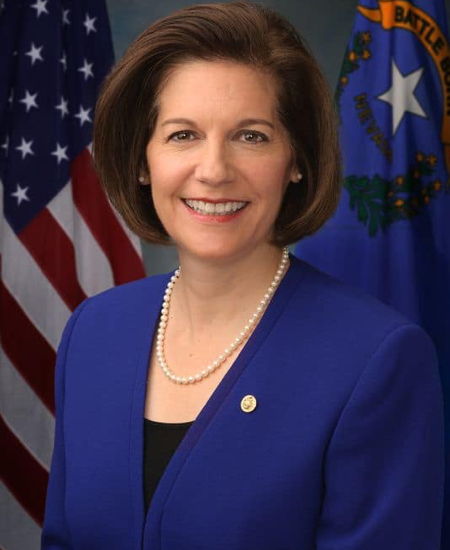
Sen. Catherine Cortez Masto
Sponsored bills
Maddy summaryThe SAVES Act of 2025 establishes a five-year pilot program at the Department of Veterans Affairs (VA) to fund nonprofit organizations that provide service dogs to eligible veterans with specific disabilities, such as blindness, mobility issues, PTSD, or traumatic brain injury. Nonprofits must apply competitively, meet training and animal welfare standards (including ADA compliance), and provide service dogs at no cost to veterans, with the VA covering all program expenses. The VA will also provide ongoing veterinary insurance for the dogs, which continues even after the pilot ends. This program is funded with $10 million annually for five years, targeting veterans as defined by VA medical criteria.
Maddy summaryThis concurrent resolution (SCONRES 25) commemorates the 15th anniversary of the January 8, 2011, Tucson shooting that killed six people and injured 13, including former Congresswoman Gabby Giffords. It honors the victims (such as Judge John Roll, Gabriel Zimmerman, and 9-year-old Christina-Taylor Green), survivors like Giffords and Ron Barber (who later became a U.S. Representative), and the community's response. The resolution expresses support for survivors, recognizes Giffords’ advocacy against gun violence, and reaffirms commitment to respectful dialogue and opposing political violence. As a symbolic gesture, it does not enact new laws or policy changes.
Maddy summaryThis bill amends the Santini-Burton Act to improve land management in the Lake Tahoe Basin by specifically supporting the Washoe Tribe of Nevada and California. It authorizes the federal government to transfer funds to the Tribe for acquiring and managing culturally significant land, and requires collaboration with the Tribe, states, local governments, and the Tahoe Regional Planning Agency for activities like forest health, water quality, and preserving cultural sites. The bill mandates annual spending plans developed with Tribe consultation, prioritizing projects that meet environmental thresholds and leverage community support. These changes directly address the Tribe’s limited land ownership (under 0.5% of the Basin) and aim to enhance shared stewardship of the region.
Maddy summaryThe Ruby Mountains Protection Act (S 1349) withdraws approximately 309,272 acres of Humboldt-Toiyabe National Forest land and 39,926 acres of Ruby Lake National Wildlife Refuge from mineral leasing and development. This protects these specific areas from future mining or mineral extraction activities, directly affecting potential developers and federal land management decisions. The bill allows noncommercial wildlife management activities by the U.S. Fish and Wildlife Service but prohibits all mineral leasing under federal law. Maps defining the exact boundaries are available for public inspection at relevant federal offices.
Maddy summarySRES 606 is a U.S. Senate resolution condemning the Iranian government for violently suppressing peaceful protests and the right to assemble, which has resulted in at least 6,126 reported deaths and 41,800 arrests since December 2025. It highlights Iran's use of internet blackouts, extrajudicial killings, arbitrary detentions, and censorship to crush nationwide demonstrations sparked by economic hardship. The resolution calls on Iran to hold free elections, allow citizens to determine their future, and hold human rights violators accountable, while commending protesters' courage. As a symbolic resolution (not a law), it expresses the Senate's stance without imposing new legal requirements.
Mining Regulatory Clarity Act This bill allows mining operators to use federal lands for activities ancillary to mining, such as waste disposal, regardless of whether those lands contain mineral deposits valuable enough to be mined (mineral validity). It also establishes the Abandoned Hardrock Mine Fund. The bill addresses a 2022 decision in the U.S. Court of Appeals for the Ninth Circuit related to the Rosemont Copper Mine in Arizona (commonly known as the Rosemont decision , described further in CRS Report R48166 ). The court held that mining claims are only allowed where mineral validity has been established and that mill site claims are more appropriate means for establishing a mining waste disposal site under the Mining Act. The bill allows a mining operator to (1) locate and include within its plan of operations as many mill site claims (e.g., areas for waste rock disposal) as are reasonably necessary for its operations, and (2) use or occupy public land in accordance with an approved plan of operations. Additionally, the bill requires any revenue generated from fees for such mill site claims to be deposited into the Abandoned Hardrock Mine Fund. The Department of the Interior must use the fund for certain abandoned hardrock mine reclamation activities.
Ski Hill Resources for Economic Development Act This bill allows National Forest System (NFS) units to keep the majority of ski area permit rental fees that were generated within their boundaries and outlines how revenues from those fees may be used. Such fees are collected by the Department of Agriculture (USDA) from ski area operators on NFS land. Within the NFS unit where the fees were generated, USDA must expend (1) 60%-48% of the collected fees for activities such as administration of the ski area permit program, visitor information, or reducing the likelihood of wildfire in or adjacent to a recreation site; and (2) 20% of the collected fees for activities such as repair of a Forest Service-owned facility, habitat restoration, or search and rescue activities. The remainder of the collected fees must be expended by USDA at any NFS unit for any of the activities specified in this bill.
Maddy summaryThis Senate resolution designates January 1 to February 1, 2026, as "National Trafficking and Modern Slavery Prevention Month" to raise public awareness about human trafficking and modern slavery. It does not create new laws or policies but formally supports observance through educational programs and community activities during this period. The resolution emphasizes collaboration between government agencies, victim advocates, and nonprofits to address trafficking, linking the timeframe to the Emancipation Proclamation anniversary (January 1) and National Freedom Day (February 1). It is a symbolic, non-binding measure intended to highlight ongoing efforts to combat trafficking, referencing existing federal anti-trafficking laws like the Trafficking Victims Protection Act.
Maddy summaryThe Strategic Subsea Cables Act of 2026 aims to protect critical subsea fiber-optic cables that form the backbone of global internet infrastructure. It requires the U.S. government to increase engagement in international bodies like the International Cable Protection Committee, establish an interagency committee for coordination, and impose sanctions on foreign entities damaging cables. The bill mandates annual reports on Chinese and Russian cable activities, strengthens information sharing between government and private cable owners, and creates new reporting requirements for U.S. agencies. These provisions directly affect U.S. government agencies, private cable companies, and foreign entities that might threaten cable security. The act focuses on enhancing the security, resilience, and protection of subsea cable networks that are vital for global communications.