EAGLES Act of 2021 This bill reauthorizes the National Threat Assessment Center (NTAC) within the U.S. Secret Service. It reauthorizes the functions of NTAC through FY2025 and expands them to include the establishment of a national program on targeted school violence prevention.
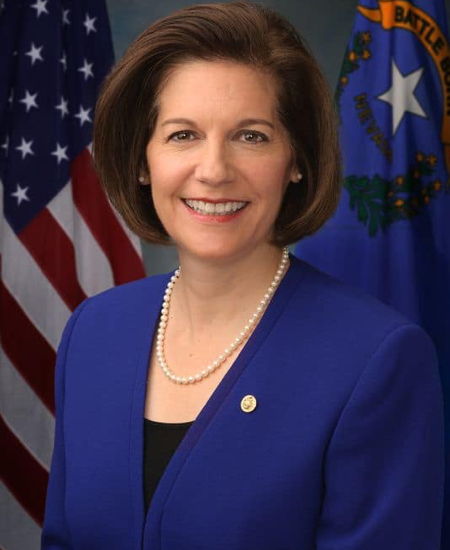
Sen. Catherine Cortez Masto
Sponsored bills
Equality Act This bill prohibits discrimination based on sex, sexual orientation, and gender identity in areas including public accommodations and facilities, education, federal funding, employment, housing, credit, and the jury system. Specifically, the bill defines and includes sex, sexual orientation, and gender identity among the prohibited categories of discrimination or segregation. The bill expands the definition of public accommodations to include places or establishments that provide (1) exhibitions, recreation, exercise, amusement, gatherings, or displays; (2) goods, services, or programs; and (3) transportation services. The bill allows the Department of Justice to intervene in equal protection actions in federal court on account of sexual orientation or gender identity. The bill prohibits an individual from being denied access to a shared facility, including a restroom, a locker room, and a dressing room, that is in accordance with the individual's gender identity.
Working On Rewarding and Keeping Employees Resilient Act or the WORKER Act This bill addresses workforce development by advancing science, technology, engineering, and mathematics (STEM) education, revising and implementing certain worker training, retention, and advancement programs. The bill requires (1) the Department of Education (ED) to award grants to eligible entities to implement certain formal and informal engineering education programs in elementary and secondary schools, and (2) the use of certain career and technical education program funds for supporting a hands-on learning approach. The bill establishes in the Department of Labor an Office of Apprenticeship, including a National Advisory Committee on Apprenticeships, to promote apprenticeship programs. Labor and ED must establish a voluntary Registered Apprenticeship-College Collaborative consisting of the sponsors carrying out registered apprenticeship programs, two- or four-year post secondary educational institutions, and organizations that represent such programs or institutions.
Transportation Opportunities for Professional Service Act or the TOPS Act This bill establishes federal training and educational programs to develop the transportation workforce. It directs the Department of Transportation to create a task force on developing a 21st century surface transportation workforce; provide grants to partnerships including states, institutions of higher education, and others, to support transportation-sector education and workforce development projects; conduct a national and international scanning tour of surface transportation agencies to identify critical future investment in workforce development; designate certain geographically diverse consortia of two-year institutions of higher education as Community and Technical College Centers of Excellence in Transportation Workforce Training; establish and administer a transportation workforce outreach program to carry out a series of public service announcement campaigns, including to increase diversity and the awareness of career opportunities in the transportation sector; and address emerging technologies in the transportation workforce, including cybersecurity related to such technologies. Additionally, the Government Accountability Office must study issues relating to workforce development in intelligent and zero-emissions transportation technologies.
COVID-19 Nursing Home Protection Act of 2021 This bill provides funds and establishes requirements for Medicare skilled nursing facilities (SNFs) and Medicaid nursing facilities (NFs) to address COVID-19 (i.e., coronavirus disease 2019). Specifically, the bill provides FY2021 funding for COVID-19 strike teams that can be deployed to these facilities to help with vaccinations, clinical care, infection control, or staffing. The amounts provided by the bill are designated as an emergency requirement pursuant to the Statutory Pay-As-You-Go Act of 2010 (PAYGO) and the Senate PAYGO rule. (This excludes the budget effects from being counted for the purposes of enforcing the PAYGO rules.) In addition, the bill requires the Centers for Medicare & Medicaid Services (CMS) to ensure that, during the public health emergency relating to COVID-19, at least one of its contracts with Medicare quality improvement organizations requires that the organization assist SNFs with COVID-19 infection control (e.g., training materials). Finally, the bill provides statutory authority for the requirement that SNFs and NFs report data regarding COVID-19 preparedness, testing, infections, and deaths. Additionally, the CMS must publish on the Nursing Home Compare website certain demographic information, aggregated by state, with respect to COVID-19 infections and deaths in such facilities.
Black Maternal Health Momnibus Act of 2021 This bill directs multi-agency efforts to improve maternal health, particularly among racial and ethnic minority groups, veterans, and other vulnerable populations. It also addresses maternal health issues related to COVID-19 (i.e., coronavirus disease 2019). The Department of Health and Human Services (HHS) and other specified departments must address the social determinants of maternal health, which include child care, housing, food security, transportation, and environmental conditions. The bill also extends to 24 months postpartum eligibility for the Special Supplemental Nutrition Program for Woman, Infants, and Children. Additionally, HHS and other agencies must take actions to grow and diversify the maternal health workforce. To increase access to maternity care, HHS and other agencies must (1) award specified grants; (2) test an alternative payment model for perinatal care under Medicaid and the Children's Health Insurance Program (CHIP); and (3) support training, technology, and telehealth initiatives. The bill also increases research and data collection on maternal morbidity and mortality, particularly among tribal populations and minority groups. The Bureau of Prisons and the Department of Justice must establish programs to improve maternity care for incarcerated populations. The Medicaid and CHIP Payment and Access Commission must also report on the impact of Medicaid ineligibility for pregnant and postpartum prisoners. Additionally, as a condition for certain grants, states and territories must have laws limiting the use of restraints on pregnant individuals in prisons. The bill also directs activities to mitigate adverse maternal health outcomes associated with climate change and to improve maternal vaccination rates.

U.S. Citizenship Act This bill establishes a path to citizenship for certain undocumented individuals. The bill also replaces the term alien with noncitizen in the immigration statutes and addresses other related issues. Specifically, the bill establishes a new status of lawful prospective immigrant . This status shall be available to an applying noncitizen who meets certain requirements, including being continually present in the United States from January 1, 2021, and passing background checks. After at least five years with this status, an eligible noncitizen may apply for and receive permanent resident status. The bill also provides permanent resident status to certain applying noncitizens, specifically for eligible noncitizens who (1) entered the United States as a minor, (2) were eligible for temporary protected status or deferred enforced departure on January 1, 2017, or (3) worked a certain amount of agricultural labor in the five years prior to applying. Among other things, the bill also redefines for immigration purposes the term conviction to exclude convictions that have been expunged or vacated, requires the Department of State to implement a strategy to advance reforms in Central America and address key factors contributing to migration from the region to the United States, requires the State Department to establish refugee processing centers in Central America, requires Customs and Border Patrol sectors and stations to have a certain number of employees with certain qualifications such as paramedic training, generally prohibits religious discrimination in granting or denying immigration benefits, and establishes grant programs for providing training and services to immigrants.
Officer Eugene Goodman Congressional Gold Medal Act This bill directs the Speaker of the House of Representatives and the President pro tempore of the Senate to arrange for the presentation of a Congressional Gold Medal to U.S. Capitol Police Officer Eugene Goodman for his actions to protect the Senate chamber during the security breach at the U.S. Capitol on January 6, 2021.
Measuring the Economic Impact of Broadband Act of 2021 This bill requires the Department of Commerce to conduct a biennial assessment and analysis regarding the contribution of the digital economy to the U.S. economy. In conducting this assessment, Commerce must consider the impact of (1) the deployment and adoption of digital-enabling infrastructure and broadband, (2) various kinds of e-commerce, and (3) the production and consumption of digital media.
This resolution recognizes Black History Month as an opportunity to reflect on U.S. history and to commemorate the contributions of African Americans. It calls for the United States to (1) honor the contribution of pioneers who helped to ensure its legacy; and (2) move forward as a nation "indivisible, with liberty and justice for all."