

Adoptee Citizenship Act of 2021 This bill provides for the automatic acquisition of citizenship for certain individuals adopted by a U.S. citizen. A child born outside the United States and adopted by a U.S. citizen shall automatically acquire citizenship upon meeting certain requirements, regardless of when the adoption was finalized. Currently, adoptees who were over the age of 18 on February 27, 2001, do not automatically acquire citizenship. An individual born outside the United States and residing in the United States shall automatically acquire citizenship if the individual (1) was adopted by a citizen before becoming 18 years old, (2) was physically present in the United States in the citizen parent's custody pursuant to lawful admission before becoming 18 years old, (3) never acquired citizenship before this bill's enactment, and (4) was lawfully residing in the United States on this bill's enactment date. An individual born outside the United States and residing outside the United States but who otherwise meets all of the requirements shall automatically acquire citizenship upon being physically present in the United States pursuant to lawful admission. Such an individual shall be subject to a background check. If the background check reveals the individual has committed a crime that was not properly resolved, the individual may not receive a visa unless the Department of Homeland Security and Department of State have coordinated with law enforcement to ensure that action was taken to resolve the issue.
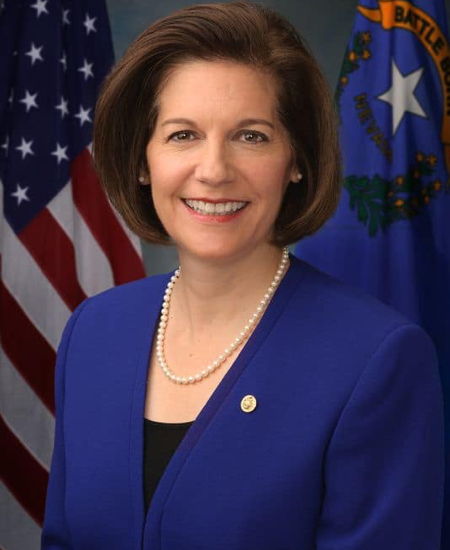
Sen. Catherine Cortez Masto
Sponsored bills
Securing America's Clean Fuels Infrastructure This bill extends the tax credit for alternative fuel vehicle refueling property through 2029. It also increases the allowable amount of such credit from $30,000 to $200,000 for any single item of refueling property.
This resolution condemns and denounces all forms of anti-Asian sentiment, including those related to COVID-19 (i.e., coronavirus disease 2019), and calls on federal law enforcement officials, working with state and local agencies, to take specified steps. The resolution calls on federal officials to expeditiously investigate and document all credible reports of hate crimes, harassment, bullying, and threats against the Asian American and Pacific Islander communities; the Attorney General to work with state and local agencies and Asian American and Pacific Islander community-based organizations to prevent discrimination and to expand culturally competent and linguistically appropriate education campaigns on public reporting of hate crimes; and the Department of Health and Human Services to issue guidance describing best practices to mitigate racially discriminatory language in describing the pandemic. The resolution recommits the United States to serving as a model for the world in building a more inclusive, diverse, and tolerant society by (1) prioritizing language access and inclusivity in communication practices, and (2) combating misinformation and discrimination that puts Asian Americans and Pacific Islanders at risk.
This resolution celebrates the successes and contributions of Latinas in the United States and recognizes the changes still to be made to ensure that Latinas can realize their full potential as equal members of society.
No Junk Plans Act This bill nullifies a rule by the Department of Treasury, the Department of Labor, and the Department of Health and Human Services regarding short-term, limited-duration health insurance plans. Short-term, limited-duration health insurance plans are plans that may only offer coverage for a limited amount of time under law and that are exempt from the market requirements of the Patient Protection and Affordable Care Act (e.g., coverage of individuals with preexisting conditions). The rule increases the maximum authorized duration of such plans from less than 3 months (including renewals) to an initial maximum duration of less than 12 months (with a total duration of up to 36 months, including renewals). The rule took effect October 2, 2018.
This resolution celebrates the successes of American Indian, Alaska Native, and Native Hawaiian women and the contributions they have made in the United States. The resolution also recognizes the importance of supporting equity, providing safety, and upholding the interests of these women.
This resolution designates March 2021 as National Women's History Month. The resolution also recognizes the celebration of such month as a time to reflect on the contributions that women have made to the United States.
Data Care Act of 20 21 This bill imposes various duties on online service providers with respect to their handling of individual-identifying data that can be reasonably linked to a specific user. Specifically, online service providers have a duty to (1) reasonably secure such data from unauthorized access, (2) refrain from using such data in a way that will result in reasonably foreseeable harm to the end user, and (3) not disclose such data to another party unless that party is also bound by the duties established in this bill. The bill authorizes the Federal Trade Commission and specified state officials to take enforcement actions with respect to breaches of such duties.
Survivors' Access to Supportive Care Act or SASCA This bill sets out programs and requirements to address access and quality issues related to sexual-assault examinations. Specifically, the bill establishes training and technical assistance programs for health care providers on conducting sexual-assault examinations and treating survivors of sexual assault, including in rural and tribal settings; grants for states to assess the availability of trained providers to perform sexual-assault examinations; and a task force to assist state-level efforts to improve medical forensic evidence collection related to sexual assault. The bill also requires institutions of higher education to provide information about the availability of sexual-assault examinations to survivors of sexual assault. Additionally, hospitals and specified components of the Department of Health and Human Services (HHS) must report on access and quality issues concerning sexual-assault examinations and related services. Furthermore, HHS must address access to, and the quality of, trained health care providers who conduct sexual-assault examinations in the National Quality Strategy. This is a national effort to align public-sector and private-sector stakeholders to achieve better health and health care.
Creating a Respectful and Open World for Natural Hair Act of 2021 or the CROWN Act of 2021 This bill prohibits discrimination based on a person's hair texture or hairstyle if that style or texture is commonly associated with a particular race or national origin. Specifically, the bill prohibits this type of discrimination against those participating in federally assisted programs, housing programs, public accommodations, and employment. Persons shall not be deprived of equal rights under the law and shall not be subjected to prohibited practices based on their hair texture or style. The bill provides for enforcement procedures under the applicable laws.