Reaching English Learners Act This bill directs the Department of Education to establish a grant program for preparing future teachers to effectively instruct English learners to achieve at high levels in early childhood education programs and in elementary and secondary schools. Under the program, grants must be given to partnerships between (1) certain institutions of higher education, and (2) high-need local educational agencies or high-need early childhood education programs.
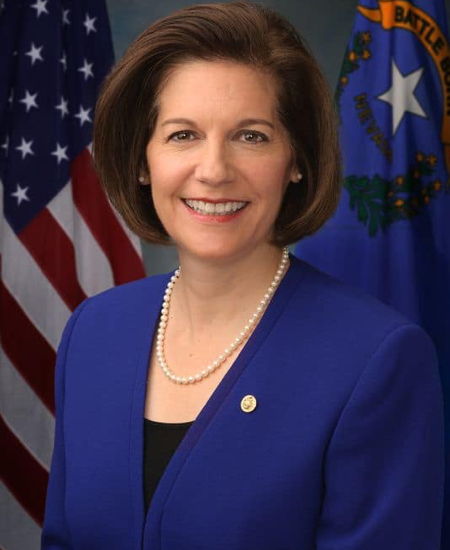
Sen. Catherine Cortez Masto
Sponsored bills
Women's Health Protection Act of 2021 This bill prohibits governmental restrictions on the provision of, and access to, abortion services. Specifically, governments may not limit a provider's ability to prescribe certain drugs, offer abortion services via telemedicine, or immediately provide abortion services when the provider determines a delay risks the patient's health. Furthermore, governments may not require a provider to perform unnecessary medical procedures, provide medically inaccurate information, comply with credentialing or other conditions that do not apply to providers whose services are medically comparable to abortions, or carry out all services connected to an abortion. In addition, governments may not (1) require patients to make medically unnecessary in-person visits before receiving abortion services or disclose their reasons for obtaining such services, or (2) prohibit abortion services before fetal viability or after fetal viability when a provider determines the pregnancy risks the patient's life or health. The bill also prohibits other governmental measures that are similar to the bill's specified restrictions or that otherwise single out and impede access to abortion services, unless a government demonstrates that the measure significantly advances the safety of abortion services or health of patients and cannot be achieved through less restrictive means. The Department of Justice, individuals, or providers may bring a lawsuit to enforce this bill, and states are not immune from suits for violations. The bill applies to restrictions imposed both prior and subsequent to the bill's enactment.

Furthering Our Recovery With American Research & Development Act or the FORWARD Act This bill makes several changes to the income tax credit for business expenses for increasing research activities. Specifically, the bill expands eligibility for the credit by increasing the maximum amount of gross receipts of an entity for the taxable year and using an eight-year (rather than five-year) period in the calculation of those amounts; removes the business credit carryforward from calculation of the payroll tax credit portion of the credit; includes among qualified research expenses wages paid in connection with research activity training expenses; and increases the credit rate for expenses incurred in certain collaborative research activities (i.e., conducted with higher education institutions, tax-exempt scientific research organizations, or charitable grant organizations) and qualified domestic manufacturers. The bill appropriates to the Social Security trust funds amounts equal to the reduction in revenues from payroll taxes by reason of this bill. The Internal Revenue Service (IRS) shall develop partnership agreements to provide for development of basic training relating to federal tax credits benefitting small business concerns and startups, especially credits for research and experimentation, and informational materials relating to such credits, including IRS guidance documents. Small business development centers shall provide informational materials, education, and basic training to small business concerns relating to federal tax credits, including those available to (1) businesses generally; and (2) small business concerns and startups specifically, especially credits for research and experimentation.
Give Our Athletes Level Salaries Act or the GOALS Act This bill prohibits the use of funds for the 2026 World Cup until the U.S. Soccer Federation agrees to provide equitable pay to the members of the U.S. Women's National Team and the U.S. Men's National Team.
Health Care Fairness for Military Families Act of 2021 This bill modifies the extension of dependent coverage under TRICARE by allowing a dependent under the age of 26 to be covered without an additional premium. Additionally, the bill authorizes such coverage of dependents without a premium regardless of whether they are eligible to enroll in an employer sponsored plan.
This resolution offers the condolences of the Senate regarding the death of Senator John William Warner and expresses deep appreciation for his outstanding and important service to his country.
This resolution recognizes the significance of Asian/Pacific American Heritage Month as an important time to celebrate the contributions of Asian Americans and Pacific Islanders to the history of the United States. The resolution also recognizes that the Asian American and Pacific Islander communities enhance the rich diversity of the United States.
National Climate Service Corps and Careers Network Act of 2021 This bill establishes the Climate Resiliency Service Corps as a national service program to assist communities in mitigating the effects climate change and establishes the Climate Careers Network to connect individuals with jobs in green industries.
Increasing Access to Osteoporosis Testing for Medicare Beneficiaries Act of 2021 This bill specifies that certain Medicare payment rules applicable to imaging services shall apply to dual-energy x-ray absorptiometry services used in bone mass scans beginning in 2022. The bill also establishes national minimum payment amounts for such services.
National Origin-Based Antidiscrimination for Nonimmigrants Act or the NO BAN Act This bill imposes limitations on the President's authority to suspend or restrict aliens from entering the United States. It also prohibits religious discrimination in various immigration-related decisions, such as whether to issue an immigrant or nonimmigrant visa, unless there is a statutory basis for such discrimination. The President may temporarily restrict the entry of any aliens or class of aliens after the Department of State determines that the restriction would address specific and credible facts that threaten U.S. interests such as security or public safety. The bill also imposes limitations on such restrictions, such as requiring the President, State Department, and the Department of Homeland Security (DHS) to (1) only issue a restriction when required to address a compelling government interest, and (2) narrowly tailor the suspension to use the least restrictive means to achieve such an interest. Before imposing a restriction, the State Department and DHS shall consult with Congress. The State Department and DHS shall report to Congress about the restriction within 48 hours of the restriction's imposition. If such a report is not made, the restriction shall immediately terminate. Individuals or entities present in the United States and unlawfully harmed by such a restriction may sue in federal court. DHS may suspend the entry of aliens traveling to the United States on a commercial airline that failed to comply with regulations related to detecting fraudulent travel documents.