

This concurrent resolution establishes the congressional budget for the federal government for FY2022, sets forth budgetary levels for FY2023-FY2031, and provides reconciliation instructions for legislation that increases the deficit. The resolution recommends levels and amounts for FY2022-FY2031 for federal revenues, new budget authority, budget outlays, deficits, public debt, debt held by the public, and the major functional categories of spending. It also recommends levels and amounts for Social Security and Postal Service discretionary administrative expenses for the purpose of budget enforcement in the Senate. The resolution includes reconciliation instructions that direct (1) several House and Senate committees to report legislation that will increase the deficit over FY2022-FY2031 by no more than an amount specified for each committee, and (2) the Senate Finance Committee and the House Ways and Means Committee to report legislation that will reduce the deficit by at least $1 billion over FY2022-FY2031. (Under current law, reconciliation bills are considered by Congress using expedited legislative procedures that prevent a filibuster and restrict amendments in the Senate.) In addition, the resolution establishes reserve funds that allow certain adjustments to committee allocations and other budgetary levels to accommodate reconciliation legislation, tax legislation that does not raise taxes on people making less than $400,000, legislation that would not increase the deficit over specified time periods, and legislation that addresses a wide range of other specified policy issues. The resolution also sets forth budget enforcement procedures that address issues such as emergency legislation, advance appropriations, infrastructure legislation, adjustments to budget allocations, and cost estimates for child care or prekindergarten legislation.
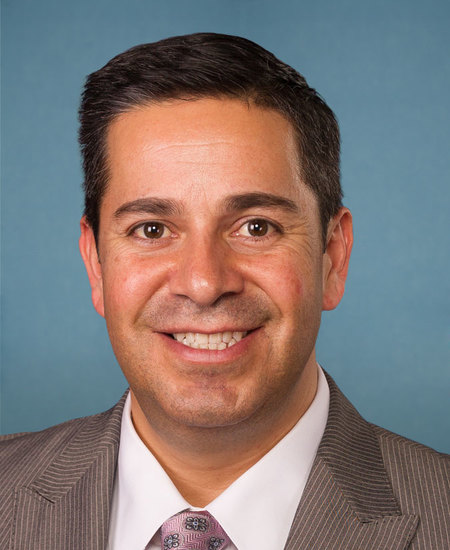
Sen. Ben Ray Luján
Sponsored bills
For the People Act of 2021 This bill addresses voter access, election integrity and security, campaign finance, and ethics for the three branches of government. Specifically, the bill expands voter registration (e.g., automatic and same-day registration) and voting access (e.g., vote-by-mail and early voting). It also limits removing voters from voter rolls. The bill requires states to establish independent redistricting commissions to carry out congressional redistricting. Additionally, the bill sets forth provisions related to election security, including sharing intelligence information with state election officials, supporting states in securing their election systems, developing a national strategy to protect U.S. democratic institutions, establishing in the legislative branch the National Commission to Protect United States Democratic Institutions, and other provisions to improve the cybersecurity of election systems. Further, the bill addresses campaign finance, including by expanding the prohibition on campaign spending by foreign nationals, requiring additional disclosure of campaign-related fundraising and spending, requiring additional disclaimers regarding certain political advertising, and establishing an alternative campaign funding system for certain federal offices. The bill addresses ethics in all three branches of government, including by requiring a code of conduct for Supreme Court Justices, prohibiting Members of the House from serving on the board of a for-profit entity, and establishing additional conflict-of-interest and ethics provisions for federal employees and the White House. The bill requires the President, the Vice President, and certain candidates for those offices to disclose 10 years of tax returns.
Frank Harrison, Elizabeth Peratrovich, and Miguel Trujillo Native American Voting Rights Act of 2021 This bill addresses the voting rights of Native American and Alaska Native voters and voting access on tribal lands. The bill includes provisions expanding the types of facilities that can be used as voter registration agencies; increasing polling site accessibility, including by expanding early in-person voting and providing ballot drop boxes; providing enforcement power to citizens and attorneys general; requiring approval for actions like moving a polling place; validating certain tribal identification for voting or registering to vote; permitting voters to designate another individual to return a ballot on their behalf; and expanding requirements for bilingual voting accessibility. In addition, the bill establishes a Native American voting task force grant program for the purpose of increasing voter outreach, education, registration, turnout, and accessibility for Native American communities. The bill also directs the Government Accountability Office to study and report on (1) the prevalence of nontraditional or nonexistent mailing addresses among Indians, members of tribes, and individuals residing on Indian lands; and (2) the alternatives for removing barriers to voter registration, receipt of voter information and materials, and receipt of ballots.
Helping Emergency Responders Overcome Act or the HERO Act This bill establishes and authorizes behavioral health programs for law enforcement officers, firefighters, emergency medical services personnel, 9-1-1 operators, and other public safety officers. Specifically, the Fire Administration within the Federal Emergency Management Agency must develop resources for educating mental health care providers about treating firefighters and emergency medical services personnel. In addition, the Department of Health and Human Services (HHS) must develop best practices and resources for identifying, preventing, and treating post-traumatic stress disorder and co-occurring disorders in public safety officers. HHS must work with relevant federal departments to incorporate these resources into federal training programs for public safety officers. The bill also authorizes HHS to set up a public safety officer suicide-reporting system and a grant program for peer-support behavioral health and wellness programs within fire departments and emergency medical services agencies.
Tribal Wildlife Corridors Act of 2021 This bill authorizes tribal wildlife corridors. Specifically, the bill permits an Indian tribe to nominate a corridor within the land of such tribe as a tribal wildlife corridor. The Department of the Interior must establish criteria for determining whether such a corridor qualifies as a tribal wildlife corridor, including criteria for restoring historical habitat. Interior must provide tribes with technical assistance to establish, manage, or expand a tribal wildlife corridor. Such assistance must include support with accessing wildlife data and working with voluntary private landowners to access programs for facilitating connectivity on nonfederal land. Additionally, Interior must (1) establish a program to award grants to tribes to increase connectivity through tribal wildlife corridors, and (2) consult with tribes to determine whether a tribal wildlife corridor may be expanded into public lands or otherwise benefit connectivity between public lands and such corridor.
This resolution designates September 2021 as National Workforce Development Month.
This resolution expresses the condolences of the Senate regarding the death of the Honorable Maurice Robert Gravel, former Senator from Alaska.
Establishment of Community Solar Programs Act of 2021 This bill requires states and certain nonregulated electric utilities to consider standards concerning the deployment of community solar projects.
Family Strengthening Infrastructure Act of 2021 This bill provides additional funding through FY2031 for state and community-based child abuse prevention and treatment programs.
Harlem Hellfighters Congressional Gold Medal Act This bill provides for the award of a Congressional Gold Medal to the 369th Infantry Regiment, commonly known as the Harlem Hellfighters, in recognition of their bravery and outstanding service during World War I.