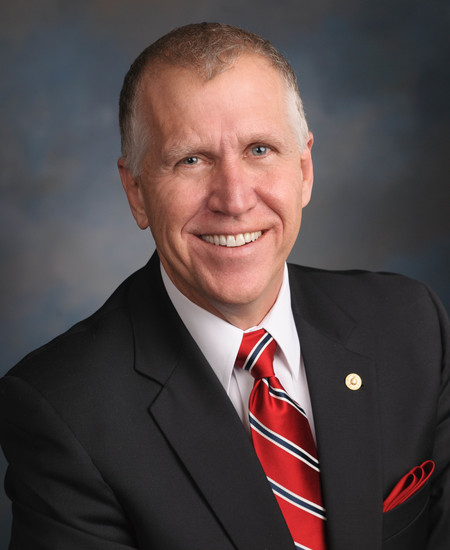
Photo of Thom Tillis
R United States Senate · North Carolina

Sen. Thom Tillis

Compare
Total votes
1,044
all sessions
Attendance
94%
65 missed
Lower than 95% of chamber peers
With party
88%
of cast votes
Lower than 90% of chamber peers
Bipartisan score
7%
crosses aisle rarely
Higher than 88% of chamber peers
Sponsored
1,573
bills & resolutions
Near the chamber average
Committees
15
assignments
1,573 bills and resolutions

Sponsored bills

Total
1,573
Primary
149
Co-sponsor
1,424
This page
1,573
matching current filters
Co-sponsor S 779
In committee · Indiana Senate · Co-sponsor
EARLY Minds Act

Maddy summaryThe EARLY Minds Act amends federal mental health law to require states to include evidence-based prevention and early intervention strategies for children and adolescents in their mental health plans. It allows states to use up to 5% of their annual federal mental health funding to support these programs, targeting youth before serious mental illness develops. States must report biennially to Congress on program details, demographics served, and outcomes like reduced treatment delays and milder symptom onset. The bill directly affects states receiving federal mental health funds and focuses on youth mental health prevention. It does not change existing eligibility for treatment but expands funding flexibility for early care.

In committee Feb 27, 2025 1 co-sponsor
Co-sponsor S 783
In committee · Indiana Senate · Co-sponsor
Assistance for Rural Water Systems Act of 2025

Maddy summaryS 783, the Assistance for Rural Water Systems Act of 2025, provides new financial assistance to rural water, wastewater, and waste disposal systems. It authorizes grants, zero-percent or 1% interest loans, and loan modifications/forgiveness for eligible entities facing public health risks or financial hardship in economically distressed areas. The bill requires the Secretary to establish affordability metrics (cost per household as a percentage of median income) to determine eligibility for assistance targeting distressed communities. This directly affects rural water systems in disadvantaged areas by offering flexible financial support to maintain essential services. The legislation focuses on concrete policy changes to improve water system sustainability without speculative outcomes.

In committee Feb 27, 2025 1 co-sponsor
Co-sponsor S 798
In committee · Indiana Senate · Co-sponsor
Capital Gains Inflation Relief Act of 2025

Maddy summaryThe Capital Gains Inflation Relief Act of 2025 would allow taxpayers to adjust the basis of certain assets for inflation when calculating capital gains tax. For assets held more than three years, it would create an "indexed basis" (adjusted basis plus inflation adjustment based on GDP deflator changes) for assets like stocks, digital assets, and property. This would potentially reduce taxable capital gains on qualifying assets. The bill would apply to assets acquired after December 31, 2025, with specific exceptions for certain foreign stocks and transactions between related parties.

In committee Feb 27, 2025 1 co-sponsor
Co-sponsor S 807
In committee · Indiana Senate · Co-sponsor
Guarding Readiness Resources Act

Maddy summaryS 807, the Guarding Readiness Resources Act, clarifies how the National Guard Bureau handles reimbursement funds from states and territories. It requires that money received from states (like California or Puerto Rico) for using military property must be returned to the specific account that covered the original costs or a similar account. These funds can only be used by the Department of Defense for repairing, maintaining, replacing, or similar upkeep of assets directly used by National Guard units during state duty. The bill directly affects the National Guard Bureau and state/territorial governments managing these reimbursements.

In committee Feb 27, 2025 1 co-sponsor
Co-sponsor S 811
In committee · Indiana Senate · Co-sponsor
RTP Full Funding Act of 2025

Maddy summaryThe RTP Full Funding Act of 2025 would require the Federal Highway Administration to annually estimate and report the total tax revenue collected from nonhighway recreation fuel (currently about $281 million yearly) to Congress. It aims to increase funding for the Recreational Trails Program (RTP) from its current $84 million annual level to match the tax revenue collected. The program, which supports trail development and maintenance nationwide, directly benefits states and local communities managing recreational trails used by hikers, cyclists, equestrians, and motorized vehicle users. The bill mandates this reporting requirement at least one year before highway program funding expires, ensuring the RTP receives funds commensurate with tax contributions.

In committee Feb 27, 2025 1 co-sponsor
Co-sponsor SRES 99
Passed · Indiana Senate · Co-sponsor
A resolution celebrating Black History Month.

This resolution recognizes Black History Month as an opportunity to reflect on U.S. history and to commemorate the contributions of African Americans. It calls for the United States to (1) honor the contribution of pioneers who helped to ensure its legacy; and (2) move forward as a nation "indivisible, with liberty and justice for all."

Passed Feb 26, 2025 1 co-sponsor
Co-sponsor S 754
In committee · Indiana Senate · Co-sponsor
Farm and Food Cybersecurity Act of 2025

Farm and Food Cybersecurity Act of 2025 This bill directs the Department of Agriculture (USDA) to (1) assess cybersecurity threats in the agriculture and food critical infrastructure sector, and (2) conduct annual crisis simulation exercises for food-related emergencies or disruptions. The agriculture and food critical infrastructure sector includes (1) any activity relating to the production, processing, distribution, storage, transportation, consumption, or disposal of agricultural or food products; and (2) any entity involved in any of these activities. Specifically, USDA, in coordination with the Department of Homeland Security (DHS) Cybersecurity and Infrastructure Security Agency, must conduct a risk assessment every two years on the cybersecurity threats to, and security vulnerabilities in, this sector. The risk assessment must include any recommendations for federal legislative or administrative actions to address related threats and vulnerabilities. USDA must also conduct an annual simulation exercise relating to a food-related emergency or disruption in coordination with DHS, the Department of Health and Human Services (HHS), and the Office of the Director of National Intelligence (ODNI). Among other things, the exercise must (1) involve a realistic and plausible scenario that simulates a food-related emergency or disruption that affects multiple sectors and jurisdictions, and (2) incorporate input from experts and stakeholders from various disciplines and sectors (e.g., agriculture, public health, emergency management, transportation, and energy).  USDA, in consultation with DHS, HHS, and ODNI, must submit a report to Congress on each simulation exercise, including recommendations to enhance the cybersecurity and resilience of the agriculture and food critical infrastructure sector.

In committee Feb 26, 2025 1 co-sponsor
Co-sponsor S 752
In committee · Indiana Senate · Co-sponsor
Accelerating Kids’ Access to Care Act

Maddy summaryThis bill creates a streamlined process for out-of-state healthcare providers to enroll in Medicaid or CHIP (Children's Health Insurance Program) in a state. It directly affects children under 21 enrolled in these programs and healthcare providers located in other states who already meet low fraud risk standards. The key provision requires states to adopt a simplified enrollment process using only basic provider information (like name and National Provider Identifier), granting eligible providers a 5-year enrollment period without repeated screening. This reduces administrative barriers for providers serving out-of-state children under 21 who qualify for Medicaid or CHIP coverage.

In committee Feb 26, 2025 1 co-sponsor
Co-sponsor S 756
In committee · Indiana Senate · Co-sponsor
Freedom to Invest in Tomorrow’s Workforce Act

Maddy summaryThis bill amends the tax code to allow 529 college savings accounts to cover certain postsecondary credentialing costs, such as certifications, licenses, and apprenticeship fees, in addition to traditional tuition. It directly affects individuals using 529 accounts who pursue industry-recognized credentials (like IT certifications, nursing licenses, or registered apprenticeships) instead of degree programs. The key provision expands "qualified higher education expenses" under Section 529(e)(3) to include tuition, testing fees, and required continuing education for recognized credentials listed in state directories or federal systems (like the COOL directory). It defines "recognized" credentials based on industry standards, federal programs, or state approval. This change enables 529 account holders to use tax-advantaged savings for workforce training beyond traditional degree paths.

In committee Feb 26, 2025 1 co-sponsor
Co-sponsor SJRES 24
In committee · Indiana Senate · Co-sponsor
A joint resolution providing for congressional disapproval under chapter 8 of title 5, United States Code, of the rule submitted by the Environmental Protection Agency relating to "National Emission Standards for Hazardous Air Pollutants: Rubber Tire Manufacturing".

Maddy summarySJRES 24 is a joint resolution that would block an Environmental Protection Agency (EPA) rule setting new standards for reducing harmful air pollutants from rubber tire manufacturing facilities. If passed, the resolution would prevent the rule - published in the Federal Register on November 29, 2024 - from taking effect, meaning tire manufacturers would not have to comply with the new requirements. The bill directly affects the rubber tire manufacturing industry by removing a specific regulatory obligation. This resolution uses a congressional disapproval process under federal law to stop the EPA rule without creating new regulations.

In committee Feb 25, 2025 1 co-sponsor
Showing 361 to 370 of 1,573 bills
Previous 1 … 36 37 38 … 158 Next