Maddy summaryThis bill requires IRS supervisors to provide written approval before applying penalties or disallowance periods to taxpayers, mandating that approval occur before any penalty notice is sent. It defines an "initial determination" as a specific written notice detailing the exact penalty amount or disallowance period, excluding general inquiries. The bill also mandates annual IRS reports on all penalties assessed, broken down by IRS unit and process step. It directly affects taxpayers facing penalties for tax credits under Sections 24, 25A, or 32, and requires the IRS to publicly report penalty data starting 24 months after enactment.
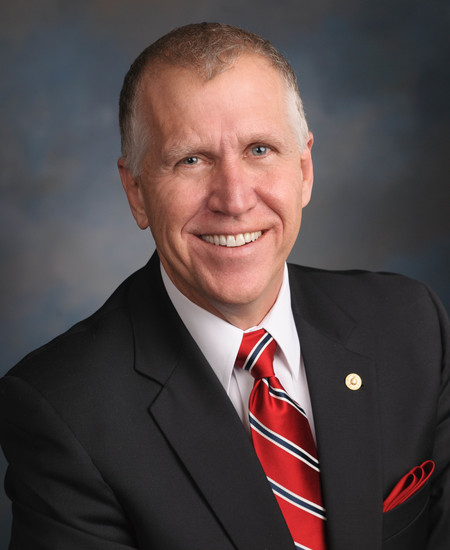
Sen. Thom Tillis
Sponsored bills
Maddy summaryThis resolution designates July 2025 as "National Anti-Counterfeiting and Consumer Education and Awareness Month" to highlight the dangers of counterfeit products. It aims to raise public awareness about how fake goods - such as unsafe electronics, pharmaceuticals, and cosmetics - threaten consumer health, safety, and the economy. The Senate resolution does not create new laws or funding but supports existing efforts to educate consumers about identifying and avoiding counterfeit items in both physical and online markets.
Maddy summaryThe WIPE Act authorizes the Department of Defense to use mobile solid waste disposal units for destroying seized illicit contraband, including counterfeit goods, narcotics, and classified materials. It specifically prohibits using open-air burn pits for disposing of contraband, classified equipment, or hazardous waste. The bill reallocates $8.95 million in fiscal year 2026 Army funding, increasing procurement funds for disposal systems while reducing operations funds previously allocated for burn pit use in contingency operations. This directly affects military installations, forward bases, and partner security forces using these disposal methods for border security and counter-narcotics efforts.
Maddy summaryS 2337, the Providing Child Care for Police Officers Act of 2025, establishes a federal grant program to help law enforcement agencies provide child care for the minor children of officers during nontraditional work hours. It allocates $24 million annually from 2026 to 2030 for competitive grants to lead agencies (state or local child care administrators), which will fund child care programs through covered entities like law enforcement agencies or consortia. At least 20% of funds are reserved for small agencies (fewer than 200 officers) or consortia including them, with recipients required to provide increasing matching funds over three years (10%, 25%, and 33.3%). The bill specifies allowable uses of funds, including startup costs, provider training, sick child care, and facilities, and mandates two studies to evaluate program effectiveness after 2 and 4 years.
Halt All Lethal Trafficking of Fentanyl Act or the HALT Fentanyl Act This act permanently places fentanyl-related substances as a class into schedule I of the Controlled Substances Act. A schedule I controlled substance is a drug, substance, or chemical that has a high potential for abuse; has no currently accepted medical value; and is subject to regulatory controls and administrative, civil, and criminal penalties under the Controlled Substances Act. Under the act, offenses involving fentanyl-related substances are triggered by the same quantity thresholds and subject to the same penalties as offenses involving fentanyl analogues (e.g., offenses involving 100 grams or more trigger a 10-year mandatory minimum prison term). Additionally, the act establishes a new, alternative registration process for certain schedule I research. The act also makes several other changes to registration requirements for conducting research with controlled substances, including permitting a single registration for related research sites in certain circumstances, waiving the requirement for a new inspection in certain situations, and allowing a registered researcher to perform certain manufacturing activities with small quantities of a substance without obtaining a manufacturing registration. Finally, the act expresses the sense that Congress agrees with the interpretation of the Controlled Substances Act in United States v. McCray , a 2018 case decided by the U.S. District Court for the Western District of New York. In that case, the court held that butyryl fentanyl, a controlled substance, can be considered an analogue of fentanyl even though, under the Controlled Substances Act, the term controlled substance analogue specifically excludes a controlled substance.

Maddy summaryThis bill clarifies that existing vehicle safety standards (Standard 108) already permit "pulsating light systems" - brake lights that briefly flash rapidly (up to 4 times for ≤1.2 seconds) before switching to steady illumination - on vehicles covered by the standard. It requires the Transportation Secretary to update Standard 108 within 180 days to formally include performance-based rules for these systems. The change directly affects vehicle manufacturers and safety regulators by explicitly allowing and standardizing this specific braking light technology. The bill does not alter current safety requirements but updates regulations to reflect permitted technology.
Maddy summaryThis bill authorizes the minting of commemorative coins for the 2028 Los Angeles Olympic and Paralympic Games and the 2034 Salt Lake City Olympic and Paralympic Winter Games. It specifies four coin types ($5 gold, $1 silver, half-dollar, and proof silver $1) with defined quantities and designs reflecting U.S. athletic participation. A surcharge on each coin sale (e.g., $35 for $5 coins) funds the respective Olympic committees' legacy programs, including youth sports initiatives. The coins are legal tender but intended solely for commemoration, with surcharges directed to the organizing committees after covering minting costs.
Maddy summaryThis bill extends the temporary waiver allowing hospitals to provide acute care at home until 2030, directly affecting hospitals participating in the Acute Hospital Care at Home initiative and the patients receiving care through this program. It requires the Department of Health and Human Services to conduct a detailed study by September 2028, comparing care quality, costs, patient outcomes, and experiences between home-based care and traditional inpatient hospital care. The study must analyze specific metrics like readmission rates, staffing ratios, treatment types, and patient demographics across participating and non-participating hospitals. The findings will be reported to Congress, providing data to inform future policy decisions about home-based hospital care.
Maddy summarySRES 307 is a non-binding Senate resolution expressing support for U.S. and Israeli military strikes targeting Iran's nuclear facilities on June 21, 2025 (Operation Midnight Hammer). It states the Senate opposes Iran acquiring nuclear weapons and commends the military actions taken to degrade Iran's nuclear program. The resolution does not create new laws, impose requirements, or directly affect any individuals or entities. It serves solely as a symbolic expression of congressional backing for the strikes, referencing specific operations and Iran's nuclear activities as context.
This resolution recognizes religious freedom as a fundamental human right and expresses concern over threats to religious freedom around the world, such as through harassment, violence, and imprisonment.