Preserving Employment Visas Act This bill reclaims unused employment-based immigrant visas from FY2020 and FY2021 and makes such unused visas available in FY2022, for the purposes of calculating the total number of employment-based immigrant visas available each fiscal year. If, at the end of FY2022, there are still unused FY2020 and FY2021 visas, these unused visas shall be available in subsequent fiscal years until they are all used.
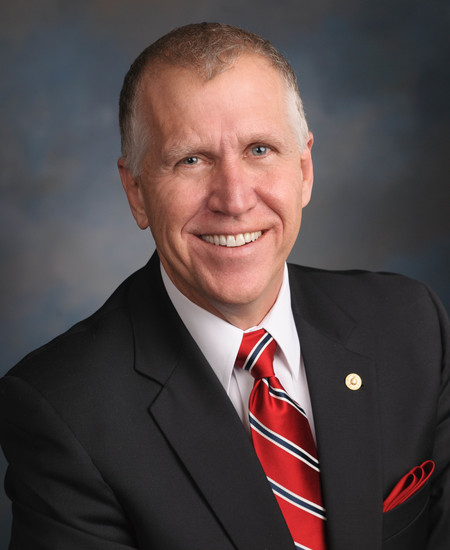
Sen. Thom Tillis
Sponsored bills
This resolution honors the contributions of small businesses in the United States and supports the designation of National Small Business Week.
Full Faith and Credit Act This bill requires the Department of the Treasury to prioritize certain obligations if the federal debt limit is reached and provides for a limited increase in the debt limit to fund these priorities. If the federal government reaches the debt limit, the following obligations must be given equal priority over all other federal obligations: the principal and interest on the debt held by the public; Social Security benefits; pay and allowances for members of the Armed Forces on active duty and members of the U.S. Coast Guard; compensation, pensions, and payments for medical services provided by the Department of Veterans Affairs, and the Medicare programs. If the debt limit has been reached and incoming revenue will be insufficient to pay the priority obligations over an upcoming two-week period, the bill requires (1) Treasury to notify Congress of the expected revenue shortfall for the two-week period, and (2) the debt limit to be increased by the amount of the expected shortfall. If the incoming revenue exceeds the expected shortfall, the excess revenue must be held in reserve and applied to the following two-week period.
Pride in Patent Ownership Act This bill requires disclosure of certain patent-related information, including information about ownership and funding. Under the bill, if a foreign or domestic governmental entity provides funding for fees related to a patent application or for paying an attorney (or patent agent) to prosecute the patent application, the application must disclose the amount and source of such funding. Similarly, if any governmental entity provides funding for paying a patent's maintenance fees or for paying an attorney (or patent agent) to submit such maintenance fees, the patent owner must submit a statement disclosing the amount and source of such funding. The bill also requires patent owners to record information about the ownership of a patent with the U.S. Patent and Trademark Office (USPTO). Patent owners must also update this information when certain rights or interests in the patent have been conveyed to another individual or entity. A patent owner may not receive increased monetary damages for infringement of that patent that occurred while the owner was out of compliance with this ownership information recordation requirement. The USPTO must make this ownership information publicly available.
Taskforce Recommending Improvements for Unaddressed Mental Perinatal & Postpartum Health for New Moms Act of 2021 or the TRIUMPH for New Moms Act of 2021 This bill temporarily establishes within the Department of Health and Human Services the Task Force on Maternal Mental Health. The task force must develop a national strategy for maternal mental health and report on best practices, policies, and programs to prevent, screen for, diagnose, treat, and reduce disparities in maternal mental health conditions. The report must identify opportunities for state- and local-level partnerships to address maternal mental health, and the task force must share those opportunities with state governors.
This bill posthumously provides for the award of a Congressional Gold Medal in commemoration of the 13 service members who died on August 26, 2021, while stationed at Hamid Karzai International Airport in Afghanistan.
This resolution recognizes the courage and resolve shown by the Ukrainian people in their pursuit of sovereignty and democracy. It also condemns the illegal military invasion and occupation of Crimea by Russia and the violence fomented by proxies of Russia in eastern Ukraine.
Preventing the Recognition of Terrorist States Act of 2021 This bill imposes sanctions related to the Taliban and addresses other related issues. The President must impose sanctions on foreign individuals and entities that knowingly provide significant support to the Taliban or senior Taliban members. The bill also repeals an exception to existing sanctions against certain entities related to energy, shipping, and shipbuilding in Iran. Specifically, the bill repeals a provision authorizing the President to exempt certain entities involved in the reconstruction of Afghanistan from such sanctions. No federal department or agency may take any action that states or implies recognition of the Taliban's claim of sovereignty over Afghanistan. The bill also bars the Department of State, the U.S. Agency for International Development (USAID), and the Department of Defense from using federal funds to prepare or implement any policy that extends diplomatic recognition to the Taliban-controlled government in Afghanistan. The State Department must designate (1) the government of Afghanistan as a state sponsor of terrorism, and (2) the Taliban as a foreign terrorist organization. Furthermore, USAID must take appropriate steps to ensure that certain foreign assistance provided in or for certain countries, including Afghanistan and Pakistan, is not going to or through any individual or entity involved in terrorist activity. The bill also prohibits using certain federal funds to provide direct assistance to any country where the duly elected head of government has been deposed in a coup or decree in which the military played a decisive role.

Restoring Trust in Public Health Act This bill requires the Senate to confirm the appointment of the Director of the Centers for Disease Control and Prevention.
This bill requires the Internal Revenue Service (IRS) to report to Congress on projections of the estimated tax gap (i.e., the difference between tax liabilities owed to the IRS and those liabilities that the IRS actually collects). The IRS may use artificial intelligence and related data analysis tools to calculate a tax gap projection. The bill also requires the Joint Committee on Taxation to issue periodic reports to the congressional tax committees on the tax gap projection. The bill restricts IRS funding to FY2021 levels for audits and enforcement until it publishes an updated tax gap projection. Funding is also restricted for certain purposes, including (1) targeting U.S. citizens who exercise their First Amendment rights, (2) targeting a group for regulatory scrutiny based on its ideological beliefs, and (3) auditing individual taxpayers with an adjusted gross income of less than $400,000. The bill directs the IRS to establish a fellowship program to recruit private sector tax experts to join the IRS to create and participate in the audit task force. The purposes of the tax force include performing audit case selection, educating IRS employees on emerging issues, auditing selected taxpayers, addressing offshore tax evasion, and identifying, mentoring, and training IRS junior employees with respect to audits.