

End Child Trafficking Now Act This bill imposes restrictions related to adult non-U.S. nationals ( aliens under federal law) being admitted into the United States with a minor. Such an adult may not be admitted with a minor unless the adult (1) presents documents and witness testimony proving that the adult is a relative or guardian of the minor, or (2) submits to a DNA test that proves such a relationship. The Department of Homeland Security may request a DNA test only if the required relationship cannot be established by the presented documents and witness testimony. An adult who does not consent to a requested DNA test shall be inadmissible. If the required relationship cannot be established and the immigration officer believes the adult is guilty of a felony offense, the officer may arrest the adult. The bill makes it a crime for an adult to knowingly use a minor to whom the adult is not a relative or guardian to enter the United States.
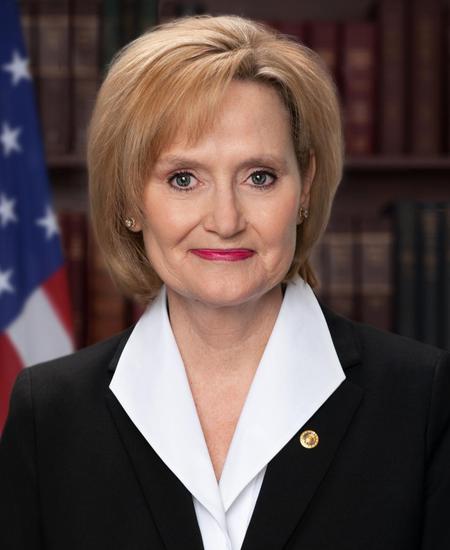
Sen. Cindy Hyde-Smith
Sponsored bills
Maddy summaryThis bill requires U.S. Customs and Border Protection officers to obtain fingerprints from noncitizen children under 14 years old if they suspect the child is a trafficking victim. It also creates a new federal crime for adults (18+) who knowingly use a minor for entry into the U.S. when not a blood relative or guardian, punishable by fines or up to 10 years in prison. The law mandates sharing fingerprints with health officials for unaccompanied children and requires annual reports to Congress and monthly public updates on trafficking apprehensions involving false relative claims. It directly affects children entering the U.S., potential traffickers, and federal agencies handling border security and child welfare.
Maddy summaryThis bill would allow individuals with a valid concealed carry permit from their home state to carry concealed handguns in other states that either permit concealed carry for residents or don’t ban it entirely. It applies to permit holders who are federally eligible to possess firearms, require government-issued ID, and must follow the host state’s specific restrictions (like where carry is prohibited). The bill does not override state laws on issuing permits but ensures reciprocity for those who legally carry in their home state, excluding machineguns and destructive devices.
Maddy summaryThis bill would make daylight saving time permanent across the United States by repealing the current rule that requires switching back to standard time in the fall. It directly affects all states and territories, though it preserves exemptions for areas like Arizona and Hawaii that currently skip daylight saving time. Key provisions include adjusting time zone calculations in historical laws (e.g., changing "4 hours" to "3 hours" in time zone references) and allowing states that already opted out of daylight saving time to maintain their preferred standard time. The bill does not create new policies but changes the legal framework to end seasonal time changes.
Maddy summaryThis bill reauthorizes key conservation programs under the America's Conservation Enhancement Act through 2030, extending provisions that were set to expire in 2025. It specifically extends the Black Vulture Livestock Protection Program, allowing public entities or Farm Bureau organizations in each state to obtain permits to manage black vulture populations threatening livestock. The bill also extends funding for Chesapeake Bay restoration efforts, Chronic Wasting Disease Task Force activities, and National Fish Habitat Conservation Partnerships through 2030. It modifies the National Fish Habitat Board to include additional tribal representatives and clarifies reporting requirements for conservation programs. The bill does not create new programs but extends existing conservation efforts and their funding mechanisms.
Maddy summaryThe Connect Our Parks Act requires the Secretary of the Interior to assess where National Parks need improved broadband internet and cellular service, focusing on areas like campgrounds, administrative facilities, and locations critical for emergency access or staff communications. Within 180 days of enactment, the Secretary must submit a report identifying priority locations for both services. By two years after enactment, the Secretary must develop a plan to install infrastructure, meeting minimum speed standards (100 Mbps downstream, 20 Mbps upstream for broadband), minimizing environmental impact, and using public-private partnerships. The plan must exclude parks where adequate service already exists, as determined by park superintendents.
Maddy summaryThe Homebuyers Privacy Protection Act (S 3502) limits how consumer credit reports can be shared during mortgage applications. It prevents credit reporting agencies from sending these reports to third parties solely based on a mortgage-related request, unless the third party has the homebuyer's explicit authorization or is directly involved in the loan (like the mortgage lender, loan servicer, or their bank holding the homebuyer's account). This directly affects homebuyers applying for residential mortgages by restricting unauthorized sharing of their credit data. The bill amends the Fair Credit Reporting Act to add these privacy protections without creating new government programs or altering existing mortgage processes.
Maddy summaryThis bill (S 3373) allows hydropower project licensees to request an extension of their construction start deadline. It specifically applies to projects licensed by the Federal Energy Regulatory Commission (FERC) before March 13, 2020. Under the bill, FERC may grant a 4-year extension beyond the existing 8-year construction period, provided the licensee shows good cause and after reasonable notice. The extension period begins after the current deadline expires and ends 4 years later. This directly affects hydropower developers needing more time to begin construction on existing licensed projects.
Maddy summarySRES 733 is a Senate resolution honoring Patrick Gottsch, founder of Rural Media Group and RFD-TV, for his work promoting rural and agricultural issues through media. It recognizes his career in agricultural programming, including founding RFD-TV and other media outlets that educated millions about rural America. The resolution expresses the Senate's gratitude for his legacy and requests a copy be sent to his family. As a commemorative resolution, it does not create policy or affect any individuals.
Maddy summaryThis bill authorizes the posthumous award of a Congressional Gold Medal to Shirley Chisholm, the first African-American woman elected to Congress (1968-1982) and the first African American to seek a major party's presidential nomination (1972). The bill directs the Secretary of the Treasury to design and strike a gold medal featuring Chisholm's image and name, which will be presented to her family by congressional leaders. After presentation, the medal will be displayed at the Smithsonian Institution for public viewing and research. The bill also authorizes the production and sale of bronze duplicates to cover costs. This is a commemorative measure honoring Chisholm's historic contributions to American politics and civil rights.