Maddy summaryThis bill prohibits the Small Business Administration (SBA) from denying financial assistance - such as loans or guarantees - to firearm-related businesses solely based on their industry. It directly affects firearm entities (manufacturers, sellers, and distributors), firearm entity affiliates (like shooting ranges), and firearm trade associations by requiring the SBA to treat them equally under existing programs. The key provision bans SBA policies that discriminate against these applicants, ensuring they can access standard SBA support without industry-based barriers. The bill does not create new funding but mandates equal treatment for eligible applicants already covered by SBA law.
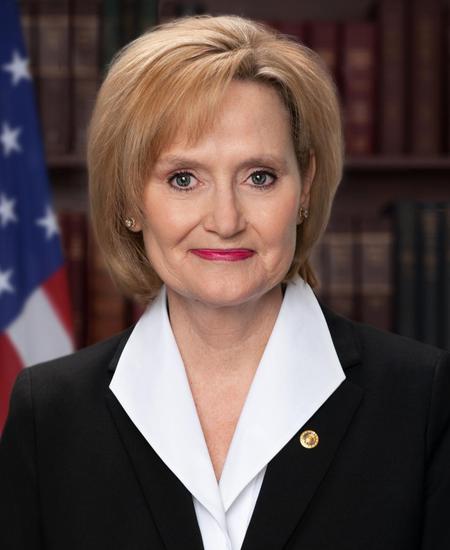
Sen. Cindy Hyde-Smith
Sponsored bills
She Develops Regulations In Vehicle Equality and Safety Act or the She DRIVES Act This bill directs the Department of Transportation (DOT) to revise motor vehicle safety standards to require the use of certain anthropomorphic test devices (i.e., crash test dummies) and testing on female crash test dummies. Specifically, DOT must issue final rules to revise the current testing regulations to include specific adult male and adult female frontal impact and side impact crash test dummies. The final rules must establish or update the testing injury criteria based on real-world injuries and the greatest potential to increase safety. The injury criteria must include head, neck, chest, abdomen, pelvis, upper leg, and lower leg criteria for the crash test dummies. The final rules must also establish crashworthiness frontal and side impact tests for adult female occupants in all front seating positions that are currently tested for adult male occupants (as of the date of the bill's enactment). Further, DOT must promulgate a final decision notice to update the testing procedures for the New Car Assessment Program of the National Highway Traffic Safety Administration to require the use of these crash test dummies for frontal and side impact crashworthiness testing. Finally, DOT must submit reports to Congress that, among other things, identify timelines for DOT to incorporate additional types of crash test dummies into the regulations and identify testing devices used in other countries for similar crashworthiness standards.
Maddy summarySRES 349 designates the week of August 3-9, 2025, as "National Farmers Market Week." The resolution recognizes farmers markets for their role in supporting local economies, connecting urban and rural communities, and promoting sustainable agriculture. It does not create new laws or funding but formally acknowledges the sector's contributions to food access, community engagement, and farming livelihoods. This is a ceremonial designation without binding policy changes.
Maddy summaryThis resolution (SRES 342) is a symbolic gesture honoring small firearm manufacturers in the U.S., recognizing their economic contributions and role in recreational shooting traditions. It specifically designates August 2025 as "National Shooting Sports Month" and commends these businesses for supporting 380,000 jobs and $91 billion in annual economic output. The resolution does not create new laws or funding but formally acknowledges small manufacturers’ role in preserving Second Amendment-related activities and outdoor culture. It is a commemorative statement with no binding policy impact.
Maddy summaryThis resolution (SRES 344) commemorates the 20th anniversary of Hurricane Katrina's 2005 Gulf Coast devastation and acknowledges rebuilding progress in affected areas. It recognizes the recovery efforts of communities across Louisiana, Mississippi, Alabama, Florida, and Georgia, citing specific improvements like the 87% population growth in Gulfport-Biloxi-Pascagoula (2006-2024) and increased tourism in New Orleans (3.7 million to 17.5 million visitors since 2006). The Senate formally expresses support for Katrina victims, commends recovery efforts, and reaffirms commitment to the Gulf Coast's ongoing rebuilding. As a symbolic resolution, it does not create new policies or allocate funds.
Maddy summaryThe Protecting Access to Credit for Small Businesses Act prohibits the Small Business Administration (SBA) from making direct loans under the 7(a) program for new applications. This means the SBA will no longer provide direct funding to small businesses through this specific channel, though it will continue servicing existing direct 7(a) loans approved before the bill's enactment. The bill does not affect the SBA’s standard role in guaranteeing loans made by banks under the 7(a) program, which remains the primary method for small business lending. As a result, small businesses seeking 7(a) loans after the bill takes effect must work with participating banks rather than the SBA directly.
Transportation, Housing and Urban Development, and Related Agencies Appropriations Act, 2026 This bill provides FY2026 appropriations to the Department of Transportation (DOT), the Department of Housing and Urban Development (HUD), and several related agencies. The bill provides appropriations to DOT for the Office of the Secretary, the Federal Aviation Administration, the Federal Highway Administration, the Federal Motor Carrier Safety Administration, the National Highway Traffic Safety Administration, the Federal Railroad Administration, the Federal Transit Administration, the Great Lakes St. Lawrence Seaway Development Corporation, the Maritime Administration, the Pipeline and Hazardous Materials Safety Administration, and the Office of Inspector General. The bill provides appropriations to HUD for Management and Administration, Public and Indian Housing, Community Planning and Development, Housing Programs, the Federal Housing Administration, the Government National Mortgage Association (Ginnie Mae), Policy Development and Research, Fair Housing and Equal Opportunity, the Office of Lead Hazard Control and Healthy Homes, and the Office of Inspector General. The bill also provides appropriations to several related agencies, including the Access Board, the Federal Maritime Commission, the National Railroad Passenger Corporation (Amtrak) Office of Inspector General, the National Transportation Safety Board, the Neighborhood Reinvestment Corporation, the Surface Transportation Board, and The U.S. Interagency Council on Homelessness. Additionally, the bill sets forth requirements and restrictions for using funds provided by this and other appropriations acts.

Maddy summaryThis bill requires hospitals and obstetric providers to disclose policies on providing life-saving care to premature infants, directly affecting parents expecting premature births and healthcare facilities. Hospitals must publicly state if they have a minimum gestational age for treatment, whether care decisions are case-by-case, and transfer plans for infants needing higher-level care. Obstetric providers must share these policies with patients during the first prenatal visit. Non-compliant hospitals and providers risk losing federal Medicaid and CHIP funding starting January 2026. The law aims to ensure transparency about neonatal care options before delivery.
Maddy summaryThis bill expands paid leave under the Family and Medical Leave Act (FMLA) to cover "spontaneous loss of an unborn child" (defined as unplanned, non-purposeful loss in the womb), allowing eligible employees to take leave for their own or their spouse's loss. It also creates a new refundable tax credit for individuals who experienced a stillbirth (defined as spontaneous fetal death before delivery), requiring a state-issued stillbirth certificate for eligibility. The bill adds specific certification requirements for leave requests and clarifies how the tax credit integrates with existing tax filing rules. It directly affects private-sector employees covered by FMLA and taxpayers who suffered a stillbirth.
Maddy summaryThe STEM RESTART Act creates a new federal grant program to help mid-career workers (unemployed or underemployed, particularly from rural areas) return to STEM careers through "returnship" programs. It provides funding for small businesses (50-499 employees) to receive $100,000-$1 million annually and medium businesses (500-9,999 employees) to receive $500,000-$5 million annually to develop these programs. The grants require programs to last at least 10 weeks, provide above-entry-level compensation and benefits, and lead to full-time employment with career advancement opportunities. Businesses must report annually on participant demographics and employment outcomes, with the Secretary required to publish best practices based on these reports. The bill authorizes $50 million annually for fiscal years 2026-2030 to fund these initiatives.