

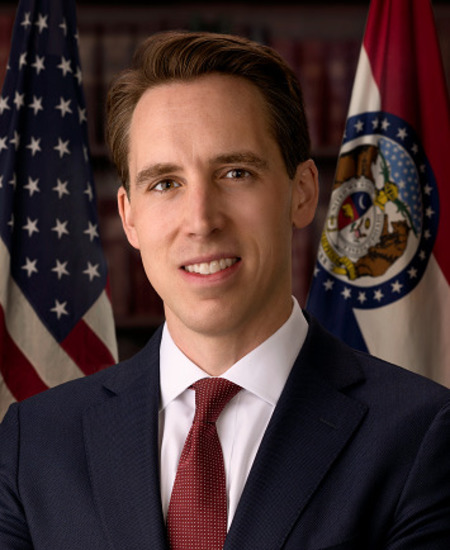
This joint resolution nullifies the rule titled Medicare and Medicaid Programs; Omnibus COVID-19 Health Care Staff Vaccination , which was issued by the Centers for Medicare & Medicaid Services on November 5, 2021. The rule requires health care providers, as a condition of Medicare and Medicaid participation, to ensure that staff are fully vaccinated against COVID-19.
Sponsored bills
American Innovation and Choice Online Act This bill prohibits certain large online platforms from engaging in specified acts, including giving preference to their own products on the platform, unfairly limiting the availability on the platform of competing products from another business, or discriminating in the application or enforcement of the platform's terms of service among similarly situated users. Further, a platform may not materially restrict or impede the capacity of a competing business user to access or interoperate with the same platform, operating system, or hardware or software features. The bill also restricts the platform's use of nonpublic data obtained from or generated on the platform and prohibits the platform from restricting access to platform data generated by the activity of a competing business user. The bill also provides additional restrictions related to installing or uninstalling software, search or ranking functionality, and retaliation for contact with law enforcement regarding actual or potential violations of law. The bill establishes affirmative defenses for the prohibited conduct. The Federal Trade Commission and the Department of Justice must designate whether an entity is a platform covered by the bill, and both must carry out enforcement activities. The bill also provides for civil penalties, injunctions, and the forfeit of profits for repeat offenders.
This resolution supports reopening the U.S. Capitol Building and Senate Office Buildings to visitors under the public visitation policies that were in place before the COVID-19 pandemic.
American Energy Independence Act of 2022 This bill addresses U.S. energy independence, the production and importation of oil and natural gas, and the rescission of specified environmental requirements. Specifically, the bill directs the President to develop a plan for the United States to achieve energy independence by 2024. The Department of Energy (DOE) must also develop a program and issue rules to ensure that the United States achieves such energy independence and becomes a net exporter of energy. The bill also addresses energy pipelines, including by approving the TransCanada Keystone Pipeline in Phillips County, Montana for the import of oil from Canada to the United States. It also provides for energy production, including by requiring regulations to be issued by DOE to reduce requirements on entities harvesting energy through hydraulic fracturing, the Department of Transportation to promote stable and affordable gasoline and diesel prices, and the Department of the Interior to promote the leasing of federal land for oil and natural gas production. In addition, the Environmental Protection Agency (EPA) must identify and repeal certain regulations that substantially reduce energy independence. Further, the bill prohibits the use of any funds to implement the Paris Agreement on climate change. Finally, the bill rescinds (1) Executive Order 14008 about tackling climate change, (2) the 2021 proposed rule issued by the EPA and the U.S. Army Corps of Engineers about the scope of the Clean Water Act, and (3) the 2021 proposed rule issued by the EPA about methane gas emissions.
This resolution supports the designation of February 19-February 26, 2022, as National FFA Week. It also (1) recognizes the important role of the National FFA Organization (Future Farmers of America) in developing the next generation of leaders who will change the world, and (2) celebrates 70 years of the National FFA Organization's membership magazine.
Maddy summaryThis Senate resolution (SRES 526) formally condemns the antisemitic terrorist attack at Congregation Beth Israel Synagogue in Colleyville, Texas, on January 15, 2022, where hostages were held at gunpoint. It expresses gratitude that no lives were lost, applauds law enforcement and emergency responders for their actions, and condemns antisemitism in the United States. The resolution does not create new policies or allocate funds; it is a symbolic expression of support for the Jewish community and law enforcement. It directly affects the congregation and local community by affirming their safety and the importance of religious freedom.
Terminating Reckless and Unnecessary Checks Known to Erode Regular Shipping Act or the TRUCKERS Act This bill prohibits the Department of Homeland Security from imposing any COVID-19 vaccination requirement on any commercial truck driver who is a national of Canada or Mexico and seeking to temporarily enter the United States for business through a land port of entry.
Open App Markets Act This bill establishes rules related to the operation of an app store by a covered company (i.e., the owner or controller of an app store with more than 50 million U.S. users). An app is a software application or electronic service that may be run or directed by a user on a computer or mobile device. An app store is a publicly available website, software application, or other electronic service that distributes apps from third-party developers to users. The bill prohibits a covered company from (1) requiring developers to use an in-app payment system owned or controlled by the company as a condition of distribution or accessibility, (2) requiring that pricing or conditions of sale be equal to or more favorable on its app store than another app store, or (3) taking punitive action against a developer for using or offering different pricing terms or conditions of sale through another in-app payment system or on another app store. A covered company may not interfere with legitimate business communications between developers and users, use non-public business information from a third-party app to compete with the app, or unreasonably prefer or rank its own apps (or those of its business partners) over other apps. The bill provides for enforcement of its provisions by the Federal Trade Commission and the Department of Justice, as well as through suits brought by developers that are injured by reason of anything prohibited by this bill.
Eliminating Abusive and Rampant Neglect of Interactive Technologies Act of 2022 or the EARN IT Act of 2022 This bill revises the federal framework governing the prevention of online sexual exploitation of children. The bill establishes the National Commission on Online Child Sexual Exploitation Prevention. The commission must develop best practices for interactive computer services providers (e.g., Facebook and Twitter) to prevent, reduce, and respond to the online sexual exploitation of children. Additionally, the bill limits the liability protections of interactive computer service providers with respect to claims alleging violations of child sexual exploitation laws. The bill replaces various statutory references to child pornography and material that contains child pornography with child sexual abuse material . Finally, the bill makes changes to the reporting requirements for electronic communication service providers and remote computing service providers (providers) who report apparent instances of crimes involving the sexual exploitation of children to the National Center for Missing and Exploited Children. Among the changes, the bill requires providers to report facts and circumstances sufficient to identify and locate each minor and each involved individual. The bill also increases the amount of time that providers must preserve the contents of a report.
Ban IRS Biometrics Act This bill prohibits the Department of the Treasury from requiring taxpayers to provide biometric information as a condition of filing any tax return, receiving any service, or accessing taxpayer information. The bill defines biometric information as any information regarding any measurable physical characteristic or personal behavioral trait used to recognize the identity, or verify the claimed identity or location, of an individual, including facial images, fingerprints, and iris scans. Treasury must also develop a plan for the safe and secure destruction and disposal of any biometric information collected or used prior to the enactment of this bill.