

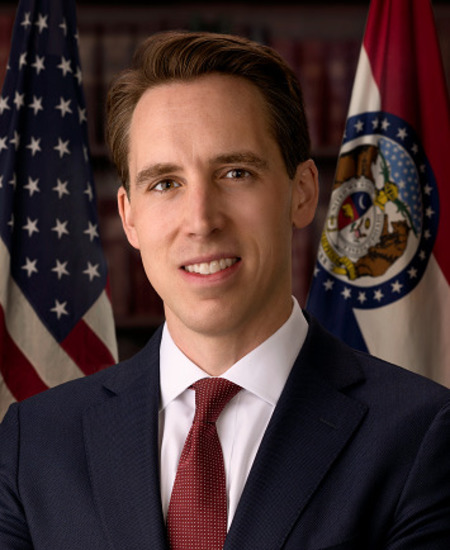
Photo of Josh Hawley
R United States Senate · Missouri

Sen. Josh Hawley

Compare
Total votes
1,044
all sessions
Attendance
97%
30 missed
Near the chamber average
With party
86%
of cast votes
Lower than 96% of chamber peers
Bipartisan score
7%
crosses aisle rarely
Higher than 94% of chamber peers
Sponsored
858
bills & resolutions
Lower than 89% of chamber peers
Committees
12
assignments
858 bills and resolutions

Sponsored bills

Total
858
Primary
155
Co-sponsor
703
This page
858
matching current filters
Co-sponsor S 401
In committee · Indiana Senate · Co-sponsor
Fair Access to Banking Act

Maddy summaryThe Fair Access to Banking Act (S 401) prohibits large financial institutions ($10 billion+ in assets) and payment networks from denying services to lawful businesses based on political or reputational factors, such as the type of legal business they operate. It requires banks to justify denials using objective, risk-based standards instead of category-based decisions, and mandates written explanations for denials. The law enables lawsuits against violators with treble damages and civil penalties up to 10% of service value (capped at $10,000 per violation). It directly affects major banks, payment processors, and credit unions that serve large-scale customers, ensuring fair access for businesses operating within federal law.

In committee Feb 4, 2025 1 co-sponsor
Co-sponsor S 382
In committee · Indiana Senate · Co-sponsor
Dismantle DEI Act of 2025

Maddy summaryThis bill would eliminate diversity, equity, and inclusion (DEI) programs across federal agencies by requiring the closure of DEI offices, rescinding related executive orders (including those on racial equity and LGBTQ+ inclusion), and prohibiting federal funds from being used for DEI-related activities. It defines "prohibited diversity, equity, or inclusion practice" as including training that asserts certain groups are inherently superior or inferior, or requiring employees to sign statements about such concepts. The bill affects all federal agencies, personnel, contractors, and grantees by banning DEI training, offices, and related activities while exempting Equal Employment Opportunity offices and disability-related programs. It also creates a private cause of action allowing individuals to sue for violations with penalties of $1,000 per violation per day.

In committee Feb 4, 2025 1 co-sponsor
Co-sponsor S 364
In committee · Indiana Senate · Co-sponsor
Hearing Protection Act

Maddy summaryS 364, titled the "Hearing Protection Act" (though it regulates firearm silencers, not hearing protection), changes federal law to treat firearm silencers like firearms for tax and regulatory purposes. It imposes a 10% federal tax on silencers (similar to firearms), preempts state laws that tax or regulate silencers beyond federal rules, and requires the destruction of existing silencer registration records within one year. The bill clarifies definitions of "firearm silencer" in federal law and modifies licensing requirements for these devices. This directly affects silencer owners, manufacturers, and state governments that previously imposed additional restrictions or taxes.

In committee Feb 3, 2025 1 co-sponsor
Co-sponsor S 373
In committee · Indiana Senate · Co-sponsor
Stopping Political Discrimination in Disaster Assistance Act

Maddy summaryThis bill amends the Robert T. Stafford Disaster Relief Act to prohibit federal disaster assistance programs from discriminating based on political affiliation. It directly affects individuals and communities applying for federal disaster aid by adding "political affiliation" to the list of protected categories, alongside existing protections for race, gender, and economic status. The key mechanism updates Section 308(a) of the Stafford Act to explicitly state that aid cannot be denied due to a recipient's political views or party membership. This change ensures federal agencies, like FEMA, distribute disaster relief without considering applicants' political beliefs. The bill does not alter other non-discrimination protections or the criteria for eligibility.

In committee Feb 3, 2025 1 co-sponsor
Co-sponsor S 292
In committee · Indiana Senate · Co-sponsor
Educational Choice for Children Act of 2025

Maddy summaryThis bill establishes tax credits for individuals and corporations who contribute to scholarship granting organizations that provide educational scholarships for eligible students. The individual tax credit is limited to 10% of adjusted gross income or $5,000, while corporate credits are capped at 5% of taxable income. The bill defines "eligible students" as those from households with income not exceeding 300% of the area median gross income, and specifies that scholarships can cover tuition, materials, tutoring, and educational therapies. The bill includes a $10 billion annual cap on tax credits, with a first-come, first-served allocation system, and requires scholarship organizations to meet specific financial and operational standards.

In committee Jan 29, 2025 1 co-sponsor
Primary S 312
In committee · Indiana Senate · Lead sponsor
Jamie Reed Protecting Our Kids from Child Abuse Act

Maddy summaryS 312, the "Jamie Reed Protecting Our Kids from Child Abuse Act," creates a federal legal claim for minors harmed by gender-transition procedures. It defines "gender-transition procedure" (excluding cases involving ambiguous biological characteristics, medical emergencies, or life-threatening conditions) and holds pediatric gender clinics, medical practitioners, and affiliated hospitals/institutions liable for bodily or mental health harm caused to minors. The bill prohibits federal funding for such clinics or procedures and allows affected individuals to sue up to 30 years after turning 18, seeking damages and attorney fees.

In committee Jan 29, 2025 0 co-sponsors
Primary S 321
In committee · Indiana Senate · Lead sponsor
Decoupling America's Artificial Intelligence Capabilities from China Act of 2025

Maddy summaryThe Decoupling America's Artificial Intelligence Capabilities from China Act of 2025 would prohibit the import of artificial intelligence technology and intellectual property from China into the United States and ban the export of such technology from the United States to China. It would also prohibit U.S. persons from conducting AI research or development in China, for Chinese entities, or in collaboration with Chinese entities, as well as restrict U.S. financing of Chinese AI entities involved in China's military-civil fusion strategy, surveillance development, or human rights abuses. Violations could result in fines up to $100 million for organizations and $1 million for individuals, along with loss of federal benefits. The bill directly affects U.S. companies, researchers, and financial institutions engaged with Chinese AI entities, aiming to limit the transfer of AI capabilities between the two nations.

In committee Jan 29, 2025 0 co-sponsors
Co-sponsor S 5
Signed into law · Indiana Senate · Co-sponsor
Laken Riley Act

Laken Riley Act This act requires the Department of Homeland Security (DHS) to detain certain non-U.S. nationals ( aliens under federal law) who have been arrested for burglary, theft, larceny, shoplifting, assault of a law enforcement officer, or any crime that results in death or serious bodily injury to another person. The act also authorizes states to sue the federal government for decisions or alleged failures related to immigration enforcement. Under this act, DHS must detain an individual who (1) is unlawfully present in the United States or did not possess the necessary documents when applying for admission; and (2) has been charged with, arrested for, convicted of, or admits to having committed acts that constitute the essential elements of the above crimes. The act also authorizes state governments to sue for injunctive relief over certain immigration-related decisions or alleged failures by the federal government if the decision or failure caused the state or its residents harm, including financial harm of more than $100. Specifically, the state government may sue the federal government over a decision to release a non-U.S. national from custody; failure to fulfill requirements relating to inspecting individuals seeking admission into the United States, including requirements related to asylum interviews; failure to fulfill a requirement to stop issuing visas to nationals of a country that unreasonably denies or delays acceptance of nationals of that country; violation of limitations on immigration parole, such as the requirement that parole be granted only on a case-by-case basis; or failure to detain an individual who has been ordered removed from the United States.

Signed into law Jan 29, 2025 1 co-sponsor
Co-sponsor S 242
In committee · Indiana Senate · Co-sponsor
Dignity for Aborted Children Act

Maddy summaryThis bill requires abortion providers to obtain patient consent for disposal of fetal tissue after an abortion, offering options to take the tissue or have the provider arrange interment or cremation within 7 days. It mandates providers to document consent, report annual abortion statistics and disposal methods to the Health Secretary, and face penalties including up to $50,000 fines or 5 years in prison for violations. The law directly affects abortion providers (clinics and doctors) and patients undergoing abortions, with no change to abortion access itself. Key provisions include standardized consent forms, disposal requirements aligned with state laws for human remains, and annual federal reporting on abortion procedures and tissue disposal.

In committee Jan 24, 2025 1 co-sponsor
Primary S 243
In committee · Indiana Senate · Lead sponsor
Radiation Exposure Compensation Reauthorization Act

Maddy summaryThe Radiation Exposure Compensation Reauthorization Act (S 243) extends and expands the existing Radiation Exposure Compensation Act (RECA) through 2031. It creates new compensation for people exposed to Manhattan Project waste (covering specific ZIP codes in Missouri, Tennessee, Alaska, and Kentucky), increases compensation to $100,000 for leukemia and other specified diseases, and expands eligibility for uranium mining workers. The bill extends the claim filing deadline from 2 to 5 years, allows up to three resubmissions of denied claims, and establishes a grant program to study uranium mining's health impacts. This legislation directly affects individuals who lived downwind of nuclear tests, worked in uranium mining, or were exposed to Manhattan Project waste.

In committee Jan 24, 2025 0 co-sponsors
Showing 191 to 200 of 858 bills
Previous 1 … 19 20 21 … 86 Next