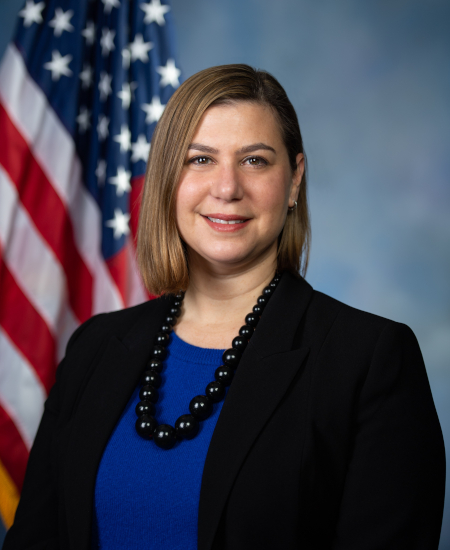
Photo of Elissa Slotkin
D United States Senate · Michigan

Sen. Elissa Slotkin

Compare
Total votes
2,625
all sessions
Attendance
98%
63 missed
Near the chamber average
With party
94%
of cast votes
Near the chamber average
Bipartisan score
3%
crosses aisle rarely
Near the chamber average
Sponsored
1,210
bills & resolutions
Near the chamber average
Committees
11
assignments
1,210 bills and resolutions

Sponsored bills

Total
1,210
Primary
151
Co-sponsor
1,059
This page
1,210
matching current filters
Co-sponsor HR 2871
In committee · Indiana House · Co-sponsor
Performing Artist Tax Parity Act of 2023

Performing Artist Tax Parity Act of 2023 This bill modifies the above-the-line tax deduction for the expenses of performing artists (including commissions paid to managers or agents) to provide for a phaseout of such deduction for taxpayers whose adjusted gross income exceeds $100,000 ($200,000 for joint return filers). The $100,000 phaseout threshold is adjusted for inflation annually for taxable years beginning after 2023.

In committee Apr 26, 2023 1 co-sponsor
Co-sponsor HR 2897
In committee · Indiana House · Co-sponsor
End Gun Violence Act of 2023

End Gun Violence Act of 2023 This bill extends federal restrictions on the sale or disposition of firearms and ammunition to a new category of persons: persons who have been convicted in any court of a violent misdemeanor within the preceding five years.

In committee Apr 26, 2023 1 co-sponsor
Co-sponsor HR 2851
In committee · Indiana House · Co-sponsor
National Apprenticeship Act of 2023

Maddy summary# Summary of the National Apprenticeship Act of 2023 This proposed legislation establishes a comprehensive framework to modernize and expand apprenticeship programs in the United States, creating a National Apprenticeship System designed to address current workforce needs and increase opportunities for underrepresented populations. ## Key Provisions ### System Framework - Establishes clear quality standards for apprenticeship, pre-apprenticeship, and youth apprenticeship programs - Requires programs to meet specific criteria including: - Minimum 2,000 hours of on-the-job learning (with flexibility for some occupations) - Structured related instruction (minimum 144 hours per year for time-based programs) - Progressive wage scales - Safety training and equipment - Equal opportunity for participation ### Program Types - **Apprenticeship Programs**: Time-based, competency-based, or hybrid models for full-time workers - **Pre-apprenticeship Programs**: Designed to prepare individuals without meeting minimum qualifications for apprenticeship - **Youth Apprenticeship Programs**: For high school students, integrating academic and work-based learning ### Diversity & Inclusion Requirements - Requires programs to actively recruit and support nontraditional apprenticeship populations: - Women, minorities, individuals with disabilities - Long-term unemployed - Individuals impacted by the criminal or juvenile justice system - Foster and former foster youth - Individuals with barriers to employment ### Registration & Oversight - Requires formal registration of programs with a registration agency - Mandates annual performance data collection and reporting - Establishes procedures for program review, technical assistance, and deregistration ### Grant Program (Title II) - Authorizes $4 billion over five years ($400M-$800M annually) for competitive grants - Funds will support: - Creation and expansion of apprenticeship programs in high-demand sectors - Encouraging employer participation, particularly with small- and medium-sized businesses - Supporting intermediaries (national and local) - Strengthening educational alignment with secondary and postsecondary systems ### Evaluation Requirements - Mandates independent evaluations of grant programs - Requires collection of disaggregated data by program type and demographic factors - Focuses on measuring outcomes including: - Program completion rates - Employment rates in related fields - Wage growth - Increased participation of underrepresented groups ### Conforming Amendments - Repeals outdated sections of the American Competitiveness and Workforce Improvement Act of 1998 - Amends the Immigration and Nationality Act to align with the new apprenticeship system This legislation represents a significant investment in workforce development, aiming to create a more inclusive, high-quality apprenticeship system that responds to 21st-century labor market needs while expanding opportunities for historically underrepresented groups.


In committee Apr 25, 2023 1 co-sponsor
Co-sponsor HR 2845
In committee · Indiana House · Co-sponsor
Enhancing K–12 Cybersecurity Act

Maddy summaryHR 2845, the Enhancing K-12 Cybersecurity Act, creates a centralized School Cybersecurity Information Exchange website managed by CISA to provide K-12 schools, school districts, and state education agencies with tailored cybersecurity resources, best practices, and funding opportunities. It establishes a voluntary registry for schools to report cyber incidents (like ransomware attacks) and requires CISA to publish annual, anonymized reports on incident trends. The bill also funds a K-12 Cybersecurity Technology Improvement Program to deploy protective tools, offer training, and prevent threats, with $10 million authorized annually for 2024-2025. This directly supports schools in strengthening digital security for students and staff, focusing on practical, accessible solutions rather than legislative changes.

In committee Apr 25, 2023 1 co-sponsor
Primary HR 2852
In committee · Indiana House · Lead sponsor
Federal Firefighter Cancer Detection and Prevention Act of 2023

Maddy summaryThis bill requires the Department of Defense to provide free, regular cancer screenings for its firefighters during annual health check-ups. It mandates specific screenings: mammograms for female firefighters (biannually for ages 40-49, annually for 50+), colon cancer tests for those 40+ (stool tests or visual exams for 45+), and prostate screenings for male firefighters (annual for 50+, high-risk individuals like African American firefighters or those with family history, or as clinically needed). Firefighters can opt out of any screening, and the program tracks participation rates and cancer trends while removing personal identifiers from data shared with the CDC for research. The law focuses on early detection for cancers linked to firefighting risks, with no cost to firefighters.

In committee Apr 25, 2023 0 co-sponsors
Co-sponsor HR 2385
In committee · Indiana House · Co-sponsor
ACE Agriculture Act

Advancing Cutting Edge Agriculture Act or the ACE Agriculture Act This bill reauthorizes the Agriculture Advanced Research and Development Authority (AGARDA) and expands the program's environmental sustainability goals. (The program supports innovative research and development of technology, research tools, and products to address long-term and high-risk challenges related to food and agriculture.) The bill expands the program's goals to include water conservation and responding to greenhouse gas emissions, as well as resilience to (1) drought, (2) infectious diseases, and (3) plant and animal pathogens and pests. The bill also removes the current pilot program designation and requires the Department of Agriculture to establish and maintain an AGARDA staff.

In committee Apr 25, 2023 1 co-sponsor
Co-sponsor HR 1788
In committee · Indiana House · Co-sponsor
Goldie’s Act

Maddy summaryHR 1788, the "Goldie’s Act," strengthens USDA enforcement of the Animal Welfare Act. It requires annual inspections of all regulated animal businesses (like dealers, research facilities, and exhibitors) and mandates immediate, humane confiscation of animals suffering due to violations, while prohibiting owners from destroying animals during this process. The bill increases civil penalties to $10,000 per violation, requires hearing panels including veterinarians, and mandates that penalties consider business size and violation severity. It also requires USDA to share violation records with local animal control within 24 hours.

In committee Apr 25, 2023 1 co-sponsor
Co-sponsor HR 1763
In committee · Indiana House · Co-sponsor
Military Family Nutrition Act of 2023

Maddy summaryThe Military Family Nutrition Act of 2023 amends the Food and Nutrition Act to exclude a military member's basic housing allowance (BAH) from income calculations when determining eligibility for nutrition assistance programs like SNAP. This change directly affects military families who receive BAH as part of their housing benefit but currently have that allowance counted as income, potentially disqualifying them from food assistance. The key provision adds a specific exclusion for BAH paid to or on behalf of uniformed service members under Title 37, U.S. Code. As a result, military families will have their housing costs subtracted from their income for program eligibility, making it easier for them to qualify for nutrition support.

In committee Apr 25, 2023 1 co-sponsor
Co-sponsor HR 1729
In committee · Indiana House · Co-sponsor
Water Affordability, Transparency, Equity, and Reliability Act of 2023

Maddy summaryThe Water Affordability, Transparency, Equity, and Reliability Act of 2023 establishes a new trust fund funded by increasing the corporate tax rate from 21% to 24.5% to support water infrastructure and affordability programs. It allocates funds to clean water programs (42%), safe drinking water funding (42.5%), household water wells (1%), colonias assistance (0.5%), Indian health services (3%), and water operator job training (0.5%). The bill requires the EPA to conduct a study and submit a report on water affordability, discrimination in water services, public participation in regionalization, and data collection related to service disconnections. It includes specific provisions for colonias, household water wells, and job training programs for water system operators to improve water access and equity.

In committee Apr 25, 2023 1 co-sponsor
Co-sponsor HR 1721
In committee · Indiana House · Co-sponsor
Healthy H2O Act

Maddy summaryThe Healthy H2O Act establishes a federal grant program to help rural households and facilities improve drinking water quality by covering costs for point-of-use or point-of-entry water treatment systems, filter replacements, and related services. It directly assists eligible end users in rural areas - including homeowners, renters, child-care facilities, and small residential property owners - who have tested water containing health contaminants like lead, arsenic, or PFAS, while prioritizing private well users and limiting assistance to households with income below 150% of the median nonmetropolitan household income. Grants can fund certified treatment systems, installation by qualified professionals, maintenance, and water quality testing, administered by the Department of Agriculture with $10 million annually from 2024-2028. The program requires annual reports to Congress on progress, barriers to safe water access, and trends in treatment technology use to inform future improvements.

In committee Apr 25, 2023 1 co-sponsor
Showing 661 to 670 of 1,210 bills
Previous 1 … 66 67 68 … 121 Next