

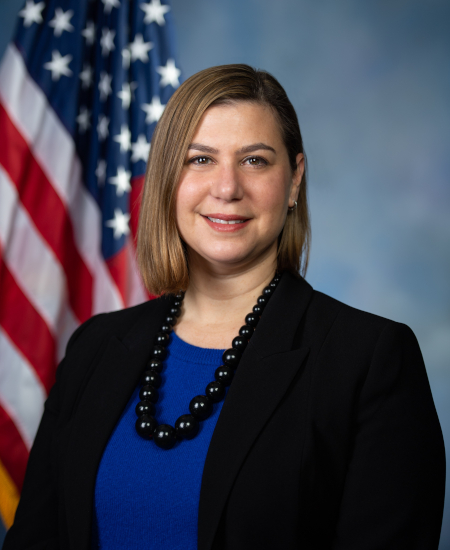
Photo of Elissa Slotkin
D United States Senate · Michigan

Sen. Elissa Slotkin

Compare
Total votes
2,615
all sessions
Attendance
98%
63 missed
Near the chamber average
With party
94%
of cast votes
Near the chamber average
Bipartisan score
3%
crosses aisle rarely
Near the chamber average
Sponsored
1,208
bills & resolutions
Near the chamber average
Committees
11
assignments
1,208 bills and resolutions

Sponsored bills

Total
1,208
Primary
151
Co-sponsor
1,057
This page
1,208
matching current filters
Primary HR 9294
In committee · Indiana House · Lead sponsor
To encourage the Secretary of the Army to support the implementation of hybrid-electric engine technology within the High Mobility Multipurpose Wheeled Vehicle fleet, and for other purposes.

Maddy summaryThis bill (HR 9294) is a non-binding resolution expressing Congress's preference for the U.S. Army to adopt hybrid-electric engine technology in its High Mobility Multipurpose Wheeled Vehicle (HMMWV) fleet. It states that Congress believes hybrid-electric propulsion enhances combat effectiveness compared to conventional engines and encourages the Secretary of the Army to support this implementation. The bill does not create new requirements but formally urges the Army to prioritize this technology for its military vehicles. It directly affects the Army's vehicle procurement and fleet modernization decisions.

In committee Aug 2, 2024 0 co-sponsors
Co-sponsor HR 9263
In committee · Indiana House · Co-sponsor
Supporting Innovation in Agriculture Act of 2024

Maddy summaryHR 9263 creates a new 30% federal tax credit for businesses investing in qualifying agricultural technology projects focused on specialty crops. It directly affects farmers and agribusinesses adopting precision agriculture (like GPS-guided equipment or soil sensors) or controlled environment agriculture (such as indoor vertical farms with climate control systems). The credit applies to qualified property like equipment, software, and infrastructure placed in service before 2035, with specific definitions for eligible technologies. Businesses cannot double-benefit by claiming this credit alongside certain existing grant programs for similar projects. The credit is available for investments completed after January 1, 2023, and integrates into the existing tax code via amendments to sections 48F and 6417.

In committee Aug 2, 2024 1 co-sponsor
Primary HR 9289
In committee · Indiana House · Lead sponsor
To direct the Secretary of Defense to establish a Connected Vehicle Cybersecurity Center in the Department of Defense, and for other purposes.

Maddy summaryHR 9289 directs the Secretary of Defense to create a Connected Vehicle Cybersecurity Center within the Department of Defense. The Center aims to leverage existing commercial investments in automotive cybersecurity technology to develop and test security solutions for both passenger vehicles/trucks and military ground combat vehicles, seeking cost savings through faster implementation. It requires an annual report to Congress detailing progress on the Center’s establishment, research projects, and federal use, and authorizes $12 million in funding for this initiative. The bill directly affects the Department of Defense, the automotive industry, and military vehicle security standards.

In committee Aug 2, 2024 0 co-sponsors
Co-sponsor HR 9228
In committee · Indiana House · Co-sponsor
BE HEARD in the Workplace Act

Maddy summary# Summary of Proposed Workplace Discrimination and Harassment Prevention Bill This comprehensive legislative proposal aims to strengthen protections against workplace discrimination and harassment through multiple interconnected provisions: 1. **Expanded Protections**: Broadens coverage to include sexual orientation, gender identity, and other protected categories in workplace discrimination laws. 2. **Nondisclosure Agreement Restrictions**: Prohibits employers from requiring nondisclosure or nondisparagement clauses that would prevent workers from reporting harassment or discrimination, with limited exceptions for settlement agreements meeting specific requirements. 3. **Arbitration Prohibition**: Bans mandatory pre-dispute arbitration agreements for work-related disputes and imposes strict requirements for post-dispute agreements. 4. **Federal Contractor Requirements**: Mandates that federal contractors disclose labor and civil rights violations from the previous three years and requires corrective actions for violations. 5. **Grant Programs**: - National grants to prevent and address workplace discrimination through education, outreach, and complaint assistance - Grants for legal assistance to low-income workers facing employment discrimination - State-level advocacy systems with funding allotments to support worker rights protection 6. **Enforcement Mechanisms**: Establishes clear enforcement procedures, with the Equal Employment Opportunity Commission (EEOC) having authority to enforce these provisions with powers similar to those under existing civil rights laws. The bill also includes definitions, implementation details, and provisions for state and federal coordination to create a comprehensive system for preventing and addressing workplace discrimination and harassment across all sectors of employment.

In committee Jul 30, 2024 1 co-sponsor
Co-sponsor HR 4581
Signed into law · Indiana House · Co-sponsor
Maternal and Child Health Stillbirth Prevention Act of 2024

Maddy summaryHR 4581, the Maternal and Child Health Stillbirth Prevention Act of 2024, amends Title V of the Social Security Act to explicitly allow federal funds to support stillbirth prevention efforts. The bill directs states receiving Title V maternal and child health funds to use these resources for evidence-based programs and research aimed at reducing stillbirths, including tracking fetal movements, screening for growth issues, smoking cessation, and community support. It directly affects state maternal health programs by clarifying that existing funding can now cover specific stillbirth prevention activities previously not explicitly permitted. The law changes how Title V funds may be spent, adding clear provisions for research and programs targeting stillbirth reduction. This is a policy change that updates funding guidelines without creating new programs or mandates.

Signed into law Jul 12, 2024 1 co-sponsor
Primary HR 9021
In committee · Indiana House · Lead sponsor
No Tax Breaks for Drug Ads Act

Maddy summaryHR 9021, the "No Tax Breaks for Drug Ads Act," prohibits pharmaceutical companies from deducting expenses related to direct-to-consumer advertising of prescription drugs when calculating their federal taxable income. This applies specifically to ads targeting the general public through media like TV, radio, print, social media, and digital platforms, but excludes ads directed at healthcare professionals. The bill directly affects drug manufacturers that spend on such consumer-facing advertising campaigns. The provision takes effect for expenses paid after the bill's enactment date.

In committee Jul 11, 2024 0 co-sponsors
Co-sponsor HR 9011
In committee · Indiana House · Co-sponsor
Ukraine Democracy Defense Lend-Lease Act of 2024

Maddy summaryHR 9011, the Ukraine Democracy Defense Lend-Lease Act of 2024, extends the U.S. government's authority to provide military equipment to Ukraine and Eastern European countries affected by Russia's invasion through fiscal year 2026 (previously ending in 2023). It requires the Secretary of Defense to submit a report within 90 days of using this authority, detailing the specific defense equipment provided and outlining a strategy for recovering and returning that equipment. The bill directly affects Ukraine's government and allied nations in Eastern Europe by enabling continued access to U.S. military aid. Key provisions include the extended funding period and mandatory transparency measures to track aid usage and future recovery.

In committee Jul 11, 2024 1 co-sponsor
Co-sponsor HRES 1355
In committee · Indiana House · Co-sponsor
Expressing support for the designation of July 10th as Journeyman Lineworkers Recognition Day.

Maddy summaryHRES 1355 is a non-binding resolution supporting the designation of July 10 as Journeyman Lineworkers Recognition Day. It honors lineworkers who maintain electrical infrastructure under hazardous conditions, including during disasters, and commemorates Henry Miller, the first president of the International Brotherhood of Electrical Workers, who died on July 10, 1896, while troubleshooting an electrical outage. The resolution encourages public recognition of these workers' contributions but does not create new laws or policies.

In committee Jul 10, 2024 1 co-sponsor
Co-sponsor HR 8988
In committee · Indiana House · Co-sponsor
Get Foreign Money Out of U.S. Elections Act

Maddy summaryHR 8988, the "Get Foreign Money Out of U.S. Elections Act," expands federal law to prohibit foreign-controlled businesses from influencing U.S. elections. It bans contributions or spending by any for-profit business entity where foreign nationals own 50% or more of voting shares, or where foreign entities collectively own 5% or more (or exert control over election activities). Businesses must certify compliance before making election-related spending, including contributions to political committees, and recipients cannot reuse uncertified funds for further election activities. This bill directly affects foreign-owned corporations, partnerships, and similar entities seeking to participate in U.S. elections.

In committee Jul 10, 2024 1 co-sponsor
Co-sponsor HR 2365
Signed into law · Indiana House · Co-sponsor
Dr. Emmanuel Bilirakis and Honorable Jennifer Wexton National Plan to End Parkinson’s Act

Maddy summaryThis bill (HR 2365, Public Law 118-66) directs the U.S. Department of Health and Human Services (HHS) to establish the National Parkinson’s Project. It requires HHS to create and update a coordinated national plan for preventing, diagnosing, treating, and researching Parkinson’s disease and related disorders (including multiple system atrophy and progressive supranuclear palsy), while coordinating federal research and care efforts across agencies like the NIH, CDC, and VA. The law mandates annual progress assessments, an advisory council with patient advocates and diverse experts, and annual reports to Congress on federal Parkinson’s programs and recommendations for improvement. It affects federal agencies managing Parkinson’s-related programs and aims to improve care coordination and research efficiency for patients and caregivers, with the law sunsetting in 2035.

Signed into law Jul 2, 2024 1 co-sponsor
Showing 401 to 410 of 1,208 bills
Previous 1 … 40 41 42 … 121 Next