Recycling and Composting Accountability Act This bill establishes data collection and reporting requirements concerning recycling and composting programs. For example, the Environmental Protection Agency must report on the capability of the United States to implement a national composting strategy for compostable materials in order to reduce contamination rates for recycling.
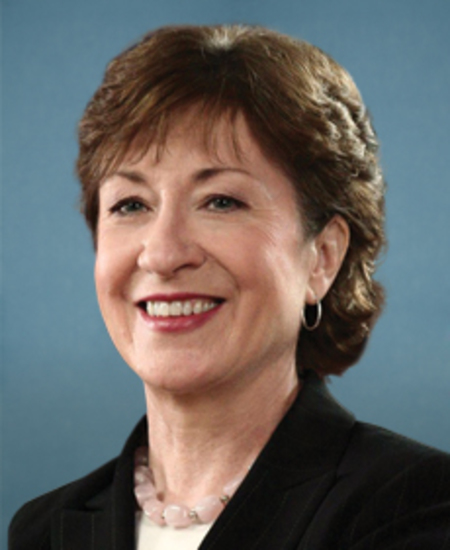
Sen. Susan M. Collins
Sponsored bills
Recovering America’s Wildlife Act of 2022 This bill provides financial and technical assistance to states, territories, and the District of Columbia for the purposes of (1) recovering species listed as a threatened or endangered species under the Endangered Species Act or under state law, or (2) avoiding the need to list species under such laws. For example, the bill establishes the Endangered Species Recovery and Habitat Conservation Legacy Fund. A portion of the fund must be used to establish an Endangered Species Recovery Grant Program. It also provides funding for (1) the conservation or restoration of wildlife and plant species of greatest conservation need; (2) the wildlife conservation strategies of states, territories, or the District of Columbia; and (3) wildlife conservation education and recreation projects. The Department of the Interior must use a portion of the funding for a grant program. The grants must be used for innovative recovery efforts for species of greatest conservation need, species listed as endangered or threatened species, or the habitats of such species. In addition, the bill requires certain revenues generated from fees and penalties for violations of environmental requirements to be used as a source for the funding.
Reproductive Freedom for All Act This bill establishes a general right of all persons to make certain reproductive decisions without undue government interference. It specifically provides statutory authority for the Supreme Court's prior holdings in Roe v. Wade and Planned Parenthood of Southeastern Pennsylvania v. Casey . In Roe , the Court held that the Constitution protects a woman's decision to terminate her pregnancy. In Casey , the Court reaffirmed this holding and additionally held that state abortion regulations may not place a substantial obstacle in the path of a woman seeking an abortion before fetal viability (i.e., an undue burden). However, a state may (1) restrict abortions after viability, except when a pregnancy endangers the life or health of the woman; and (2) enact regulations to further the health or safety of a woman seeking an abortion, except for unnecessary health regulations that present a substantial obstacle to a woman seeking an abortion. Additionally, the bill provides statutory authority for the Court's holdings in Griswold v. Connecticut (the right of married couples to obtain contraception), Eisenstadt v. Baird (the right of single persons to obtain contraception), Carey v. Population Services International (the right of minors to obtain contraception), and Whole Woman's Health v. Hellerstedt (that certain state restrictions on abortion facilities and providers created an undue burden). The bill allows the Department of Justice or any person adversely affected by a state law that violates this bill to seek injunctive relief. It also specifies that the bill does not affect laws regarding conscience protection.

Weatherization Assistance Program Improvements Act of 2022 This bill expands the Department of Energy's Weatherization Assistance Program, including by establishing a Weatherization Readiness Fund. If the dwellings of low-income households have significant defects or hazards that prevent the installation of weatherization (e.g., energy efficiency) measures under the program, then states may use the fund for repairing such defects and hazards.
Empowering States to Protect Seniors from Bad Actors Act This bill reauthorizes through FY2028 and otherwise revises the Senior Investor Protection Grant Program. The bill moves the program from the Consumer Financial Protection Bureau to the Securities and Exchange Commission, establishes a task force to oversee the program, and eliminates certain grant eligibility requirements.
Combating Violent and Dangerous Crime Act This bill revises various statutes with respect to violent crimes and establishes new criminal offenses. For example, the bill (1) increases the statutory maximum penalty for carjacking, and (2) establishes enhanced criminal penalties for certain federal drug offenses involving the manufacture or distribution of candy-flavored controlled substances or similar products for minors.
Maddy summaryThis resolution designates July 30, 2022, as "National Whistleblower Appreciation Day" to commemorate the July 30, 1778, passage of the first U.S. whistleblower protection law by the Continental Congress. It directs federal agencies to inform employees and the public about whistleblower rights and acknowledge whistleblowers' contributions to preventing fraud, waste, and abuse of public funds. The resolution does not create new legal protections or penalties but encourages agencies to recognize whistleblowers' role in safeguarding taxpayer resources and ethical governance. As a ceremonial resolution, it focuses on raising awareness rather than implementing new policy.
This resolution (1) designates July 2022 as National Blueberry Month; and (2) recognizes the contributions of blueberry growers in the United States and their families, and that purchasing blueberries grown in the United States supports farmers, jobs, communities, and the economy of the United States.
Supporting Seniors with Opioid Use Disorder Act of 2022 This bill requires the Centers for Medicare & Medicaid Services to conduct additional outreach regarding opioid use disorder treatment services that are covered under Medicare and to collect relevant data on the utilization of such services.
Preserving Access to Home Health Act of 2022 This bill restricts the Centers for Medicare & Medicaid Services (CMS) from decreasing payments for Medicare home health services based on certain adjustments until 2026. Current law requires the CMS to make certain permanent and temporary payment adjustments under the Medicare prospective payment system for home health services based on behavioral assumptions for 2020 through 2026. The bill restricts the CMS from making adjustments that decrease payments until 2026; the CMS must also ensure that any such necessary decreases are made before 2032.