

Bridging the Gap for New Americans Act This act requires the Department of Labor to submit to Congress a study on the factors affecting employment opportunities for certain individuals with professional credentials obtained in a non-U.S. country, specifically individuals who are lawfully present noncitizens or naturalized U.S. citizens. The study shall include policy recommendations for better enabling such individuals to obtain skill-appropriate employment in the United States.
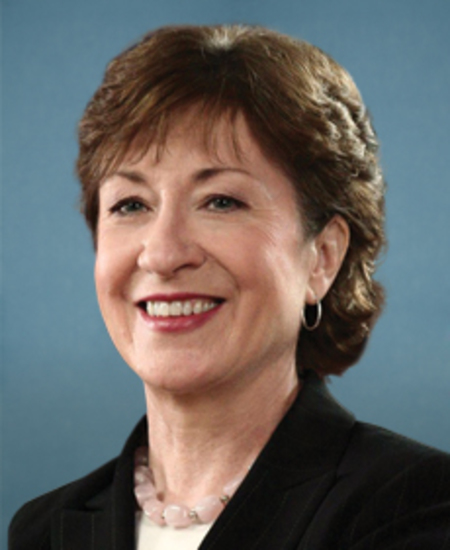
Sen. Susan M. Collins
Sponsored bills
Solid Start Act of 2022 This act permanently authorizes and expands the Solid Start program, which is an outreach program for veterans in their first year of separation from the military. Specifically, the act requires the Department of Veterans Affairs (VA) to coordinate with the Department of Defense to collect updated contact information during transition classes or separation counseling for members of the Armed Forces who are separating from service; explain the existence and purpose of the program; call veterans three times within the first year of separation; publish information about the program in booklets and on the VA website; provide women veterans with information tailored to their health care and benefit needs; provide information on access to state and local resources, such as Vet Centers; gather and analyze data that assesses the effectiveness of the program; ensure calls are tailored to each veteran's needs by conducting quality assurance tests; and prioritize outreach to veterans who have accessed mental health resources prior to separation from the Armed Forces. Under the act, the VA is authorized to (1) encourage members of the Armed Forces to provide additional contact information if they are unreachable following their separation, and (2) follow up on missed phone calls.
Maximizing Outcomes through Better Investments in Lifesaving Equipment for (MOBILE) Health Care Act This bill allows a health center that currently receives funding through a Health Resources & Services Administration Health Center Program grant to use a New Access Point grant to set up a mobile unit regardless of whether the health center also establishes a permanent health care delivery site. New Access Point grants help health centers establish new delivery sites to provide comprehensive primary care to medically underserved populations. Under current law, health centers may only use the grants to set up a mobile unit if they also establish a permanent site.
Oral Health Literacy and Awareness Act of 2022 This bill requires the Health Resources and Services Administration (HRSA) to conduct a public education campaign to increase oral health literacy and awareness. HRSA must design the campaign to focus on children, pregnant women, parents, older adults, people with disabilities, and racial and ethnic minorities.
Red Listing Monterey Bay Aquarium Act This bill prohibits federal funds from being appropriated, awarded, or granted to the Monterey Bay Aquarium located in Monterey, California.
Relief for Farmers Hit with PFAS Act This bill directs the Department of Agriculture (USDA) to establish a grant program to help states address contamination by perfluoroalkyl and polyfluoroalkyl substances, commonly referred to as PFAS, on agricultural land and commercial farms. The bill also requires USDA to establish a task force to provide (1) advice regarding whether addressing PFAS contamination should be added as an eligible activity for each USDA program, and (2) technical assistance to states in addressing PFAS contamination.
This resolution supports the designation of October 2-October 8, 2022, as National 4-H Week. It also (1) recognizes the important role of 4-H in youth development and education, and (2) encourages all citizens to recognize 4-H for the significant impact the organization and members have made and continue to make by empowering young people with the skills needed to lead for a lifetime.
Maddy summarySRES 774 is a non-binding Senate resolution designating September 2022 as "National Democracy Month." It encourages the U.S. government, states, and local communities to observe this month through ceremonies and activities that reflect on the U.S. system of government and its global contributions to democracy. The resolution emphasizes educating citizens about democratic principles and honoring historical sacrifices that preserved U.S. freedoms. It does not create new laws or affect specific groups, as it is a symbolic, ceremonial designation.
FDA Modernization Act 2.0 This bill authorizes the use of certain alternatives to animal testing, including cell-based assays and computer models, to obtain an exemption from the Food and Drug Administration to investigate the safety and effectiveness of a drug. The bill also removes a requirement to use animal studies as part of the process to obtain a license for a biological product that is biosimilar or interchangeable with another biological product.
Protecting the Health and Wellness of Babies and Pregnant Women in Custody Act This bill establishes requirements to address the health needs of incarcerated women related to pregnancy and childbirth. The bill requires the Bureau of Justice Statistics to collect data on the health needs of incarcerated pregnant women at the federal, state, tribal, and local levels. With respect to incarcerated women at the federal level, the bill requires the Bureau of Prisons (BOP) to provide appropriate services and programs to address the health and safety needs related to pregnancy and childbirth, as well as appropriate health care to a woman with a high-risk pregnancy; limits the use of restrictive housing for prisoners who are pregnant or in postpartum recovery; prohibits the use of solitary confinement for an incarcerated pregnant woman in her third trimester; requires the BOP to annually report on the number of administrative claims and appeals filed by pregnant inmates; and requires the Government Accountability Office (GAO) to study the services and protections for pregnant incarcerated women in federal pretrial detention facilities. With respect to incarcerated women at the state and local level, the bill requires the GAO to study the services and protections for pregnant incarcerated women in state and local correctional settings.