

Maddy summaryThe Outdoors for All Act establishes a federal grant program to fund outdoor recreation projects in underserved communities. It provides funding for eligible entities (like cities, counties, tribes, or nonprofits) to acquire land for parks or develop outdoor facilities in qualifying areas - urban regions with 25,000+ people, adjacent clusters, or tribal lands. Grants prioritize projects that improve park access in low-income neighborhoods, engage youth, create jobs, and support cultural gathering spaces, while requiring a 100% cash or in-kind match (with possible waivers). Funds cannot cover maintenance, indoor facilities, or restricted-access land, and recipients must submit annual progress reports to the Interior Secretary.
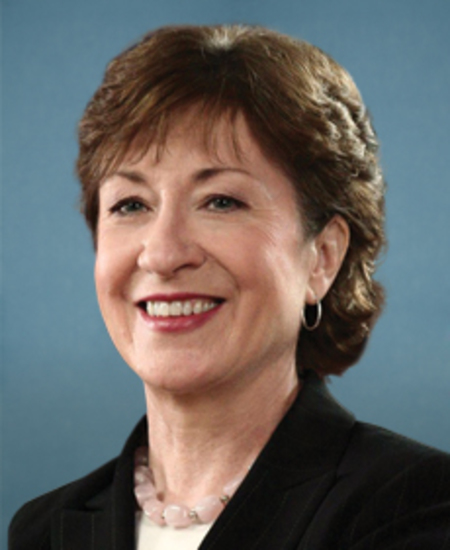
Sen. Susan M. Collins
Sponsored bills
Maddy summaryThis bill directs the Health Resources and Services Administration (HRSA) to create a national public education campaign focused on improving oral health literacy and awareness. The campaign will target specific groups including children, pregnant women, the elderly, people with disabilities, and racial/ethnic minorities (such as Indigenous and Native Hawaiian communities), using culturally and linguistically appropriate materials. It requires evidence-based strategies to prevent oral diseases like cavities, gum disease, and oral cancer, and mandates measuring the campaign's effectiveness. The bill authorizes $750,000 annually from 2024-2028 for this effort and requires a report to Congress on outcomes within three years.
Maddy summaryS 411, the EAGLES Act of 2023, reauthorizes and expands the National Threat Assessment Center (NTAC) within the U.S. Secret Service to prevent targeted violence, particularly in schools. The bill requires the NTAC to provide training, research, and consultation on threat assessment to schools, law enforcement, and mental health professionals, with specific mandates to hire staff specializing in child psychology and school threat assessment. It directs the Center to develop evidence-based programs, track training participation by state, and report annually to Congress on implementation. The bill uses unobligated DHS coronavirus funds for this purpose and explicitly prohibits using these funds for firearm training.
Maddy summaryThis joint resolution (SJRES 7) seeks congressional disapproval of a 2023 rule defining "Waters of the United States" (WOTUS), which would have changed how federal agencies regulate wetlands and waterways. It targets a rule jointly issued by the Army Corps of Engineers, EPA, and other agencies (88 Fed. Reg. 3004, Jan. 18, 2023), directly affecting landowners, developers, and environmental regulators by altering jurisdiction over water resources. If passed, the resolution would nullify the rule under a specific disapproval process in Title 5 of U.S. Code, preventing it from taking effect. The resolution does not create new regulations but aims to block an existing federal rule. This is a procedural step, not a new law.
Maddy summaryThis joint resolution (SJRES 12) seeks congressional disapproval of the District of Columbia Council’s approval of the Revised Criminal Code Act of 2022 (D.C. Act 24-789). It directly affects D.C. residents and local government, as the resolution targets the District’s newly enacted criminal code. The mechanism is a formal congressional disapproval under the District of Columbia Home Rule Act, requiring passage by both chambers to block the D.C. law from taking effect. The resolution does not alter the D.C. code itself but aims to halt its implementation through federal action.
Maddy summaryThe SWAT Act of 2023 establishes a $6.5 million fund within the U.S. Department of Agriculture to support research and mitigation efforts targeting the spotted wing drosophila, an invasive insect pest causing significant damage to fruit crops. This bill directly affects fruit farmers growing berries, cherries, and stone fruits (like raspberries, blueberries, strawberries, peaches, and plums), which have experienced up to 20% revenue losses due to the pest. The fund, administered by the Animal and Plant Health Inspection Service, will provide grants for research and control activities over five fiscal years. The legislation authorizes $6.5 million annually for the first five years following enactment.
Maddy summaryThis bill limits attorneys' fees for claims related to water contamination at Camp Lejeune, North Carolina, affecting veterans, civilians, and their attorneys filing under the Camp Lejeune Justice Act. It caps fees at 12% of administrative claim payments or 17% of court settlements/judgments, prohibits additional fees/costs, and requires attorneys to certify fee amounts. The bill also mandates annual reporting to Congress on all fees paid, including attorney names and amounts. These changes apply to all pending and future claims under the Camp Lejeune Justice Act.
Maddy summaryS 375, the Simplifying Grants Act of 2023, requires federal agencies to simplify grant application processes for small local governments. It directly affects "covered local governments" (defined as counties, cities, or towns with populations below the threshold for an urbanized area as determined by the Census). The bill mandates agencies to review and simplify grant requirements within 180 days of enactment, and to publish step-by-step checklists for each grant program. Agencies must also report annually on simplified processes, technical assistance provided, and funding awarded to covered versus other local governments.
Maddy summaryThis bill allows veterans with combat-related disabilities and less than 20 years of service to receive both military retired pay and VA disability compensation simultaneously. Previously, such veterans had their retired pay reduced to avoid "concurrent receipt" of both benefits. The bill removes the 20-year service requirement for this group, applying specifically to those retired under Chapter 61 of Title 10 with a combat-related disability as defined in existing law. It does not change eligibility for veterans with non-combat disabilities or those with 20+ years of service.
Maddy summaryThis bill, S 317 (Reproductive Freedom for All Act), guarantees Americans the right to make reproductive decisions - including access to contraceptives and abortion care - without undue government interference, directly affecting all individuals and state governments. It prohibits states from banning contraceptives or imposing barriers to abortion before fetal viability (when a fetus can survive outside the womb), while allowing reasonable health-related regulations and permitting post-viability abortions when medically necessary to protect a patient’s life or health. The law explicitly bases these protections on established Supreme Court precedents (like *Griswold* and *Roe*) and responds to the *Dobbs* decision by creating federal safeguards. States violating these provisions could face legal challenges seeking court-enforced remedies.