This bill prohibits smoking on the premises of any Veterans Health Administration facility. The bill defines smoking as the use of cigarettes, cigars, and pipes (i.e., the heating or combustion of tobacco), as well as the use of any electronic nicotine delivery system.
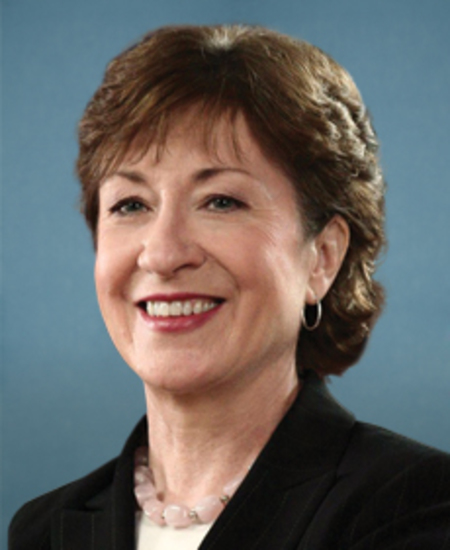
Sen. Susan M. Collins
Sponsored bills
Refund Equality Act of 2021 This bill permits legally married same sex couples to amend their tax returns to file as married filing jointly for returns outside of the statute of limitations.
Filter Bubble Transparency Act This bill establishes requirements for large online platforms that use algorithms applying artificial intelligence or machine learning to user-specific data to determine the manner in which content is displayed to users. Specifically, if an online platform applies such techniques to user-specific data that is not expressly provided by the user, the platform must (1) notify users that the platform uses such data, and (2) make a version of the platform available that uses only user-specific data that has been expressly provided by the user and which enables users to switch between the two platforms. These requirements do not apply to search engines operated by downstream providers with fewer than 1,000 employees and that have an agreement to access an index of web pages from an upstream provider. However, the bill requires such upstream providers to make their algorithm available to downstream providers as part of such an agreement.
Hunger-Free Summer for Kids Act of 2021 This bill revises the Summer Food Service Program to direct the Department of Agriculture to permanently establish electronic benefit transfer (EBT) cards and off-site consumption as two alternative delivery options for certain children through schools and service institutions in the program. These options shall be available to a child only if (1) the child lives or attends school in a rural area or outside of an area in which poor economic conditions exist, and (2) the child is eligible for a free or reduced price lunch and breakfast. In the case of off-site consumption, the option is also available if the summer program is available to the child at a congregate feeding site but (1) the site is closed due to extreme weather conditions, (2) violence or other public safety concerns in the area prevent the child from traveling safely to the site, (3) the site is open not more than four days a week, or (4) the site provides only one meal per day. A state may not operate the EBT card option and the off-site consumption option simultaneously in the same area. Each state desiring to participate in the summer food service program shall include in its annual management and administration plan the state's plans for using one or both of these alternative delivery options.
Central American Women and Children Protection Act of 2021 This bill temporarily authorizes the Department of State to enter into bilateral compacts with the governments of El Salvador, Guatemala, and Honduras to strengthen criminal justice systems, social supports, and other means to protect women and children from domestic and gender-based violence. At least 15 days before entering a compact, the State Department must submit to Congress a copy of the proposed agreement and related materials. Authority to enter a compact terminates on September 30, 2023, and a compact may last no more than six years. To support the objectives outlined in a compact, the State Department may provide assistance to international organizations, civil society, or other private entities for programs and activities to prevent and respond to domestic and gender-based violence in a compact country. The bill bars the provision of assistance to the government of a compact country as direct budgetary support. The State Department may suspend or terminate the assistance if a compact country or entity receiving the assistance engaged in conduct contrary to U.S. national security interests or inconsistent with the objectives of the compact. The State Department must notify Congress at least 15 days before suspending or terminating assistance. The bill also requires the State Department to annually report on progress made under each compact, including its effect on reported violence against women and children and other domestic and gender-based violence indicators.

Ending the Diagnostic Odyssey Act of 2021 This bill allows state Medicaid programs to cover whole genome sequencing services for certain individuals. Specifically, states may cover such services for individuals under the age of 21 (or a lower age, if the state chooses) and for former foster youth under the age of 26 who (1) have been referred or admitted to an intensive care unit or seen by a medical specialist for a suspected genetic or undiagnosed disease, or (2) are suspected by a medical specialist to have a neonatal- or pediatric-onset genetic disease. The Centers for Medicare & Medicaid Services may award grants to assist states in developing plans to cover such services.
Protecting Access to Ground Ambulance Medical Services Act of 2021 This bill modifies Medicare payment of ground ambulance services in rural areas. Specifically, the bill extends the specialized rate increase for such services for an additional five years (until January 1, 2028). The bill also requires the Centers for Medicare & Medicaid Services to (1) allow an area that has 1,000 or fewer individuals per square mile to retain its status as a rural area even if it would otherwise no longer qualify, and (2) establish an appeals process for providers to seek reconsideration of a change in an area's status.
Increasing Access to Quality Cardiac Rehabilitation Care Act of 2021 This bill accelerates and expands certain changes that are scheduled to take effect relating to the coverage of cardiac, intensive cardiac, and pulmonary rehabilitation programs under Medicare. Currently, such programs require physician supervision. Effective January 1, 2024, physician assistants, nurse practitioners, and clinical nurse specialists may also supervise these programs. The bill expedites the effective date of these changes to January 1, 2022, and also allows these practitioners to administer programs in their offices, prepare and sign treatment plans, and prescribe exercise.
This bill revises requirements for the tax exclusion for contributions to the capital of a corporation. Specifically, the bill allows an exclusion for certain amounts received by a regulated public utility that provides water or sewerage disposal services.
Rural Maternal and Obstetric Modernization of Services Act or the Rural MOMS Act This bill expands initiatives to address maternal health in rural areas. The bill requires the Health Resources and Services Administration (HRSA) to establish rural obstetric networks. These networks must foster collaboration to improve birth outcomes and reduce maternal morbidity in rural areas. HRSA also must award demonstration grants to medical schools and other health professional training programs to support education and training on maternal health in rural areas. In addition, the bill incorporates maternal health services in certain telehealth grant programs. It also revises various research and other activities of the Department of Health and Human Services that pertain to maternal health.