

Israel Relations Normalization Act of 2021 This bill requires the Department of State to take certain actions promoting the normalization of relations between Israel, Arab states, and other relevant countries and regions. Specifically, the State Department must develop a strategy on expanding and strengthening the Abraham Accords (the term used to refer collectively to agreements between Israel and the United Arab Emirates and between Israel and Bahrain marking the public normalization of relations between the two Arab countries and Israel). The strategy must include a description of how the U.S. government will encourage further normalization of relations with Israel. The State Department must report on the status of efforts to promote normalization of relations with Israel and other countries, including information on (1) laws that punish individuals for people-to-people relations with Israelis (i.e., anti-normalization laws), and (2) instances of the use of state-owned or state-operated media outlets to promote the prosecution of citizens or residents of Arab countries calling for peace with Israel.
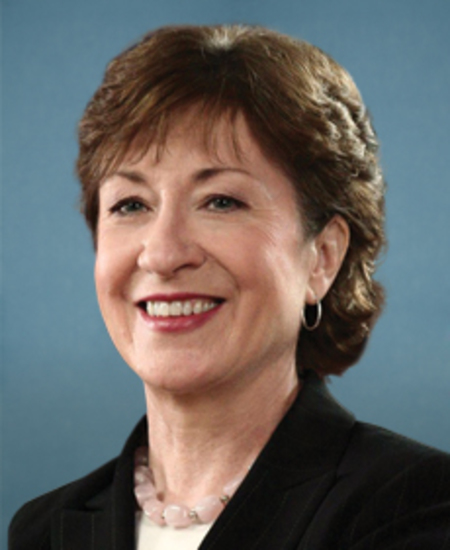
Sen. Susan M. Collins
Sponsored bills
Combating Global Corruption Act of 2021 This bill requires the Department of State to develop a program to combat corruption in foreign countries. The State Department must annually report to Congress a tiered list of all foreign countries. The first tier shall contain countries that meet minimum standards for combating public corruption, while the second tier shall contain countries that do not yet meet these standards but are making significant efforts to do so. Third-tier countries do not meet the minimum anti-corruption standards and are not making significant efforts to do so. Factors for assessing efforts to address corruption include a country's compliance with specified relevant international agreements. The State Department must report on whether, for purposes of potential sanctions, foreign persons are engaged in significant corruption in third-tier countries or in relation to the planning, construction, or operation of the Nord Stream 2 pipeline. The State Department must also designate an anti-corruption point of contact in the U.S. diplomatic post in each second- or third-tier country and where the State Department determines that such a point of contact is necessary. The point of contact shall be responsible for enhancing coordination and promoting the implementation of a whole-of-government approach to enhancing the ability of foreign countries to combat public corruption.
Restored, Equitable, Coronavirus Adjusted Lodging Act of 2021 or the RECAL Act of 2021 This bill prohibits the General Services Administration (GSA), when determining the FY2022 and FY2023 per diem reimbursement rates for locations within the Continental United States (CONUS), from setting lodging allowances below the FY2020 levels. CONUS per diem reimbursement rates are the maximum allowances that federal employees are reimbursed for official travel expenses. The rates consist of lodging, meals, and incidental expense allowances; the GSA sets rates annually based on data from the prior 12-month period.
Improving Medicare Beneficiary Access to Innovative Diabetes Technologies Act of 2021 This bill establishes the Task Force on Innovative Diabetes Technologies and Services to address the accessibility of innovative diabetes technologies and services to Medicare beneficiaries. The bill defines innovative diabetes technologies and services as medical technologies and services for diabetes treatment that are not covered under Medicare. Among other activities, the task force must (1) recommend ways to improve access to innovative diabetes technologies and services through new or alternative payment models and existing policies, and (2) propose changes to foster collaboration between the Food and Drug Administration and the Centers for Medicare & Medicaid Services to streamline approval and coverage.
Promoting Effective and Empowering Recovery Services in Medicare Act of 2021 or the PEERS Act of 2021 This bill specifies that peer support specialists may participate in the provision of behavioral health integration services with the supervision of a physician or other entity under Medicare. The bill defines peer support specialists as individuals who are recovering from a mental health or substance-use condition and have certain national or state credentials, as specified, to provide peer support services.
Jury Access for Capable Citizens and Equality in Service Selection Act of 2021 or the Jury ACCESS Act This bill prohibits the exclusion of individuals from jury service on the basis of their sexual orientation or gender identity.
Personal Care Products Safety Act This bill requires cosmetics brands and manufacturers to register with the Food and Drug Administration (FDA), provides the FDA with various regulatory authorities, and addresses related issues. Cosmetics brand owners and contract manufacturers must annually register their manufacturing facilities with the FDA. Certain entities and facilities, such as manufacturers with gross sales below certain thresholds, are exempted. Registrants with gross annual sales above certain thresholds must pay a registration fee. Each registration must contain certain information, including an ingredient list for all cosmetic products from a registered facility, with different requirements for registrants that qualify as small businesses. The FDA may suspend a registration for various reasons, including if the registrant's product has a reasonable probability of causing serious adverse health consequences and the problem cannot be isolated to a single product. The FDA must annually conduct a safety review of at least five cosmetics ingredients or nonfunctional constituents and, if appropriate, issue a final finding on the safety of that ingredient or constituent. The FDA must also implement regulations for good cosmetics manufacturing practices. The bill also requires cosmetics brand owners and manufacturers to report to the FDA any serious adverse event associated with their products. The FDA shall have various authorities to regulate cosmetics, including to (1) order a mandatory recall of a product, (2) inspect the records of manufacturers and processors, and (3) require warning labels for certain products. The FDA must issue a proposed rule to ban using intentionally added perfluoroalkyl or polyfluoroalkyl substances in cosmetics.
Student Assisted Vaccination Effort Act or the SAVE Act This bill expands the types of medical personnel authorized to administer or use a covered countermeasure (i.e., a qualified pandemic or epidemic product, a security countermeasure, certain drugs, biomedical products, or medical devices, or a respiratory protective device) during a federally-declared public health emergency to include specified health profession students with appropriate training in administering vaccines and supervision by a licensed health professional.
United States–Israel Artificial Intelligence Center Act This bill requires the Department of State to establish the United States–Israel Artificial Intelligence Center to leverage the experience, knowledge, and expertise of institutions of higher education and private sector entities in the United States and Israel to develop more robust research and development cooperation in specified areas (e.g., machine learning, object detection, and speech recognition).
Senior Financial Empowerment Act of 20 21 This bill requires the Federal Trade Commission (FTC) to disseminate to senior citizens and their families and caregivers information regarding mail, telemarketing, and internet fraud that targets senior citizens. This includes information about safe and smart financial practices, instructions for referring a fraud complaint to law enforcement, and a toll-free telephone number that connects to a live individual who answers calls from seniors seeking advice about scams or how to report instances of fraud. Further, the Department of Justice may award grants for the prevention of senior citizen fraud to state attorneys general, state or local law enforcement, senior centers, or nonprofit organizations that provide assistance to seniors. The FTC must provide education regarding legal obligations and industry best practices with respect to addressing financial exploitation and neglect of seniors to specified financial entities and to employees of financial institutions who may be able to identify elder financial abuse. The National Institutes of Health must research the increased vulnerability of seniors to scams and fraud due to age-related health and neurological conditions. The bill expresses the sense of Congress that a week in March of each year should be designated as National Senior Fraud Awareness Week.