This bill expands the permissible uses of the Commodity Futures Trading Commission Customer Protection Fund to include administrative expenses.
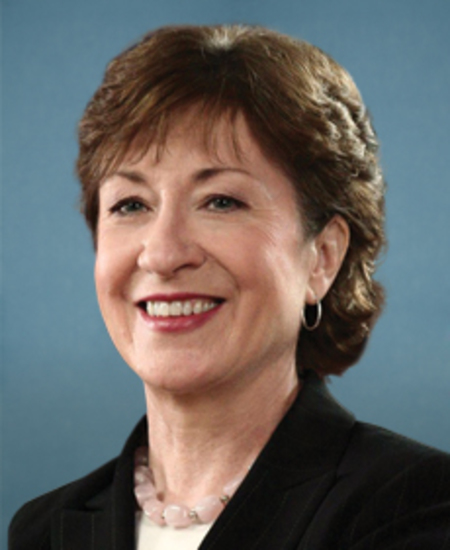
Sen. Susan M. Collins
Sponsored bills
This joint resolution nullifies the Oil and Natural Gas Sector: Emission Standards for New, Reconstructed, and Modified Sources Review rule published by the Environmental Protection Agency on September 14, 2020. The rule finalized amendments to new source performance standards under the Clean Air Act for the oil and natural gas sector, such as an amendment that removed limitations on methane emissions from such sector.
This resolution encourages the Centers for Disease Control and Prevention (CDC) to update certain guidance to clarify that individuals who are fully vaccinated against COVID-19 need not wear masks on public transportation networks. The resolution also recommends that the Transportation Security Administration align its mask requirements with such CDC guidance.
This resolution (1) supports the designation of June 2021 as National Dairy Month, and (2) encourages the people of the United States to visit with dairy producers to learn more about agriculture and the vital role dairy producers play in our global food system.
This bill temporarily exempts certain workers involved with forest health or conservation from the annual limit on visas for temporary nonagricultural workers (H-2B visas). Specifically, for five years starting from the bill's enactment, a visa for a temporary nonagricultural worker entering the United States to perform certain work (such as orchard work, tree planting, nursery care, or harvesting minor forest products) shall not count against the annual limit on H-2B visas. (Currently, only 66,000 H-2B visas may be issued each year, with exemptions for certain types of workers.)
Medication Access and Training Expansion Act of 2021 or the MATE Act of 2021 This bill requires health care providers, as a condition of receiving or renewing a registration to prescribe potentially addictive drugs, to complete a one-time training on managing patients with substance use disorders. In addition, the Department of Health and Human Services must award grants to health professional associations and education programs for integrating substance use disorder training into relevant curricula.
Advancing FASD Research, Services, and Prevention Act or the FASD Respect Act This bill expands and establishes programs for fetal alcohol spectrum disorders (FASD). Specifically, it directs the Department of Health and Human Services, the National Institutes of Health, the National Center on Birth Defects and Developmental Disabilities, and the Health Resources and Services Administration to carry out and coordinate research, surveillance, and related activities to diagnose, prevent, and treat FASD. Furthermore, the bill establishes various grant programs to support FASD coalitions and develop systems of care; provide services for individuals affected by FASD and other conditions related to prenatal substance exposure; identify and implement best practices for educating children with FASD; and establish centers for excellence to build relevant capacity for preventing, treating, and responding to the needs of individuals with FASD. The bill also directs the Department of Education and the Department of Justice to develop and disseminate trainings and best practices related to FASD in schools and correctional facilities, respectively.

Prevent All Soring Tactics Act of 2021 or the PAST Act of 2021 This bill addresses the practice of soring horses. The soring of horses includes various actions taken on horses' limbs to produce higher gaits that may cause pain, distress, inflammation, or lameness. Specifically, the bill expands soring regulation and enforcement at horse shows, exhibitions, sales, and auctions, including by establishing a new system for inspecting horses for soring. In addition, the bill increases penalties for violations.
Veterinary Medicine Loan Repayment Program Enhancement Act This bill modifies the requirements for calculating taxable income to exclude from gross income payments under the federal veterinary medicine loan repayment program or any state loan repayment or forgiveness program that is intended to provide for increased access to veterinary services in such state.
Historic Tax Credit Growth and Opportunity Act of 2021 This bill increases the rehabilitation tax credit and modifies certain requirements for the credit. The bill increases the rate of the credit to 30% for small projects (rehabilitation expenditures not exceeding $3.75 million) and caps the credit for such projects at $750,000 for all taxable years. The bill also expands the types of buildings eligible for rehabilitation by decreasing the rehabilitation threshold from 100% to 50% of project expenses. It also eliminates the basis adjustment requirement for the credit and modifies rules relating to the eligibility of tax-exempt use property for the credit.