

This resolution strongly condemns the ongoing violence, war crimes, crimes against humanity, and systematic human rights abuses being carried out by Russia's military and its proxies at the direction of Russian President Vladimir Putin. It also encourages the U.S. government and partner nations to use their influence and vote in international organizations to hold those responsible for such crimes and abuses accountable.
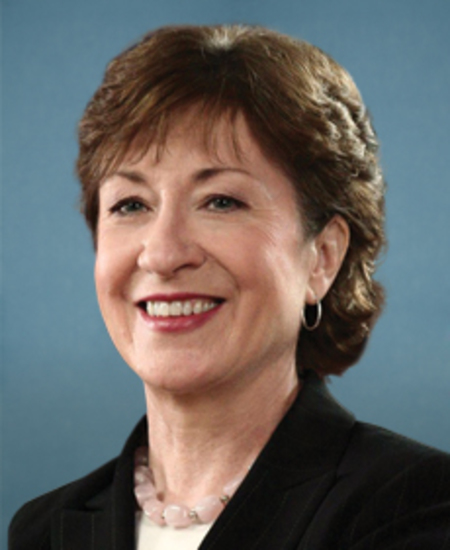
Sen. Susan M. Collins
Sponsored bills
Strengthening American Cybersecurity Act of 2022 This bill addresses cybersecurity threats against critical infrastructure and the federal government. The Cybersecurity and Infrastructure Security Agency (CISA) must perform ongoing and continuous assessments of federal risk posture. An agency, within a specified time frame, must (1) determine whether notice to any individual potentially affected by a breach is appropriate based on a risk assessment; and (2) as appropriate, provide written notice to each individual potentially affected. Each agency must (1) provide information relating to a major incident to specified parties, and (2) develop specified training for individuals with access to federal information or information systems. The bill requires reporting and other actions to address cybersecurity incidents. Entities that own or operate critical infrastructure must report cyber incidents and ransom payments within specified time frames. The bill limits the use and disclosure of reported information. The bill establishes (1) an interagency council to standardize federal reporting of cybersecurity threats, (2) a task force on ransomware attacks, and (3) a pilot program to identify information systems vulnerable to such attacks. The bill provides statutory authority for the Federal Risk and Authorization Management Program (FedRAMP) within the General Services Administration (GSA). FedRAMP is a government-wide program that provides a standardized approach to security assessment, authorization, and continuous monitoring for cloud computing products and services. The bill establishes a FedRAMP Board to examine the operations of FedRAMP and the Federal Secure Cloud Advisory Committee.
Reproductive Choice Act This bill provides statutory authority for certain Supreme Court holdings on abortion rights and restrictions in the cases of Roe v. Wade and Planned Parenthood of Southeastern Pennsylvania v. Casey . In Roe , the Court held that the Constitution protects a woman's decision to terminate her pregnancy. In Casey , the Court reaffirmed this holding and additionally held that state abortion regulations may not place a substantial obstacle in the path of a woman seeking an abortion before fetal viability (i.e., an undue burden). However, a state may (1) restrict abortions after viability, except when a pregnancy endangers the life or health of the woman; and (2) enact regulations to further the health or safety of a woman seeking an abortion, except for unnecessary health regulations that present a substantial obstacle to a woman seeking an abortion. The bill provides statutory authority for these holdings. It also specifies that the bill does not affect laws regarding conscience protection.
Emmett Till Antilynching Act This bill makes lynching a federal hate crime offense. Specifically, the bill imposes criminal penalties—a fine, a prison term of up to 30 years, or both—on an individual who conspires to commit a hate crime offense that results in death or serious bodily injury or that includes kidnapping or an attempt to kidnap, aggravated sexual abuse or an attempt to commit aggravated sexual abuse, or an attempt to kill.
This bill exempts until June 30, 2025, certain contractors that receive federal highway or public transportation funding from having to adjust costs associated with their contracts to account for loan forgiveness through the Paycheck Protection Program (PPP). (The PPP provided small businesses with loans for payroll and other costs to respond to the COVID-19 emergency with loan forgiveness under certain conditions.) Under current law, a contractor with a cost-reimbursable contract must reduce costs or provide cash refunds to the Department of Transportation (or a state department of transportation) if the contractor receives or accrues any income, rebate, allowance, or other credit relating to an allowable contract cost, which includes PPP loan forgiveness.
Modernizing Access to our Public Land Act This bill directs the Department of the Interior, the Forest Service, and the U.S. Army Corps of Engineers to jointly develop and adopt interagency standards to ensure compatibility and interoperability among federal databases for the collection and dissemination of certain data. Specifically, these requirements shall apply to outdoor recreation data related to federal lands and used to depict locations at which recreation uses are available to the public. Each such department shall digitize and make publicly available on their websites, as applicable, geographic information system mapping data that specifies, with respect to the relevant department, all federal interests in private land, including easements, reservations, and rights-of-way to which the federal government does not have a fee title interest, and that may be used to provide recreational access to the federal land. Interior, the Forest Service, and the Corps of Engineers must digitize and publish geographic information system mapping data that includes status information as to whether roads and trails are open or closed, the dates on which roads and trails are seasonally opened and closed, the types of vehicles that are allowed on each segment of roads and trails, and the boundaries of areas where hunting or recreational shooting is regulated or closed.
Promoting Rigorous and Innovative Cost Efficiencies for Federal Procurement and Acquisitions Act of 2021 or the PRICE Act of 2021 This bill directs the Management Directorate of the Department of Homeland Security (DHS) to publish an annual report on a DHS website on projects that have used innovative procurement techniques within DHS to accomplish specified goals. Such goals are improving or encouraging better competition, reducing time to award, achieving cost savings, achieving better mission outcomes, or meeting the goals for contracts awarded to small business concerns. The Management Directorate shall (1) develop and disseminate guidance and offer training for specified personnel concerning when and how to use such techniques, and (2) share best practices across DHS and make available to other federal agencies information to improve procurement methods and training. The Office of Federal Procurement Policy shall convene a Chief Acquisition Officers Council to examine best practices for acquisition innovation in contracting in the federal government.
Harriet Tubman Bicentennial Commemorative Coin Act This bill directs the Department of the Treasury to mint and issue 50,000 $5 gold coins, 400,000 $1 silver coins, and 750,000 half-dollar clad coins emblematic of the legacy of Harriet Tubman as an abolitionist. The Secretary may issue coins under this bill only during the period of January 1, 2024, through December 31, 2024. All surcharges received by Treasury from the sale of such coins must be paid equally to the National Underground Railroad Freedom Center in Cincinnati, Ohio, and The Harriet Tubman Home, Inc. in Auburn, New York, for the purpose of accomplishing and advancing their missions.
This resolution supports the designation of February 19-February 26, 2022, as National FFA Week. It also (1) recognizes the important role of the National FFA Organization (Future Farmers of America) in developing the next generation of leaders who will change the world, and (2) celebrates 70 years of the National FFA Organization's membership magazine.
Maddy summaryThis Senate resolution (SRES 526) formally condemns the antisemitic terrorist attack at Congregation Beth Israel Synagogue in Colleyville, Texas, on January 15, 2022, where hostages were held at gunpoint. It expresses gratitude that no lives were lost, applauds law enforcement and emergency responders for their actions, and condemns antisemitism in the United States. The resolution does not create new policies or allocate funds; it is a symbolic expression of support for the Jewish community and law enforcement. It directly affects the congregation and local community by affirming their safety and the importance of religious freedom.