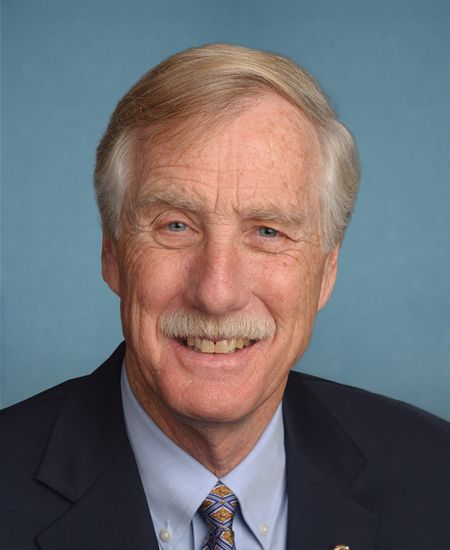
Photo of Angus S. King, Jr.
I United States Senate · Maine

Sen. Angus S. King, Jr.

Compare
Total votes
1,054
all sessions
Attendance
99%
7 missed
Near the chamber average
With party
-
no party-line votes scored
Bipartisan score
-
no party-line votes scored
Sponsored
1,578
bills & resolutions
Near the chamber average
Committees
10
assignments
1,578 bills and resolutions

Sponsored bills

Total
1,578
Primary
138
Co-sponsor
1,440
This page
1,578
matching current filters
Co-sponsor SRES 846
Passed · Indiana Senate · Co-sponsor
A resolution designating November 2022 as "National College Application Month".

Maddy summarySRES 846 is a symbolic Senate resolution designating November 2022 as "National College Application Month." It encourages all Americans to evaluate college options, submit financial aid applications (like the FAFSA), and support students in navigating the college application process. The resolution urges communities, educators, and officials to host activities promoting college applications and financial aid awareness, with a specific focus on helping low-income and first-generation students. It does not create new programs or funding but aims to raise awareness about higher education opportunities.

Passed Nov 17, 2022 1 co-sponsor
Co-sponsor S 2130
In committee · Indiana Senate · Co-sponsor
RISEE Act of 2022

Reinvesting In Shoreline Economies and Ecosystems Act of 2022 or the RISEE Act of 2022 This bill expands the amount of revenue generated from leases for energy development on federal land or submerged lands in the Outer Continental Shelf that is shared with certain states and coastal communities. For example, the bill dedicates a percentage of the revenue generated from offshore wind leases for coastal states. Currently, this revenue is deposited in the U.S. Treasury. In addition, the bill increases the amount of revenue generated from offshore oil and gas leases that is shared with states under the Gulf of Mexico Energy Security Act. States must use the funding from the revenue for specified purposes, such as coastal restoration, conservation, or infrastructure.

In committee Nov 17, 2022 1 co-sponsor
Co-sponsor S 5108
In committee Nov 16, 2022 1 co-sponsor
Co-sponsor SRES 814
Passed · Indiana Senate · Co-sponsor
A resolution designating the week beginning on October 9, 2022, as "National Wildlife Refuge Week".

This resolution designates the week beginning on October 9, 2022, as National Wildlife Refuge Week. The resolution acknowledges the importance of national wildlife refuges for their recreational opportunities and contribution to local economies. Finally, the resolution reaffirms the support of the Senate for wildlife conservation and the National Wildlife Refuge System.

Passed Nov 15, 2022 1 co-sponsor
Co-sponsor S 5098
In committee · Indiana Senate · Co-sponsor
Senator Paul Simon Study Abroad Program Act of 2022

Senator Paul Simon Study Abroad Program Act of 2022 This bill expands access to study abroad for U.S. undergraduate students. It revises the Increase and Diversify Education Abroad for U.S. Students program (commonly known as the IDEAS program) and formally renames the program as the Senator Paul Simon Study Abroad Program.

In committee Nov 15, 2022 1 co-sponsor
Co-sponsor S 5089
In committee · Indiana Senate · Co-sponsor
GUARD VA Benefits Act

Governing Unaccredited Representatives Defrauding VA Benefits Act or the GUARD VA Benefits Act This bill imposes criminal penalties and/or fines on individuals for directly or indirectly soliciting, contracting for, charging, or receiving any unauthorized fee or compensation with respect to the preparation, presentation, or prosecution of any claim for Department of Veterans Affairs benefits. The attempted commission of such offenses is also punishable by fine or imprisonment.

In committee Nov 15, 2022 1 co-sponsor
Co-sponsor S 4573
In committee · Indiana Senate · Co-sponsor
Electoral Count Reform and Presidential Transition Improvement Act of 2022

Electoral Count Reform and Presidential Transition Improvement Act of 2022 This bill revises the process of casting and counting electoral votes for presidential elections. The bill also revises provisions related to the presidential transition process. The bill specifies that the choice of electors must occur in accordance with the laws of the state enacted prior to election day. Additionally, the bill identifies each state's governor (unless otherwise identified in the laws or constitution of a state in effect on election day) as responsible for submitting the certificate of ascertainment identifying the state's electors. Further, the bill provides for expedited judicial review for any action brought by an aggrieved presidential or vice-presidential candidate arising under the U.S. Constitution or U.S. laws with respect to the issuance or transmission of such a certificate. The bill revises the framework for the joint session of Congress to count electoral votes and make a formal declaration of which candidates have been elected President and Vice President. Among other changes, the bill (1) specifies that the role of the Vice President during the joint session shall be ministerial in nature, and (2) raises the objection threshold in Congress to at least one-fifth of the duly chosen and sworn members of both the House of Representatives and the Senate. The bill also revises the presidential transition process, including to (1) allow more than one candidate to receive federal transition resources under certain circumstances, and (2) require additional reporting by the General Services Administration.

In committee Oct 18, 2022 1 co-sponsor
Co-sponsor S 3904
In committee · Indiana Senate · Co-sponsor
Healthcare Cybersecurity Act of 2022

Healthcare Cybersecurity Act of 2022 This bill requires the Department of Health and Human Services (HHS) to undertake activities to improve the cybersecurity of the health care and public health sector. HHS must coordinate with the Cybersecurity and Infrastructure Security Agency (CISA) on these activities; in particular, CISA must make resources, including cyber-threat indicators and appropriate defense measures, available to federal and nonfederal entities that receive information through HHS programs. In addition, HHS must provide training on cybersecurity risks and mitigation strategies to owners of assets in the health care and public health sector. HHS must also update the Healthcare and Public Health Sector Specific Plan, which guides the sector's effort to enhance the security and resilience of critical infrastructure. The updates must address, among other topics, the impact of the risks on rural entities and small- and medium-sized entities, cybersecurity workforce shortages in the sector, and challenges related to the COVID-19 emergency.

In committee Oct 18, 2022 1 co-sponsor
Co-sponsor S 3375
In committee · Indiana Senate · Co-sponsor
Omnibus Travel and Tourism Act of 2021

Omnibus Travel and Tourism Act of 2021 This bill addresses measures to support the U.S. travel and tourism industry with a specific focus recovery from the COVID-19 pandemic. The bill establishes the office of Assistant Secretary of Commerce for Travel and Tourism. Among other responsibilities, the Assistant Secretary must develop and implement a strategy to assist the U.S. travel and tourism industry to recover from the COVID-19 pandemic. The bill also provides statutory authority for the United States Travel and Tourism Advisory Board and directs the board to assist with the recovery strategy. Additionally, the Department of Commerce must study the effects of the COVID-19 pandemic on employment, revenue, and other aspects of the travel and tourism industry and provide policy recommendations to promote the industry. Commerce must also publish trends in domestic travel and tourism. Further, the Department of Health and Human Services must establish a joint federal task force to address health, safety, security, and other logistical issues affecting air travel during and after the COVID-19 pandemic. The bill establishes a committee comprised of representatives of airports and other aviation stakeholders to advise the task force. In addition, the Transportation Security Administration (TSA) must study the feasibility of using dogs to detect the presence of the virus that causes COVID-19 as part of airport security screenings. The TSA may also establish a pilot program at up to six foreign airports to allow passengers departing from those airports to bypass domestic security rescreening at a connecting airport in the United States.


In committee Oct 18, 2022 1 co-sponsor
Showing 1,071 to 1,080 of 1,578 bills