

Maddy summaryThis is a Senate resolution (SRES 604), not a bill, expressing the Senate's non-binding view that the federal government should create a Transgender Bill of Rights. It calls for protections including equal access to healthcare (specifically affirming gender-affirming care), anti-discrimination measures in employment and housing, easier legal gender recognition on documents, and safety improvements for transgender and nonbinary people in custody. The resolution outlines detailed policy goals but does not create new law or mandate government action. It serves as a statement of principle, not a legislative proposal.
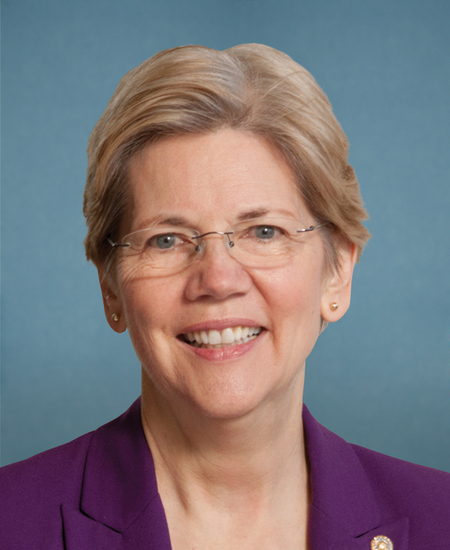
Sen. Elizabeth Warren
Sponsored bills
Maddy summaryThis bill creates new criminal and civil penalties for corporate entities whose actions contribute to patient harm in healthcare settings. It targets "covered parties" including executives, directors, shareholders, and private equity firms that receive "covered compensation" (such as salaries, bonuses, or equity) from a healthcare organization experiencing a "triggering event" like financial distress leading to patient harm. The bill establishes a clawback mechanism allowing the Attorney General or state attorneys general to recover compensation received by these entities during the 10 years before or after the triggering event, with recovered funds to be used for employee benefits or community health services. It also requires healthcare entities to report ownership information and mandates a study on profit-driven practices in healthcare delivery.
Maddy summaryThis bill amends U.S. tax law to prevent corporations from avoiding U.S. taxes through "inversions," where a foreign company acquires a U.S. business and moves its tax residence abroad. It treats certain foreign corporations as domestic for tax purposes if they acquire a U.S. entity after May 8, 2014, and either have over 50% of their stock held by former U.S. shareholders or maintain significant U.S. operations (at least 25% of employees, compensation, assets, or income in the U.S.). Exceptions apply if the corporation has substantial business activities in its original foreign country. The changes apply to taxable years ending after May 8, 2014, targeting tax avoidance strategies rather than affecting most standard multinational businesses.
Maddy summaryThis bill, S 3823 (FAIR Act), sets specific pay adjustments for federal employees in calendar year 2027. It mandates a 3.1% increase in base pay for employees covered by statutory pay systems (most federal workers) and prevailing rate employees (those paid based on local private-sector wages), and a 1% increase in locality pay adjustments. These changes directly affect all federal employees whose pay is determined under the specified systems outlined in Title 5 of the U.S. Code. The bill is procedural, establishing concrete pay rate adjustments without altering broader employment policies.
Maddy summaryThe Break Up Big Medicine Act requires large healthcare companies that own multiple parts of the healthcare system (such as insurance, pharmacies, and physician practices) to divest certain businesses to eliminate conflicts of interest. It prohibits common ownership between entities like health insurers and physician practices, or drug wholesalers and medical providers, mandating divestiture within one year of enactment. Non-compliance would trigger penalties including monthly escrow of 10% of profits, and the bill allows government agencies and individuals to sue for violations. This directly affects the largest health insurance companies, pharmacy benefit managers, and drug distributors that have integrated operations across the healthcare sector.
Maddy summarySRES 598 is a Senate resolution condemning President Trump's decision to approve the export of advanced AI chips to the United Arab Emirates. It cites national security concerns, noting the UAE signed a secret $500 million deal to buy nearly half of the Trump family's crypto company (World Liberty Financial) just days before Trump's 2025 inauguration, followed by UAE officials meeting with Trump to push for chip access. The resolution states the export risks chips being diverted to China, which seeks such technology to advance its military and compete globally. It calls for reversing the export decision but does not create new policy or alter existing law.
Maddy summaryThis Senate resolution (SRES 601) designates the week beginning February 2, 2026, as "National Tribal Colleges and Universities Week" to recognize these institutions' role in serving Native communities and their economic contributions. It highlights that tribal colleges serve students from over 250 federally recognized tribes, offer culturally grounded education, and contribute $3.8 billion annually to the U.S. economy. As a symbolic resolution (not a law), it has no binding effect but calls for public observance through community activities. The resolution focuses on honoring tribal colleges' mission and achievements, citing their open enrollment and economic impact statistics.
Maddy summaryThe Stop Underrides Act 2.0 requires new safety standards for side underride guards on commercial trucks and trailers to prevent passenger vehicles from sliding under them during collisions. The bill mandates that the Secretary of Transportation finalize regulations requiring these guards within 18 months, with full compliance required within two years. The regulations must meet specific performance standards to prevent intrusion into passenger vehicle occupant space during side collisions at speeds up to 40 mph. This law directly affects commercial truck manufacturers, trucking companies, and all road users, particularly vulnerable road users like cyclists and pedestrians who are at higher risk in underride crashes. The bill also establishes a public website for underride crash resources and requires studies to better understand and prevent these crashes.
Maddy summarySRES 593 is a Senate resolution honoring the 67 victims of the January 29, 2025 mid-air collision between a U.S. Army Black Hawk helicopter and American Airlines Flight 5342 over the Potomac River. It specifically recognizes the lives of all victims, including 11 U.S. figure skating athletes, their families, and 3 Army soldiers, as well as the 1,700+ first responders who assisted in the recovery efforts. The resolution offers condolences to affected families, acknowledges the bravery of emergency personnel, and commits the Senate to using safety lessons from the crash to prevent future incidents. As a commemorative resolution, it does not create new laws or provide direct benefits but serves to formally memorialize the tragedy and honor those impacted.
Maddy summaryThe Empowering States' Rights To Protect Consumers Act of 2026 would amend federal consumer credit law to require that annual percentage rates (APRs) for non-mortgage consumer credit - such as credit cards and personal loans - cannot exceed the maximum rate permitted by the state where the consumer resides. This means state laws, not federal limits, would set the cap for these products, directly affecting consumers in states with lower interest rate restrictions and the financial institutions offering these services. The bill adds a new section (140B) to the Truth in Lending Act, explicitly overriding federal APR rules for non-mortgage transactions. It does not apply to residential mortgages.