

Water Affordability, Transparency, Equity, and Reliability Act of 2021 This bill provides funding for several programs related to controlling water pollution or protecting drinking water, revises requirements concerning the clean water state revolving fund (SRF) and the drinking water SRF, and creates or reauthorizes several grant programs for water infrastructure. For example, the Environmental Protection Agency must establish a grant program for repairing, replacing, or upgrading septic tanks and drainage fields. In addition, the bill makes permanent a grant program for household water well systems in rural areas. It also increases the amount of appropriations for grant programs, including a program that awards grants to prevent lead from contaminating drinking water fountains in schools and day care facilities.
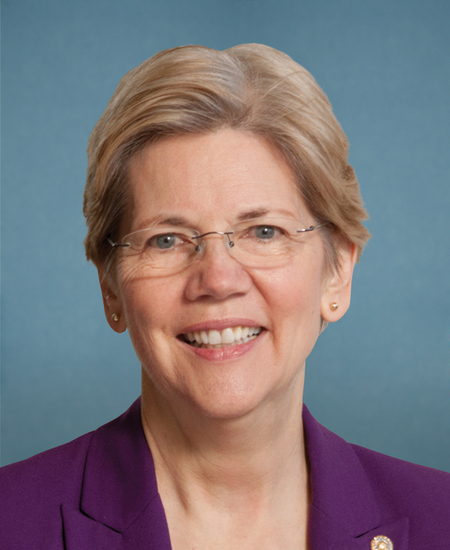
Sen. Elizabeth Warren
Sponsored bills
Prescription Drug Price Relief Act of 2021 This bill establishes a series of oversight and disclosure requirements relating to the prices of brand-name drugs. Specifically, the bill requires the Department of Health and Human Services (HHS) to review at least annually all brand-name drugs for excessive pricing; HHS must also review prices upon petition. If any such drugs are found to be excessively priced, HHS must (1) void any government-granted exclusivity; (2) issue open, nonexclusive licenses for the drugs; and (3) expedite the review of corresponding applications for generic drugs and biosimilar biological products. HHS must also create a public database with its determinations for each drug. Under the bill, a price is considered excessive if the domestic average manufacturing price exceeds the median price for the drug in Canada, the United Kingdom, Germany, France, and Japan. If a price does not meet this criteria, or if pricing information is unavailable in at least three of the aforementioned countries, the price is still considered excessive if it is higher than reasonable in light of specified factors, including development cost, revenue, and the size of the affected patient population. The bill also requires drug manufacturers to report specified financial information for brand-name drugs, including research and advertising expenditures.
Funding Attorneys for Indigent Removal Proceedings Act or the FAIR Proceedings Act This bill expands access to counsel for aliens in immigration proceedings and provides for protections related to such proceedings. An alien shall have the privilege of being represented by counsel in any immigration proceeding, whereas currently this privilege is statutorily provided for only in removal proceedings. Similarly, the Department of Justice (DOJ) may provide counsel at government expense to aliens in any immigration proceeding, whereas currently DOJ is statutorily authorized to provide counsel to aliens only in removal proceedings and at no expense to the government. Under this bill, DOJ shall provide counsel to children and vulnerable individuals in such proceedings, at government expense if necessary. If DOJ fails to do so, certain limits on filing a motion to reopen removal proceedings (such as the time limit for filing) shall not apply, and the alien's removal shall be stayed upon the motion's filing. The Department of Homeland Security (DHS) shall provide each alien, generally at the beginning of proceedings, a complete copy of the alien's case file in DHS possession, unless the alien waives this right in writing. Failure to provide such documents shall delay the alien's removal proceeding. DHS shall facilitate for all detained aliens access to counsel and programs that inform such aliens of their immigration-related rights and obligations.
COVID-19 Disinformation Research and Reporting Act of 2021 This bill requires the National Science Foundation to contract with the National Academies of Sciences, Engineering, and Medicine to study disinformation and misinformation about COVID-19 (i.e., coronavirus disease 2019) on the internet and social media platforms.
Survivors' Access to Supportive Care Act or SASCA This bill sets out programs and requirements to address access and quality issues related to sexual-assault examinations. Specifically, the bill establishes training and technical assistance programs for health care providers on conducting sexual-assault examinations and treating survivors of sexual assault, including in rural and tribal settings; grants for states to assess the availability of trained providers to perform sexual-assault examinations; and a task force to assist state-level efforts to improve medical forensic evidence collection related to sexual assault. The bill also requires institutions of higher education to provide information about the availability of sexual-assault examinations to survivors of sexual assault. Additionally, hospitals and specified components of the Department of Health and Human Services (HHS) must report on access and quality issues concerning sexual-assault examinations and related services. Furthermore, HHS must address access to, and the quality of, trained health care providers who conduct sexual-assault examinations in the National Quality Strategy. This is a national effort to align public-sector and private-sector stakeholders to achieve better health and health care.
Recycling Enhancements to Collection and Yield through Consumer Learning and Education Act of 2021 or the RECYCLE Act This bill provides support for recycling programs. Specifically, the bill requires the Environmental Protection Agency (EPA) to establish a program to award grants to improve the effectiveness of residential and community recycling programs through public education and outreach. In addition, the EPA must develop a model recycling program toolkit for states, Native American tribes, and local governments. Finally, the bill specifies that the EPA's review of its federal procurement guidelines for purchasing certain recycled materials and items made with such materials must occur at least once every five years.
Medicare Drug Price Negotiation Act This bill makes a series of changes relating to the prices of prescription drugs under the Medicare prescription drug benefit and Medicare Advantage (MA) prescription drug plans (PDPs). Under current law, the Centers for Medicare & Medicaid Services (CMS) may neither negotiate the prices of covered drugs nor establish a formulary. The bill repeals these restrictions and instead specifically requires the CMS to (1) negotiate the prices of covered drugs; and (2) either establish a formulary for covered drugs, or require changes to PDP formularies that take into account CMS negotiations. If the CMS is unable to negotiate an appropriate price for a drug in accordance with certain criteria, the price must be the lowest of three specified options (e.g., the median price in other countries). The CMS must identify drugs that are subject to negotiation, with priority given to certain categories of drugs based on usage and cost. Additionally, drug manufacturers must issue rebates to the CMS for drugs dispensed to eligible low-income individuals. Subject to civil monetary penalties, a Medicare or MA PDP sponsor must report, both to drug manufacturers and to the CMS, specified information related to the determination and payment of such rebates.
Affordable and Safe Prescription Drug Importation Act This bill allows expanded importation of eligible prescription drugs and addresses related issues. Current law allows the Department of Health and Human Services (HHS) to authorize the importation of certain eligible prescription drugs from Canada if HHS certifies to Congress that doing so would pose no additional risk to public health and safety and would result in significant cost savings for consumers. The bill removes this certification requirement and requires HHS to issue regulations that permit the importation of qualifying prescription drugs from Canada. After a certain amount of time, HHS may authorize importation from certain other countries if it determines that importation from Canada has resulted in cost savings for consumers and increased access to safe medication. The bill also expands the types of prescription drugs eligible for importation to include, for example, biologics such as insulin. Furthermore, the bill allows individuals to use an eligible licensed foreign pharmacy to fill a U.S.-issued prescription for a qualifying drug for personal use. Currently, an individual seeking to import a prescription drug generally must acquire a waiver from HHS. The bill imposes various requirements related to certification of foreign sellers, labeling of imported drugs, and supply chain security. The bill also (1) prohibits certain acts that discriminate against foreign sellers, such as charging higher prices to foreign sellers than to other sellers in the same country; and (2) imposes criminal penalties for online websites that sell counterfeit drugs or dispense drugs without a required prescription.
Creating a Respectful and Open World for Natural Hair Act of 2021 or the CROWN Act of 2021 This bill prohibits discrimination based on a person's hair texture or hairstyle if that style or texture is commonly associated with a particular race or national origin. Specifically, the bill prohibits this type of discrimination against those participating in federally assisted programs, housing programs, public accommodations, and employment. Persons shall not be deprived of equal rights under the law and shall not be subjected to prohibited practices based on their hair texture or style. The bill provides for enforcement procedures under the applicable laws.
Mental Health Access Improvement Act of 2021 This bill provides for coverage of marriage and family therapist services and mental health counselor services under Medicare. It also excludes such services from the skilled nursing facility prospective payment system, and authorizes marriage and family therapists and mental health counselors to develop discharge plans for post-hospital services.