

Maximizing Outcomes for Moms through Medicaid Improvement and Enhancement of Services Act or the MOMMIES Act This bill establishes a series of programs and requirements under Medicaid and the Children's Health Insurance Program (CHIP) relating to maternal health. For example, the bill expands eligibility for coverage under Medicaid and CHIP from 60 days to one year after the last day of pregnancy and requires such coverage to include oral health services. The bill also establishes a demonstration program in which states receive grants to implement or expand models for maternity care homes that provide services to Medicaid or CHIP beneficiaries. The Government Accountability Office must report on (1) gaps in coverage under Medicaid and CHIP for pregnant and postpartum women, and (2) the use of telehealth by state Medicaid programs to increase access to maternity care.
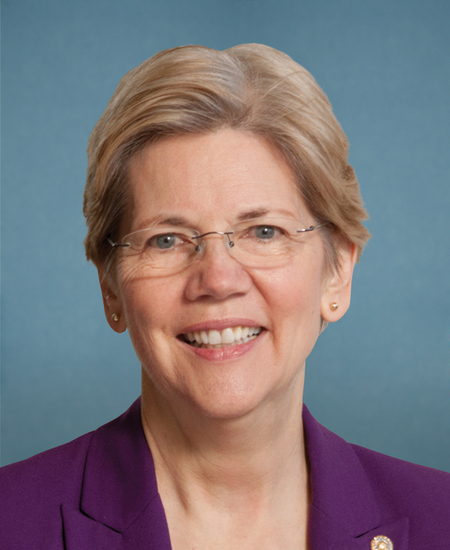
Sen. Elizabeth Warren
Sponsored bills
This resolution sets forth procedures that allow Senators to cast their votes from outside of the Senate chamber. Specifically, these votes may be cast using certain technology approved by the Secretary of the Senate and Sergeant at Arms and Doorkeeper if the majority leader and minority leader jointly determine that an extraordinary crisis of national extent exists in which it would be infeasible for Senators to cast their votes in person.
This resolution thanks the teachers of the United States and promotes the teaching profession by encouraging students, parents, school administrators, and public officials to recognize National Teacher Appreciation Week.
This resolution condemns the acts of gun violence that led to the tragic loss of eight lives in Georgia on March 16, 2021.
Military Justice Improvement and Increasing Prevention Act of 2021 This bill modifies the process and policy related to the disposition of charges and convening of courts-martial for certain sexual assault cases and other specified offenses under the Uniform Code of Military Justice (UCMJ). Among other elements, the bill provides that the determinations on the preferral, disposition, and referral of charges for specified offenses under the UCMJ must be made by a commissioned officer of the Armed Forces who is designated as a court-martial convening authority (in grade O-6 or higher) and who is available for detail as trial counsel, has significant trial experience, and is outside the chain of command of the member subject to the charges.
Respect for Workers Act This bill requires at least one member of the Board of Governors of the Federal Reserve System to have experience supporting or protecting the rights of workers. This member is in charge of developing policy recommendations regarding the board's goal of maximum employment. (The board is made up of seven members that are nominated by the President and confirmed by the Senate. Members serve 14-year terms, with one term beginning every two years.) The bill also requires the board to discuss in their semiannual report the distributional effect of monetary policy.
Creating Opportunities Now for Necessary and Effective Care Technologies (CONNECT) for Health Act of 2021 or the CONNECT for Health Act of 2021 This bill expands coverage of telehealth services under Medicare. Among other provisions, the bill allows the Centers for Medicare & Medicaid Services (CMS) to waive certain restrictions, such as restrictions on the types of technology that may be used; permanently removes geographic restrictions on originating sites (i.e., the location of the beneficiary) and allows the home of the beneficiary to serve as the originating site for all services; permanently allows federally qualified health centers and rural health clinics to serve as the distant site (i.e., the location of the health care practitioner); and allows the CMS to generally waive coverage restrictions during any public health emergency. Additionally, the CMS must report on the effects of expanded telehealth services during the COVID-19 public health emergency, including with respect to the utilization, quality, and outcomes of services. The Center for Medicare and Medicaid Innovation may also test alternative payment models relating to expanded telehealth services.
Reach Every Mother and Child Act of 2021 This bill authorizes the President to provide assistance to implement a comprehensive five-year strategy to contribute toward the global goal of ending preventable child and maternal deaths by 2030.
Advancing International and Foreign Language Education Act This bill reauthorizes through FY2027 and otherwise revises international education programs. These programs provide grants to institutions of higher education and related entities to (1) enhance instruction in international and foreign language studies, and (2) promote international business skills and education. First, the bill reauthorizes programs related to international and foreign language studies. Specifically, it extends (1) the Graduate and Undergraduate Language and Area Centers and Programs, which include the National Resource Centers program; (2) the Language Resource Centers; (3) the Undergraduate International Studies and Foreign Language Programs; and (4) the American Overseas Research Centers. Next, the bill reauthorizes the Foreign Language and Area Studies Fellowships program. It also revises the program to permit graduate students to receive a stipend for the beginning, intermediate, or advanced study of a foreign language related to the student's area of specialization. Further, the bill extends the Technological Innovation and Cooperation for Foreign Information Access program. It also modifies the program, such as by (1) revising the types of available grants, and (2) allowing the Department of Education to establish a national database on international and foreign language education. Finally, the bill reauthorizes programs related to international business skills and education. Specifically, it reauthorizes the Centers for Business Education program. It also reauthorizes the Education and Training program and otherwise makes changes to the program, including by (1) renaming the program; and (2) mandating certain program activities, such as the incorporation of specified programs and studies into professional education and technical training curricula.
Military Hunger Prevention Act This bill requires the Department of Defense (DOD) to pay a basic needs allowance to certain low-income members of the Armed Forces. Specifically, those eligible for the basic needs allowance are members who (1) have completed initial entry training, (2) have a gross household income that did not exceed an amount equal to 130% of the federal poverty guidelines of the Department of Health and Human Services (HHS), and (3) do not elect to decline the allowance. In situations where a household contains two or more eligible members, the bill specifies that only one allowance may be paid per year to one member they jointly elect. The amount of the allowance must be the aggregate amount equal to 130% of the HHS federal poverty guidelines minus the gross household income of the covered member during the preceding year divided by 12. The Defense Finance and Accounting Service (DFAS) of DOD must notify, in writing, individuals determined to be eligible for the allowance. The notice must include information regarding financial management and assistance programs administered by DOD for which the individuals are also eligible. Individuals who seek to receive the allowance must submit specified information to DFAS.