

Reconciliation in Place Names Act This bill directs the Department of the Interior to establish the Advisory Committee on Reconciliation in Place Names to advise the Board on Geographic Names with regard to renaming geographic features with offensive place names. The board shall rename a geographic feature with an offensive name in accordance with a recommendation of the committee unless the board determines that (1) there is a compelling reason and substantial public interest in rejecting the recommendation, or (2) approving the recommendation would violate federal law. The board shall accept or reject a recommendation within three years of receiving the recommendation.
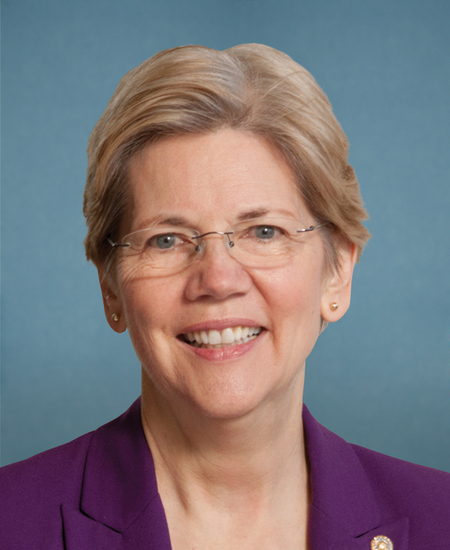
Sen. Elizabeth Warren
Sponsored bills
Support Through Loss Act This bill provides employees with 24 hours of paid leave time each year for an absence resulting from a pregnancy loss or other specified circumstance related to pregnancy, fertility, or an unsuccessful assisted reproductive procedure or adoption match. Employers must notify each employee about the availability of this paid leave and may not discriminate or discharge an employee for exercising or attempting to exercise the right to such paid leave. The bill provides for enforcement of this requirement by the Department of Labor and through civil action brought by an employee or individual. Further, the bill requires specified federal agencies to conduct research and publish information about pregnancy loss and related evidence-based treatment options.
This bill authorizes a three-year pilot program under which the Department of Defense may use noncompetitive procedures for awarding follow-on contracts to qualified businesses wholly-owned through an ESOP (i.e., an S corporation for which 100% of the outstanding stock is held through an employee stock ownership plan) if the prior contract was rated as satisfactory or better. The Government Accountability Office must report on the individual and aggregate uses of the authority provided under this bill.
Reverse Transfer Efficiency Act of 2021 This bill allows the release of a transfer student's educational records from an institution of postsecondary education where a student earned credit for coursework to an institution of postsecondary education where the student was previously enrolled in order to apply the student's coursework and credits toward completion of a recognized postsecondary credential, such as an associate's degree. Specifically, the bill allows the Department of Education to provide funding to an institution of postsecondary education that releases a student's records of postsecondary coursework and credits without the consent of the student or the student's parents if the student provides written consent prior to receiving the credential.
Uyghur Forced Labor Prevention Act This bill imposes importation limits on goods produced using forced labor in China, especially the Xinjiang Uyghur Autonomous Region, and imposes sanctions related to such forced labor. The Department of Homeland Security shall report to Congress a strategy for preventing the importation of goods produced in China using forced labor. The strategy must contain certain information, including a list of entities working with the government in Xinjiang to move forced labor or Uyghurs, Kazakhs, Kyrgyz, or members of other persecuted groups out of Xinjiang. The U.S. Customs and Border Protection shall generally presume that goods produced by these entities and certain other entities, generally those sourcing material from Xinjiang or involved with Chinese government forced labor programs, are barred from importation into the United States. The bill also expands existing asset- and visa-blocking sanctions related to Xinjiang to cover foreign individuals and entities responsible for serious human rights abuses in connection with forced labor. The Department of State shall report to Congress a strategy to enhance international awareness of forced labor in Xinjiang and to address such forced labor.
Department of Defense Climate Resiliency and Readiness Act This bill requires the Department of Defense (DOD) to address climate resiliency and energy and resource efficiency. Each DOD contract for the procurement of property or services entered into on or after October 1, 2021, must include specified information related to energy consumption and energy sources. When deciding whether to enter into a contract, DOD must consider whether the contractor verifiably produces as much renewable energy as the total energy it consumes and whether there is any order against the contractor for a violation of an environmental law or regulation. Among other elements, the bill requires DOD to achieve aggregate net zero energy in use of energy by non-operational sources by December 31, 2031; DOD to give preference to contractors and small businesses that use green manufacturing technology; DOD to administer the Energy and Climate Resiliency Fund established by the bill; DOD and the military departments to consider climate change risks when making strategic decisions related to any military installation; DOD and other relevant federal agencies to incorporate climate change into the National Defense Strategy, the National Military Strategy, and DOD's operational plans; and DOD to conduct a program of research, development, and demonstration of hybrid microgrid systems and electric grid energy storage. The Government Accountability Office must report on the individual and aggregate uses of DOD's authority to give preference to contractors that use green manufacturing technology and small businesses that verifiably use green manufacturing technology or operate with net zero energy.
Military Housing Oversight and Service Member Protection Act This bill modifies various provisions related to the contracting and provision of privatized military housing. Among other requirements, DOD must establish formal written requirements and guidance for entering into and renewing contracts related to the acquisition and improvement of military housing, employ a sufficient number of independent housing inspectors with appropriate certifications to conduct inspections without notice to landlords, provide oversight to ensure that maintenance for such housing units is completed in accordance with applicable health and building codes, publish the financial details of each contract for the management of housing units, and ensure all military medical treatment facilities screen members of the armed forces or their family members who have resided in unsafe housing units. The bill also extends legal protections afforded to tenants located in a jurisdiction surrounding a military instillation to tenants residing in housing located on a military installation, establishes a presumption of service-connection for certain conditions that are determined to be associated with residing in privatized military housing, provides Department of Veterans Affairs health care for conditions associated with residing in privatized military housing to a family member of a veteran (including a child in utero) during a specified time period, and prohibits specified individuals from owning interest in an entity that owns or manages privatized military housing. DOD is authorized to modify any contract entered into regarding privatized military housing to conform to changes made by this bill.
This bill provides for the removal of certain statues and busts from display in the Capitol. The bill directs the Joint Committee on the Library to remove the bust of Roger Brooke Taney in the Old Supreme Court chamber of the Capitol and replace it with a bust of Thurgood Marshall. The committee must remove the statues of Charles Brantley Aycock, John Caldwell Calhoun, and James Paul Clarke and the bust of John Cabell Breckinridge from areas of the Capitol accessible to the public. The Architect of the Capitol (AOC) must store the statues and bust until it arranges their return to the states that provided them. Additionally, the bill prohibits the display of statues in National Statuary Hall of persons who served as officers or voluntarily with the Confederate States of America or of the military forces or government of a state while it was in rebellion against the United States; requires the AOC to identify such statues and arrange for their transfer and delivery from the Capitol to the Smithsonian Institution; requires the Smithsonian to follow its preexisting policies and procedures regarding the storage and display of such transferred statues; requires each statue to be returned to the providing state, including its ownership, if the state requests and agrees to pay any transportation-related costs; and permits a state that has a statue removed to replace the statue.
Tribal Access to Clean Water Act of 2021 This bill provides funding for and expands access to water resources for Native communities (i.e., Indian tribes and Native Hawaiian communities). First, the bill provides funding for the Indian Health Service to (1) plan, design, construct, modernize, improve, and renovate water, sewer, and solid waste sanitation facilities; (2) provide technical assistance; and (3) operate and maintain water facilities that serve Native communities. Next, the bill provides funding for the Department of Agriculture to provide water and wastewater facility grants to eligible entities (e.g., Native communities) that have residents facing significant health risks due to inadequate water supply systems. An eligible entity shall not be required to provide a matching contribution in order to receive a grant. In addition, the bill reauthorizes through FY2031 the Bureau of Reclamation's Rural Water Supply Program. Further, the bill provides funding for and establishes a grant program for tribal clean water access projects. It also provides funding for the Native American Affairs Technical Assistance Program. The bill also provides funding for the Environmental Protection Agency to provide grants to Indian tribes and Alaska Native villages for drinking water and clean water.
Farm System Reform Act of 2021 This bill places a moratorium on large concentrated animal feeding operations; requires country-of-origin labeling for beef, pork, and dairy products; and otherwise revises provisions related to the marketing of livestock, poultry, and meat.