

Maddy summaryThe Polluters Pay Climate Fund Act of 2025 imposes a tax on fossil fuel companies based on their historical carbon emissions from 2000-2023. Companies that emitted more than 1 billion metric tons of CO2 during this period must pay a tax calculated as a proportion of a total $1 trillion tax amount, based on their excess emissions. The tax revenue will fund a new trust fund to support climate resilience projects, with at least 40% of funds directed to environmental justice communities (communities of color, low-income, and Tribal/Indigenous communities). Companies can pay the tax over 9 years in installments, and the bill explicitly states it doesn't affect existing legal claims against polluters or preempt state climate laws.
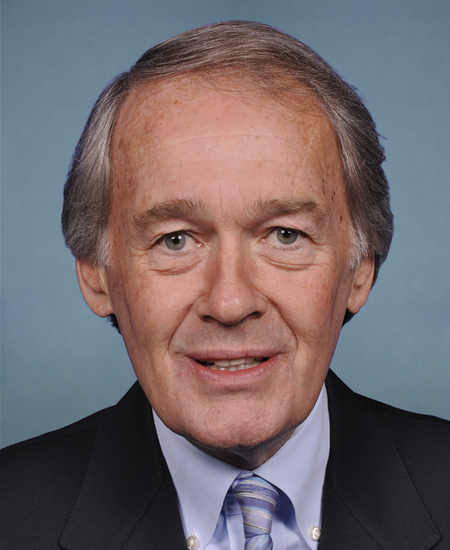
Sen. Edward J. Markey
Sponsored bills
Maddy summaryThis bill would make daylight saving time permanent across the United States by repealing the current rule that requires switching back to standard time in the fall. It directly affects all states and territories, though it preserves exemptions for areas like Arizona and Hawaii that currently skip daylight saving time. Key provisions include adjusting time zone calculations in historical laws (e.g., changing "4 hours" to "3 hours" in time zone references) and allowing states that already opted out of daylight saving time to maintain their preferred standard time. The bill does not create new policies but changes the legal framework to end seasonal time changes.
Maddy summaryThe Truth and Healing Commission on Indian Boarding School Policies Act of 2024 would establish a federal commission to investigate and document the historical impacts of Indian boarding school policies on American Indian, Alaska Native, and Native Hawaiian communities. The Commission would hold public hearings for survivors, families, and tribal representatives, work to locate unmarked graves and document records from these schools, and develop recommendations for healing and preventing similar practices today. It would include 10 diverse members representing tribal communities, experts in boarding school history, and healing practitioners, with an Advisory Committee composed of tribal organizations and survivors. The Commission would issue an initial report within three years and a final report within five years, making recommendations for federal action to address historical trauma and support mental health and cultural healing. This bill focuses on documenting the government's role in cultural termination and developing concrete steps for acknowledgment and healing.
Maddy summaryThe ICEE HOT Act of 2024 establishes a federal rebate program to promote energy-efficient building electrification products. It provides 30% rebates to contractors, distributors, and manufacturers for eligible products like heat pumps, water heaters, and electric stoves, with 40% of funds required to support disadvantaged businesses or those with 40% disadvantaged employees. The program mandates that 85% of rebates be passed through to end consumers and offers additional incentives for union labor and high-efficiency products exceeding Energy Star standards. The bill authorizes $10 billion for states to implement these rebates from 2025-2032, aiming to increase product availability and address equity in the energy transition.
Maddy summaryThe Small Business Opportunity Grants Act of 2024 creates a federal grant program providing up to $20,000 to eligible new small businesses meeting specific criteria. It directly affects small businesses located in low-income communities, rural areas, HUBZone designations, or disaster-affected zones, and those owned by women, veterans, minorities (including Black, Hispanic, Native American, and Asian Pacific American individuals), tribal members, formerly incarcerated individuals, or people with disabilities. The program caps grants at 1 million total awards, requires covered lenders (like community development financial institutions) to administer grants, and mandates the Small Business Administration to collect and publicly publish anonymized demographic data on recipients. This focuses on direct financial support for underserved business owners rather than loans or other financial products.
Maddy summaryS 5637 establishes the Biomedical Innovation Fund in the Treasury, requiring annual $10 billion transfers from the general fund starting September 1, 2025, through 2034. The fund distributes amounts to the National Institutes of Health (NIH) and Food and Drug Administration (FDA) based on their discretionary appropriations relative to minimum funding levels, with 20% of each annual allocation available for obligation each year over five fiscal years. Funds must support specific research activities including basic disease research, innovative treatments for unmet medical needs, early-career scientist programs, and studies targeting conditions disproportionately affecting Medicare/Medicaid populations. The bill strictly prohibits non-compliant uses and mandates annual reports on fund operations and research outcomes to Congress.
Maddy summaryThis bill renames the "Salem Maritime National Historic Site" in Massachusetts as the "Salem Maritime National Historical Park" and updates all federal references to match this new name. It requires the Secretary of the Interior to conduct a study evaluating whether to expand the park's boundaries to include maritime, coastal defense, and military history sites in Salem and its immediate area. The study will assess the suitability of adding specific locations like the Salem Armory Visitor Center and adjacent Salem Armory Park. The Secretary must submit a report to Congress within three years of funding the study, detailing findings and recommendations for potential boundary changes.
Maddy summaryThis bill directs the federal government to study whether the Deerfield River (including all its branches and major tributaries like the Green River and North River) in Massachusetts and Vermont should be designated as a Wild and Scenic River. It requires the Secretary of the Interior to complete this study within three years of funding and submit a report to Congress with the findings. The study itself is the primary action; it does not immediately protect the river but would inform future decisions about potential designation. This affects the river watershed and communities along its path by initiating a formal review process.
Maddy summaryThis bill creates a federal task force within Homeland Security to reunite children separated from parents at the U.S.-Mexico border between January 2017 and January 2021 under the Zero-Tolerance Policy. The task force must identify all affected children (under 18 during separation), recommend legal pathways for reunification (including visa options and parole), and propose support services like mental health care. It must report to Congress every 60 days and will sunset 120 days after all reunifications are complete or by January 20, 2039, whichever comes first. The bill directly affects thousands of children and families impacted by the 2018 border separation policy.
Maddy summaryS 5588, the Keep It in the Ground Act of 2024, prohibits new oil and gas leasing on all federal lands and waters, including the Gulf of Mexico, Atlantic, Pacific, and Arctic oceans, and bans renewals or extensions of nonproducing leases (leases that haven’t extracted fossil fuels). It directly affects oil and gas companies seeking to develop federal fossil fuel projects. The law requires the Secretary of the Interior to cancel existing leases in the Beaufort, Cook Inlet, and Chukchi Seas within 60 days of enactment. Exceptions only apply for imminent national security threats or to avoid breach-of-contract lawsuits. The bill aims to prevent emissions from federal fossil fuel reserves by keeping 90% of potential emissions underground.