

Maddy summaryS 261 prohibits U.S. persons (including citizens, entities, and individuals in the U.S.) from engaging in petroleum-related transactions in Venezuela’s energy sector. This includes transactions permitted under the 2023 Barbados Agreement or specific Treasury licenses (General Licenses 41/8M) as of the bill’s enactment date. The ban remains in effect until the Maduro regime formally recognizes Edmundo Gonzalez’s victory in Venezuela’s July 28, 2024, election and transfers power to the democratically elected government or a transitional government agreed upon with the opposition. The bill terminates automatically upon the President’s certification to Congress that this recognition has occurred.
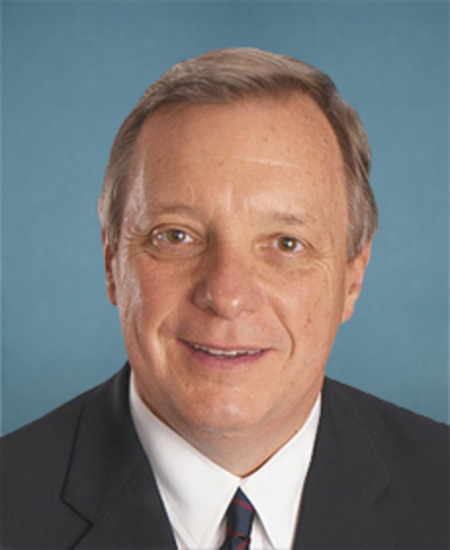
Sen. Richard J. Durbin
Sponsored bills
Maddy summaryThis concurrent resolution expresses Congress's sense that tax-exempt fraternal benefit societies - organizations providing life, health, and accident benefits to members - have historically and continue to deliver significant community benefits through charitable programs, volunteer efforts, and mutual aid. It highlights their role in addressing unmet community needs, supporting financial security for members, and contributing an estimated $3.8 billion annually in social value. The resolution affirms that their tax-exempt status under section 501(c)(8) of the Internal Revenue Code is essential to sustaining these services. As a procedural resolution, it does not create new law but formally recognizes these societies' contributions.
Maddy summarySRES 36 is a non-binding Senate resolution expressing the Senate's support for the United States working with states, cities, Tribal nations, businesses, and institutions to achieve the goals of the Paris Agreement on climate change. It urges federal, state, and local policies to reduce emissions and align with the Paris Agreement's objectives. The resolution highlights existing climate actions by states, cities, and businesses (like renewable energy commitments and the Inflation Reduction Act) but does not create new laws or funding. It serves as a symbolic statement of bipartisan support for climate action, noting the U.S. has submitted updated emissions targets to meet Paris goals.
Maddy summaryThis non-binding Senate resolution (SRES 37) expresses the Senate's view that U.S. citizens should maintain continuous access to health information provided by the Department of Health and Human Services (HHS). It references existing HHS communications like the Morbidity and Mortality Weekly Report and CDC health alerts (e.g., for avian influenza or measles) as critical tools for public health. The resolution does not create new laws, funding, or requirements - it simply states a principle supporting current HHS information-sharing practices. It directly affects the public by affirming their right to rely on these established federal health communications.
Maddy summarySRES 33 is a symbolic Senate resolution designating January as "Muslim-American Heritage Month" to honor the contributions of Muslim Americans to U.S. society. It formally supports this designation, recognizes Muslim Americans' historical and contemporary roles in fields like business, science, sports, and public service, and urges the public to observe the month with educational activities. The resolution does not create new laws or funding but serves as a ceremonial acknowledgment of Muslim Americans' diverse heritage and experiences. It directly affects Muslim Americans by affirming their cultural presence in the United States, though it has no legal or financial impact. The Senate passed this resolution to promote awareness of their contributions, including figures like Nobel laureates, athletes, and military veterans.
Maddy summaryThis bill (S 218) renames a specific street segment in Washington, D.C., between 16th Street NW and Fuller Street NW, and 16th Street NW and Euclid Street NW, as "Oswaldo Payá Way." It also redesignates the address 2630 16th Street NW as 2630 Oswaldo Payá Way. The bill requires the District of Columbia to install new street signs matching the design used for Metro station signs. This is a purely symbolic designation honoring Oswaldo Payá, a Cuban dissident who died in a 2012 car crash widely believed to involve the Cuban government.
Maddy summaryThe DTC Act of 2025 requires pharmaceutical companies to disclose the wholesale acquisition cost (WAC) for a 30-day supply (or typical treatment course) of prescription drugs in direct-to-consumer advertisements. This applies to drugs covered by Medicare or Medicaid, excluding those with a WAC under $35 per 30-day supply. The bill mandates clear, conspicuous display of the WAC in ads, along with a note that actual patient costs may vary based on insurance coverage. It takes effect July 1, 2026, and includes penalties for noncompliance, such as civil fines up to $100,000 per violation. The law aims to increase price transparency for consumers seeing drug ads, particularly affecting patients with high-deductible plans or Medicare beneficiaries.
Maddy summaryThis bill prohibits businesses from using pricing algorithms that rely on nonpublic competitor data (like unpublicized prices or terms). It requires companies to disclose when algorithms set prices for customers or workers, and mandates audits of such algorithms upon request by the FTC or Justice Department. Violations could trigger daily fines of up to $10,000. The bill also presumes collusion if algorithms are shared between competitors, potentially leading to joint liability.
Maddy summaryThe Neighbors Not Enemies Act repeals the Alien Enemies Act, a 19th-century law that allowed the president to detain or deport non-citizens during wartime. This removes a historical legal authority that targeted non-citizens based on nationality during declared wars. The repeal affects how the government could act against non-citizens in wartime scenarios but does not change current immigration or detention policies in peacetime. The bill makes no other policy changes beyond this specific repeal.
Maddy summaryThis Senate resolution (SRES 28) honors women who have served in combat roles in the U.S. Armed Forces. It recognizes their contributions, bravery, and sacrifices, specifically highlighting their service since 9/11 - including over 3,000 women earning combat badges - and acknowledges the Department of Defense opening all military roles to women in 2015. The resolution has no binding policy effect; it is a symbolic gesture to celebrate their service and inspire future generations.