

Maddy summaryThis bill, the Tax Cut for Workers Act of 2025, expands the Earned Income Credit (EIC) to make it more accessible and generous for low-income workers without children. It lowers the minimum age for the credit from 25 to 19 (with exceptions for students, former foster youth, and homeless youth), removes the maximum age limit, and increases the credit amount and income thresholds. The bill also adjusts these amounts for inflation and allows taxpayers to use their prior year’s earned income if it was higher, applying to taxable years starting after 2025. These changes extend the credit to U.S. territories like Puerto Rico and American Samoa without prior time limits.
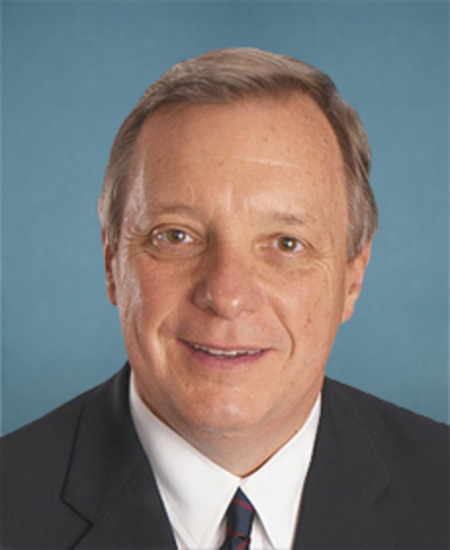
Sen. Richard J. Durbin
Sponsored bills
Protecting Employees and Retirees in Business Bankruptcies Act of 2025 This bill establishes limits on executive compensation and provides protections for employee wages and benefits if an employer files for Chapter 11 (reorganization) bankruptcy. First, the bill increases the limit on claims for wages, salaries, other employee benefits, and commissions from $10,000 to $20,000 and eliminates the requirement that such claims must have been earned within 180 days before the filing of the bankruptcy petition. The bill grants certain claims higher priority in the bankruptcy process, including specific types of severance pay; contributions to an employee benefit plan; back pay, civil penalties, or damages arising from certain labor law violations; and certain pension plan withdrawal liabilities. The bill also limits executive compensation under a reorganization plan. For example, insiders (parties with close relationships to the debtor), senior executives, and others as specified by the bill may only receive payments or other distributions that are generally applicable to all full-time employees, subject to certain limits. The bill further restricts the compensation of any insider who continues to be employed by the debtor. A reorganization plan may only be approved if it provides for the recovery of claims relating to retiree benefits or for other financial returns paid under the plan. The bill also provides protections for collective bargaining agreements (CBAs) during bankruptcy proceedings. If a proceeding resulting from a CBA was or could have been commenced before the bankruptcy, the bankruptcy does not act as a stay in such a proceeding.
Maddy summaryThe American Family Act creates a new monthly child tax credit that would provide $300 per month for each child under age 6 and $300 per month for each child age 6 and older, with income-based eligibility limits. The credit would be refundable, meaning it could be paid even if a family owes no income tax, and would replace the current annual child tax credit. The bill establishes income thresholds ($150,000 for joint filers) above which the credit begins to phase out, with full phase-out at $400,000 for joint filers. It also includes provisions for "presumptive eligibility" to allow for advance payments based on previous tax returns or government program data. The bill would terminate the existing annual child tax credit after 2024, replacing it with this monthly payment system.
Maddy summaryThe Raise the Wage Act of 2025 gradually increases the federal minimum wage from $9.50 to $17.00 per hour over six years, with future annual increases tied to median wage growth. It eliminates the separate lower minimum wage for tipped workers (currently $2.13/hour base), requiring employers to pay the full minimum wage to all tipped employees starting in 2031. The bill also ends the special $4.25/hour starting wage for workers under 20, phasing it out by 2030. Additionally, it prohibits new special wage certificates for disabled workers under Section 14(c) and requires their phaseout by 2030, while providing transition support for affected employers and workers.
Maddy summaryThe Public Service Freedom to Negotiate Act of 2025 establishes federal minimum standards for collective bargaining rights for public employees and supervisory employees. The Federal Labor Relations Authority will determine if states' laws "substantially provide" these rights, and if not, the federal standards will apply to affected workers. The bill guarantees rights like forming labor organizations, negotiating wages and working conditions, and resolving disputes through mediation or arbitration, while prohibiting strikes that would disrupt emergency services. Existing collective bargaining agreements and units are protected from the bill's implementation.
Maddy summaryThis Senate resolution (SRES 161) supports designating April 7-11, 2025, as "National Assistant Principals Week," as proposed by education organizations like the National Association of Secondary School Principals. It honors assistant principals for their roles in creating safe learning environments, supporting staff and students, and advancing school improvement efforts. The resolution encourages public recognition of their contributions through ceremonies and activities but does not create new laws or alter policies. It directly affects the education community by raising awareness of assistant principals' responsibilities in schools.
Maddy summaryThis resolution (SRES 159) is a ceremonial Senate measure honoring the late Senator John Bennett Johnston, Jr. (1932-2024), who represented Louisiana in the U.S. Senate from 1972 to 1997. It commemorates his career, including his work on energy policy, flood control, and Louisiana conservation efforts, and requests the Senate adjourn in his memory while sending condolences to his family. As a non-binding resolution, it has no policy impact or direct effect on any individuals or laws.
Maddy summaryS 1310, the No Tax Breaks for Union Busting (NTBUB) Act, denies tax deductions for employer spending aimed at influencing workers' decisions about union organizing or collective bargaining. It amends the tax code to block deductions for expenses like anti-union consultant fees, captive audience meetings, and other tactics that interfere with labor rights under the National Labor Relations Act. Employers must report such spending on tax returns with specific details, including dates, amounts, and whether activities relate to unfair labor practice charges. This directly affects businesses that engage in anti-union organizing tactics, removing a tax incentive for these activities while preserving deductions for standard union negotiations.
Maddy summaryS 1275, the Impact Aid Infrastructure Partnership Act, provides federal funding to help schools on federal lands improve their aging facilities. It targets federally impacted local educational agencies (those serving schools on federal property like Indian reservations or military bases) that struggle with poor building conditions and limited local funding capacity. The bill authorizes $250 million annually for four years to fund competitive emergency repairs for schools with health/safety hazards and formula grants for agencies with limited bonding capacity. Local matching requirements vary based on financial capacity, with some agencies required to contribute 10-25% of project costs depending on their ability to pay.
Maddy summaryThe American Innovation Act (S 1276) authorizes multi-year funding for key federal science and technology agencies, including the National Science Foundation, Department of Energy's Office of Science, Department of Defense science programs, National Institute of Standards and Technology, and NASA's Science Mission Directorate. It sets specific annual funding levels from fiscal years 2026 through 2035, with automatic annual increases starting in 2036 based on the Consumer Price Index to adjust for inflation. The bill also exempts these appropriations from automatic budget cuts (sequestration) under the Balanced Budget Act. This funding directly affects the operations and research capabilities of these federal agencies.