

Maddy summaryThis bill bans the commercial provision of conversion therapy - defined as paid attempts to change a person's sexual orientation or gender identity - as it is deemed ineffective and harmful. It directly affects therapists, clinics, and any commercial entity offering such services, while exempting gender transition support and non-discriminatory counseling. Key mechanisms include prohibiting paid conversion therapy, banning deceptive advertising (e.g., claiming it’s harmless), and empowering the Federal Trade Commission and state attorneys general to enforce penalties. The law focuses on preventing fraud by stopping profit-driven practices with no scientific basis, aligning with professional consensus on the risks.
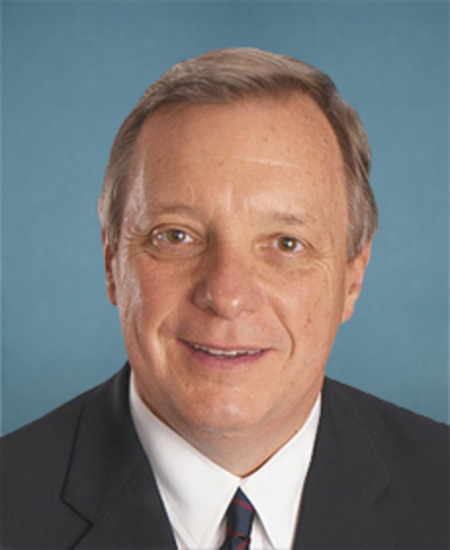
Sen. Richard J. Durbin
Sponsored bills
Maddy summaryThe TEST AI Act of 2025 establishes a pilot program to develop measurement standards for artificial intelligence (AI) systems used by federal agencies. It requires the National Institute of Standards and Technology (NIST) to create testbeds (controlled testing environments) and form a working group - including government, private sector, and academic representatives but excluding citizens of China, Russia, North Korea, and Iran - to define standards covering reliability, security, privacy, and bias in AI systems. Within two years, NIST must develop testbeds to demonstrate these standards, and after the first demonstration, submit a report to Congress detailing findings and recommendations. The bill aims to create consistent evaluation methods for federal AI use, ensuring systems are safe, effective, and secure.
Maddy summarySRES 201 is a non-binding Senate resolution designating the week of May 4-10, 2025, as "National Small Business Week." It honors small businesses and entrepreneurs across all U.S. communities for their economic contributions, citing that small businesses support over 59 million jobs. The resolution recognizes their resilience and celebrates their role in strengthening local economies. This symbolic gesture, consistent with annual presidential proclamations since 1963, does not create new laws or affect any specific group through policy changes.
Maddy summaryThis Senate resolution (SRES 204) symbolically recognizes global threats to press freedom, including violence against journalists in conflict zones and under authoritarian regimes. It reaffirms the U.S. government’s commitment to press freedom as a priority for promoting democracy and human rights, specifically commemorating World Press Freedom Day on May 3, 2025. The resolution does not create new laws or policies but expresses support for journalists worldwide and calls on the President and Secretary of State to advance press freedom efforts. It highlights documented risks like journalist killings (124 globally in 2024) and imprisonment (361 in 2024), emphasizing press freedom’s role in accountability and informed societies. As a non-binding resolution, it focuses on diplomatic reaffirmation rather than concrete legislative action.
Maddy summarySRES 202 is a Senate resolution recognizing April 2025 as "Community College Month" to celebrate the role of U.S. community colleges. It highlights how over 1,000 community colleges - serving 10.2 million students - support affordable higher education, workforce training, and economic growth, citing their $898 billion annual economic impact. The resolution has no binding effect; it is a symbolic acknowledgment intended to honor these institutions' contributions to education and prosperity.
Maddy summaryThe PREVAIL Act (S 1553) aims to improve the U.S. patent system by making patent review processes more efficient and fair. It requires 3-member panels for patent reviews at the Patent Trial and Appeal Board, establishes a code of conduct for board members, and prevents repetitive patent challenges by creating a "single forum" for patent validity disputes. The bill also clarifies who counts as a "real party in interest" to stop strategic filings, changes the burden of proof in patent reviews to require "clear and convincing evidence" for unpatentability, and ensures patent fees are properly used for patent-related activities through a new Innovation Promotion Fund. These changes directly affect patent owners, patent challengers, and the U.S. Patent and Trademark Office (USPTO).
Maddy summaryThis bill requires federal agencies planning layoffs to provide detailed justifications to Congress. It directly affects agencies implementing workforce reductions under specific federal rules, mandating they explain: (1) the reasons for layoffs, (2) impacts on employees and operations, (3) alternatives considered and rejected, (4) consultations with affected employees and their representatives, and (5) effects on veteran employees. The law amends existing review procedures to include these specific requirements before agencies can proceed with significant workforce changes. This applies to agency actions like layoffs or restructuring that materially impact staff.
Maddy summaryThis resolution (SRES 189) is a symbolic Senate measure expressing support for designating April 1-30, 2025, as "Fair Chance Jobs Month." It does not create new law but aims to raise awareness about employment barriers faced by people with criminal records, including systemic hiring restrictions and lack of access to licenses or stable jobs. The resolution urges efforts to dismantle these barriers, expand workforce programs for returning citizens, and promote fair-chance hiring practices. It directly affects formerly incarcerated individuals and employers seeking to hire them, focusing on policy changes like reducing licensing restrictions and connecting job seekers with opportunities.
Maddy summaryThis Senate resolution (SRES 193) designates April 2025 as "Financial Literacy Month" to raise public awareness about the importance of personal financial education and the consequences of financial illiteracy. It does not create new laws or directly affect specific groups; instead, it calls on federal, state, local, school, nonprofit, and business entities to observe the month with educational programs. The resolution cites statistics on unbanked households, student debt, and the benefits of financial education as context, but the only action taken is the symbolic designation. This is a procedural resolution with no binding requirements.
Maddy summaryThis bill strengthens enforcement of the Animal Welfare Act by giving the Attorney General new authority to sue violators and seek penalties up to $10,000 per day for ongoing violations. It requires dealers and exhibitors to hold valid licenses for animal sales or transport and allows seized animals to be taken by the government if they’re harmed by violations. Fines collected from violations will fund temporary care for animals during legal cases. The law directly affects animal dealers, exhibitors, and enforcement agencies (USDA and DOJ), clarifying that violations include breaches of related rules and regulations.