

Maddy summaryThis resolution (SRES 224) calls for urgent U.S. diplomatic action to address the severe humanitarian crisis in Gaza, where approximately 2.2 million civilians face acute hunger and malnutrition, including 10,000 children identified with acute malnutrition since January 2025. It highlights that Gaza’s borders have been blocked since March 2, 2025, preventing entry of food, medicine, and other lifesaving aid, leading to closed bakeries and exhausted food rations. The Senate resolution specifically urges the White House and State Department to use all available diplomatic tools to end the blockade, secure hostage releases, and achieve a durable conflict resolution. As a non-binding resolution, it does not enact law but formally expresses the Senate’s concern and directs executive branch action.
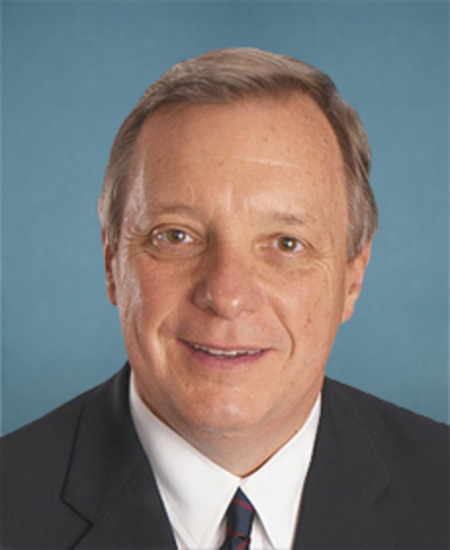
Sen. Richard J. Durbin
Sponsored bills
Maddy summarySRES 220 designates the week of May 11-17, 2025, as "National Police Week" to honor law enforcement officers across the United States. The resolution recognizes officers who have been killed, disabled, or injured in the line of duty, including 234 officers honored for 2024 fatalities and 18 officers killed in 2025. It expresses the Senate’s support for law enforcement, acknowledges the need for adequate resources for officer safety, and encourages public observance to celebrate their service and sacrifices. This is a ceremonial resolution with no new policy or funding changes.
Maddy summaryThis bill streamlines how conservation practice standards are developed and updated for U.S. agricultural programs. It requires the Secretary of Agriculture to establish a public, rolling review process for conservation standards every five years (replacing the previous annual requirement), prioritizing innovative technologies like precision agriculture and nutrient-efficient farming methods. Farmers, state agricultural agencies, and the public will gain clearer pathways to submit new conservation practices for consideration and provide input during reviews. The bill also mandates publishing all proposed changes, public comments, and final decisions online to improve transparency.
Maddy summaryThis bill amends the Fair Labor Standards Act to prohibit children under 18 from having direct contact with tobacco plants or dried tobacco leaves on farms. It directly affects minors working in tobacco agriculture by adding this restriction to existing labor protections. The key change modifies the law to explicitly exclude tobacco-related farming from exemptions that previously allowed minors in certain manufacturing or mining roles. This creates a clear policy change banning underage labor in direct tobacco handling on farms.
Maddy summaryThe RETAIN Act creates a refundable tax credit for educators in high-need schools, including early childhood educators, teachers, school leaders, and school-based mental health providers. The credit amount increases with years of continuous service, ranging from $5,800 for the first two years to $11,600 after 10 years of service. It is refundable (meaning it pays out even if no income tax is owed) and applies to those working in qualifying schools serving high-poverty areas or meeting Title I eligibility criteria. The credit aims to address retention challenges by rewarding long-term service in under-resourced educational settings.
Maddy summaryThe Neighborhood Homes Investment Act creates a new tax credit to increase affordable homeownership in distressed communities by closing financing gaps. It allows developers to claim a credit equal to the difference between development costs and affordable sale prices, capped at 40% of development costs or 32% of the national median home price. To qualify, homes must be sold to individuals with incomes at or below 140% of area median income in designated distressed census tracts, with specific requirements for rehabilitation and affordability. The credit is designed to address housing shortages in low-income areas while requiring repayment if homes are resold within five years.
Maddy summaryS 1668 prohibits senior U.S. government officials - including the President, Vice President, Members of Congress, and Senate-confirmed appointees - from issuing, sponsoring, or endorsing cryptocurrencies, tokens, or stablecoins for profit. It also bans acquiring similar financial interests through derivatives or investment funds, while allowing normal public market trading. Violations face civil penalties of up to 10% of the financial interest's value or profits gained, and criminal charges if losses exceed $1 million or personal financial gain occurs. The law applies during official service and for one year after leaving office.
Maddy summaryThis bill bans the commercial provision of conversion therapy - defined as paid attempts to change a person's sexual orientation or gender identity - as it is deemed ineffective and harmful. It directly affects therapists, clinics, and any commercial entity offering such services, while exempting gender transition support and non-discriminatory counseling. Key mechanisms include prohibiting paid conversion therapy, banning deceptive advertising (e.g., claiming it’s harmless), and empowering the Federal Trade Commission and state attorneys general to enforce penalties. The law focuses on preventing fraud by stopping profit-driven practices with no scientific basis, aligning with professional consensus on the risks.
Maddy summaryThe TEST AI Act of 2025 establishes a pilot program to develop measurement standards for artificial intelligence (AI) systems used by federal agencies. It requires the National Institute of Standards and Technology (NIST) to create testbeds (controlled testing environments) and form a working group - including government, private sector, and academic representatives but excluding citizens of China, Russia, North Korea, and Iran - to define standards covering reliability, security, privacy, and bias in AI systems. Within two years, NIST must develop testbeds to demonstrate these standards, and after the first demonstration, submit a report to Congress detailing findings and recommendations. The bill aims to create consistent evaluation methods for federal AI use, ensuring systems are safe, effective, and secure.
Maddy summarySRES 201 is a non-binding Senate resolution designating the week of May 4-10, 2025, as "National Small Business Week." It honors small businesses and entrepreneurs across all U.S. communities for their economic contributions, citing that small businesses support over 59 million jobs. The resolution recognizes their resilience and celebrates their role in strengthening local economies. This symbolic gesture, consistent with annual presidential proclamations since 1963, does not create new laws or affect any specific group through policy changes.