

This resolution establishes the Senate Human Rights Commission to (1) serve as a forum for bipartisan discussion of international human rights issues and promotion of internationally recognized human rights as enshrined in the Universal Declaration of Human Rights; (2) raise awareness of international human rights violations through regular briefings and hearings; and (3) collaborate with congressional entities, the executive branch, human rights entities, and nongovernmental organizations to promote human rights initiatives within the Senate. In addition, the resolution prohibits the commission from (1) having legislative jurisdiction; (2) having authority to take legislative action on any bill or resolution; or (3) encroaching upon the jurisdiction of any standing, select, or special committee of the Senate.
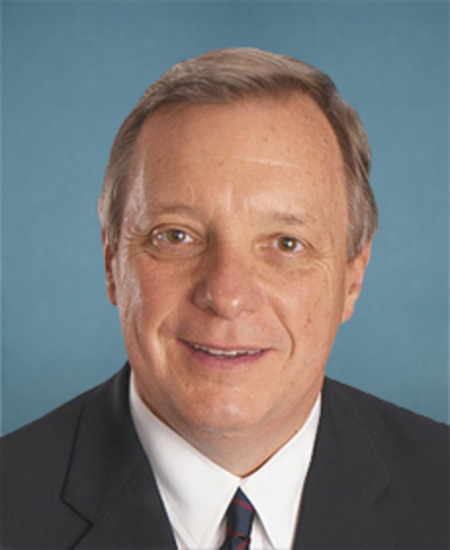
Sen. Richard J. Durbin
Sponsored bills
This resolution supports the designation of February 20-February 27, 2021, as National FFA Week. It also (1) recognizes the important role of the National FFA Organization (Future Farmers of America) in developing the next generation of leaders who will change the world, and (2) celebrates 50 years of National FFA alumni and supporters.
This bill requires the Joint Committee on the Library to obtain, and the Architect of the Capitol to permanently install in the U.S. Capitol or on the U.S. Capitol Grounds, a monument honoring Associate Justice of the Supreme Court Ruth Bader Ginsburg.
Unemployment Insurance Technology Modernization Act of 2021 This bill requires the Department of Labor to study and report on the technology needs of federal and state unemployment compensation programs. Based on this study, Labor must develop, operate, and maintain a modular set of technology capabilities to modernize the delivery of unemployment compensation. Before the deployment of the technology capabilities to all states, Labor must select at least four states to participate in a pilot program to test the technology capabilities and demonstrate that they meet requirements. The bill establishes accessibility requirements for filing online unemployment compensation claims. In addition, it prohibits the technology capabilities from relying solely on a high-risk automated decision system to (1) deny a claim for unemployment compensation, (2) reduce the amount of unemployment compensation for which a claimant is eligible, or (3) deny a claimant's right to appeal an unemployment compensation decision.
Forced Arbitration Injustice Repeal Act This bill prohibits a predispute arbitration agreement from being valid or enforceable if it requires arbitration of an employment, consumer, antitrust, or civil rights dispute.
This concurrent resolution (1) affirms, on the 400th anniversary of the arrival of the first slave ship, that the nation owes a debt of remembrance not only to those who lived through the injustices of slavery but also to their descendants; and (2) urges the establishment of a U.S. Commission on Truth, Racial Healing, and Transformation to properly acknowledge, memorialize, and be a catalyst for progress, including toward permanently eliminating persistent racial inequities.
This resolution designates the week of February 22-February 26, 2021, as Public Schools Week.
Stop Tip-overs of Unstable, Risky Dressers on Youth Act or the STURDY Act This bill requires the Consumer Product Safety Commission to revise the safety standards for freestanding clothing storage units such as dressers, bureaus, or chests of drawers. Such standards must include specified testing related to tip overs and new warning requirements for all such products entering the U.S. market.
Rebuild Rural America Act of 2021 This bill directs the Department of Agriculture (USDA) to establish the Rural Innovation and Partnership Administration and the Rural Future Partnership Fund to provide five-year renewable rural partnership block grants to certified rural regions to implement locally-developed regional revitalization plans. For purposes of these grants, the following areas may constitute a rural region: a micropolitan statistical area (i.e., at least 10,000 but fewer than 50,000 people); a collection of rural census tracts or counties that fall outside of a micropolitan or metropolitan statistical area (i.e., 50,000 people or more) and that demonstrate evidence of economic, social, and cultural cooperation; or an Indian reservation. To be eligible to receive a grant, a rural region must be certified by its state (or in the case of an Indian reservation, approved by USDA) after having formed a rural partnership council made up of representatives from across different sectors. USDA must provide each rural partnership council with training, education, support, and advice to enhance the technical assistance, research, organizational, and other capacities of the council. The bill also establishes a Rural Future Corps to (1) help rural communities expand critical services such as child care, health, nutrition assistance, education, and job training; and (2) strengthen the capacity of local governments and economic and community development organizations.
COVID-19 Bankruptcy Relief Extension Act of 2021 This bill extends existing provisions that provide relief to debtors in bankruptcy, including those related to the COVID-19 (i.e., coronavirus disease 2019) pandemic. These provisions (1) exclude certain COVID-19 aid payments from income for the purposes of bankruptcy, and (2) increase the debt eligibility threshold for businesses qualifying for certain types of Chapter 11 reorganization bankruptcy. Currently, these provisions expire March 27, 2021. The bill extends these provisions for one year. The bill also allows for modification of a Chapter 13 repayment plan for plans confirmed before the date of enactment of this bill if the debtor is experiencing material financial hardship due to COVID-19. Currently, such a modification is only available for plans confirmed before March 27, 2020. In addition, the bill extends through March 27, 2022, other bankruptcy protections that currently expire December 27, 2021. These provisions include those that (1) provide for discharge of certain debts, (2) prohibit denying a party COVID-related mortgage or eviction relief due to a party being a debtor in bankruptcy, and (3) protect against termination of utility services in certain circumstances.