

Climate Change Education Act This bill declares that the evidence for human-induced climate change is overwhelming and undeniable. The National Oceanic and Atmospheric Administration (NOAA) must establish a Climate Change Education Program to increase the climate literacy of the United States by broadening the understanding of human-induced climate change, including possible consequences, disproportionate impacts of such consequences, and potential solutions; apply the latest scientific and technological discoveries to provide learning opportunities to people of all ages; and help people understand and promote implementation of new technologies, programs, and incentives related to climate change, climate adaptation and mitigation, climate resilience, climate justice, and environmental justice. NOAA must also establish a grant program for climate change education.
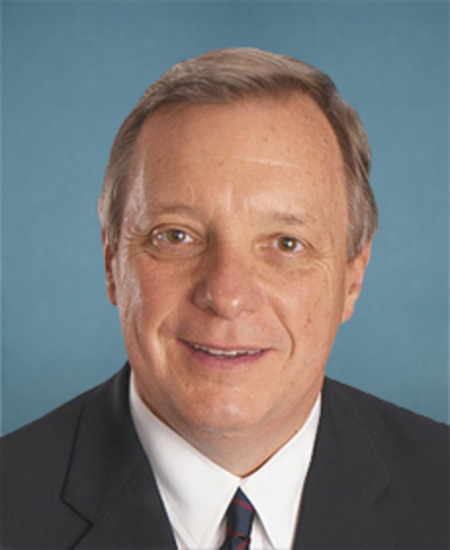
Sen. Richard J. Durbin
Sponsored bills
Korematsu-Takai Civil Liberties Protection Act of 2021 This bill modifies the detention authority of the United States. Specifically, it prohibits detention or imprisonment based solely on an actual or perceived protected characteristic of an individual. A protected characteristic includes each of the following: race, ethnicity, national origin, religion, sex, gender identity, sexual orientation, disability, and any additional characteristic that the Department of Justice determines to be a protected characteristic.
Smarter Sentencing Act of 2021 This bill reduces statutory mandatory minimum penalties for certain drug offenses, requires reporting on the impact of cost savings from the reductions, and establishes a public database of federal criminal offenses. First, the bill reduces statutory mandatory minimum penalties for two types of offenders: (1) individuals who manufacture, distribute, or possess with intent to distribute a controlled substance; and (2) couriers who import or export a controlled substance. Second, the bill requires the Department of Justice (DOJ) to report on how the reduced expenditures on federal corrections and cost savings from the reductions in mandatory minimum sentences help to reduce overcrowding in federal prisons, increase investment in law enforcement and crime prevention, and reduce recidivism. Third, the bill requires DOJ and federal agencies to report on and create public databases of all criminal offenses—criminal statutory offenses and criminal regulatory offenses.
Help Students Vote Act This bill addresses voter registration of students who attend institutions of higher education (IHEs) that participate in federal student-aid programs. The bill also directs IHEs to use a specified portion of federal work-study grants to compensate students for civic engagement activities. Specifically, the bill (1) requires IHEs to make every reasonable effort to distribute voter registration applications to each of their students at least twice a year, (2) authorizes grants to IHEs that greatly exceed the requirements governing the distribution of voter registration applications, and (3) allows civil actions against IHEs that violate the requirements. In addition, the bill requires IHEs to use a specified portion of federal work-study grants to compensate students who are employed in civic engagement activities, including voter registration, nonpartisan voter engagement, and voter participation work.
Break Free From Plastic Pollution Act of 2021 This bill sets forth requirements and incentives to reduce the production of a variety of products and materials, including plastics, and increase efforts to collect, recycle, or compost products and materials. The bill makes certain producers of products (e.g., packaging, paper, single-use products, beverage containers, or food service products) fiscally responsible for collecting, managing, and recycling or composting the products after consumer use. In addition, the bill establishes (1) minimum percentages of products that must be reused, recycled, or composted; and (2) an increasing percentage of recycled content that must be contained in beverage containers. Beginning on January 1, 2023, the bill phases out a variety of single-use products, such as plastic utensils. The bill also sets forth provisions to encourage the reduction of single-use products, including by establishing programs to refund consumers for returning beverage containers and by establishing a tax on carryout bags. The bill creates a temporary moratorium on new or expanded permits for certain facilities that manufacture plastics until regulations are updated to address pollution from the facilities. The Environmental Protection Agency (EPA) must publish guidelines for a national standardized labeling system for recycling and composting receptacles. Producers must include labels on their products that are easy to read and indicate whether the products are recyclable, compostable, or reusable. The EPA must also ensure that certain clothes washers have filtration units as required by this bill. Finally, the bill establishes limitations on the export of plastic waste to other countries.
Japanese American Confinement Education Act This bill establishes a museum program on the historical importance of Japanese American confinement during World War II and permanently reauthorizes the Japanese American Confinement Sites preservation program. The bill directs the Department of the Interior to establish a program of grants to a Japanese American museum to educate individuals in the United States on the historical importance of such confinement and the commitment of the United States to equal justice.
This bill requires the Joint Committee on the Library to enter into an agreement to obtain a statue of Shirley Chisholm, the first African American woman elected to Congress. The committee shall place the statue in a permanent public location in the U.S. Capitol.
Computer and Internet Access Equity Act This bill increases broadband service support for low-income consumers, establishes a grant program to provide internet safety education or training, and provides a tax credit for certain computer and education costs. Specifically, the bill modifies the broadband service support program known as Lifeline, which assists low-income consumers with access to telecommunications and broadband services, to (1) increase the amount of the payments that a provider of Lifeline services may receive for each low-income consumer to whom the provider supplies such services, (2) allow consumers with higher incomes to qualify for participation in the program, and (3) allow a broadband service provider to receive Lifeline support for providing such service to a low-income consumer without being designated as an eligible telecommunications carrier. The bill also requires the Federal Communications Commission to establish a grant program to develop and implement internet education and training programs for low-income individuals. Further, the bill provides a refundable tax credit, not to exceed $2,000 ($4,000 in the case of a joint return) in a taxable year or $10,000 in a lifetime ($20,000 in the case of a joint return), for amounts paid or incurred for computers, printers, and other education-related technology. The Department of the Treasury must establish a program for making advance payments of such credit to eligible individuals.
Carbon Capture, Utilization, and Storage Tax Credit Amendments Act of 2021 This bill extends the carbon oxide sequestration tax credit through 2030. It also permits taxpayers to elect to receive a payment in lieu of the tax credits for carbon oxide sequestration and qualifying advanced coal projects. The bill also makes other modifications to certain carbon sequestration credits, including (1) an allowance of carbon sequestration credits against the base erosion minimum tax, (2) modifications to sequestration requirements for certain qualifying advanced coal project credit equipment, and (3) increasing the sequestration credit value for direct air capture projects.
This bill makes changes to facilitate data sharing between the Supplemental Nutrition Assistance Program (SNAP) and programs that subsidize communication services to verify eligibility for applicable programs. Specifically, the Federal Communications Commission (FCC) must award grants to states and tribes for establishing or modifying connections between databases with information regarding benefit programs (e.g., SNAP) and the National Lifeline Eligibility Verifier to verify eligibility for the Lifeline program (which subsidizes telephone and internet services for low-income individuals) and the Emergency Broadband Benefit Program (which subsidizes broadband services for those who suffered income loss during the COVID-19 pandemic and other eligible households). The bill also reauthorizes through FY2026 the fund that supports the Emergency Broadband Benefit Program. In addition, the FCC must establish an automated connection to share data between the National Lifeline Eligibility Verifier and the National Accuracy Clearinghouse for SNAP. The FCC must coordinate with the Department of Agriculture to establish the connection.