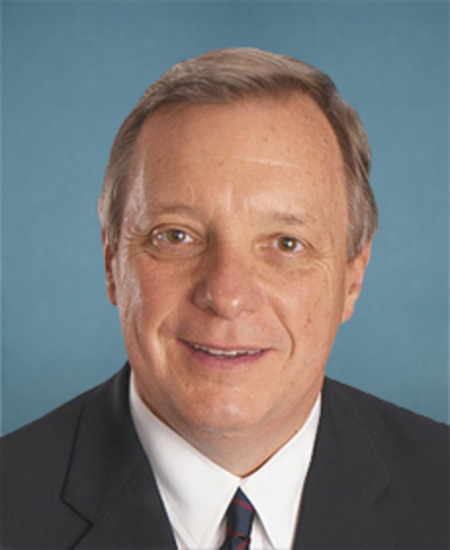
This bill provides for the award of Congressional Gold Medals posthumously to Glen Doherty, Tyrone Woods, J. Christopher Stevens, and Sean Smith (four Americans who were killed in the September 11, 2012, attack on the U.S. consulate in Benghazi, Libya) in recognition of their contributions to the nation.
Sen. Richard J. Durbin
Sponsored bills
Toxic Exposure in the American Military Act or the TEAM Act This bill requires the Department of Veterans Affairs (VA) to expand health care, benefits, and resources for veterans with conditions related to exposure to toxic substances. Specifically, the bill expands eligibility for VA hospital care, medical services, and nursing home care to include veterans who (1) were exposed to toxic substances, radiation, or other conditions, and were awarded certain medals (e.g., the Armed Forces Service Medal); (2) are eligible for inclusion in the Airborne Hazards and Open Burn Pit Registry; or (3) have been identified by the Department of Defense to have been possibly exposed during service to an open burn pit, toxic substance, or specified hazardous sites. (A burn pit is an area used for burning solid waste in open air without equipment.) The bill establishes a presumption of service-connection for diseases associated with exposure to certain toxic substances and that become manifest within a certain time period; the VA must specify such diseases and requirements through regulations. Under a presumption of service-connection, specific conditions diagnosed in certain veterans are presumed to have been caused by the circumstances of their military service. Health care benefits and disability compensation may then be awarded. The bill also requires the VA to take specified actions to (1) evaluate scientific evidence regarding associations between diseases and exposure to toxic substances; (2) train its health care personnel on identifying, treating, and assessing illnesses related to such exposure; and (3) provide resources to veterans exposed to toxic substances.
Fair Care for Vietnam Veterans Act of 2021 This bill provides a presumption of service-connection for hypertension and monoclonal gammopathy of undetermined significance (MGUS) for veterans who served in Vietnam between January 9, 1962, and May 7, 1975. Under a presumption of service-connection, specific conditions diagnosed in certain veterans are presumed to have been caused by the circumstances of their military service. Health care benefits and disability compensation may then be awarded.
Veterans Burn Pits Exposure Recognition Act of 2021 This bill requires the Department of Veterans Affairs (VA) to concede, for the purposes of health care benefits and wartime disability compensation, that a veteran was exposed to certain toxic substances, chemicals, and hazards from burn pits if such veteran served on active duty in a covered location during a specified time frame (unless there is affirmative evidence to establish that the veteran was not exposed during such service). A burn pit is an area used for burning solid waste in open air without equipment. Specifically, the bill covers the following locations and corresponding time periods: Iraq between August 2, 1990, and February 28, 1991, as well as from March 19, 2003, until burn pits are no longer used in this location; Southwest Asia (including Kuwait, Saudi Arabia, Oman, and Qatar) from August 2, 1990, until burn pits are no longer used in these locations; and Afghanistan, Syria, Jordan, Egypt, Lebanon, Yemen, and Djibouti from September 11, 2001, until burn pits are no longer used in these locations. Under the bill, if an exposed veteran submits insufficient evidence to establish a service-connection for purposes of disability compensation, the VA shall provide a medical examination and request a medical opinion regarding a causal link between the disability and a toxin, chemical, or hazard.

Puppy Protection Act of 2021 This bill requires the Department of Agriculture to expand standards that govern the humane handling, care, treatment, and transportation of animals to include new requirements for commercial dog dealers. Specifically, the standards must require dog dealers to provide to dogs adequate housing, exercise, and veterinary care; appropriate and nutritious food; continuous access to potable water; and meaningful socialization with humans and compatible dogs for at least 30 minutes each day. The standards must also include requirements for breeders to use safe breeding practices and make all reasonable efforts to find humane placement for retired breeding dogs.
Protecting Roadside First Responders Act This bill addresses transportation matters relating to Move Over laws and crash avoidance technology. Move Over laws are intended to ensure first responder and motorist safety by requiring motorists to change lanes or slow down when approaching an authorized emergency vehicle that is parked or otherwise stopped on a roadway. Specifically, the bill requires the Department of Transportation (DOT) to contract with the National Academies of Sciences, Engineering, and Medicine to produce research findings on the efficacy of Move Over laws and related public awareness campaigns; DOT to award grants to states to prevent death and injury from crashes involving vehicles striking vehicles and individuals stopped at the roadside; DOT to implement rules to establish minimum performance standards with respect to crash avoidance technology and to require mandating crash avoidance technology on all new passenger and commercial motor vehicles; and all federal fleet vehicles to have crash avoidance technology and, if such vehicles are used for emergency response activities, be equipped with digital alert technology.
America's College Promise Act of 2021 This bill provides funding and establishes grant programs to expand access to higher education, including by providing free community college to students. Specifically, the bill establishes a program to waive resident tuition and fees for community college students. The Department of Education (ED) must award grants to states and Indian tribes to pay the federal share (75% of the average resident community college tuition and fees per student) of the program. As a condition of receiving such a grant, a state must (1) submit a plan to align the requirements for receiving a regular high school diploma with the requirements for entering credit-bearing coursework at community colleges; and (2) submit a plan to improve transfer pathways between institutions of higher education (IHEs), including by ensuring that associate degrees awarded by community colleges are fully transferable to four-year IHEs. Next, the bill directs ED to award grants to states and Indian tribes for implementing evidence-based institutional reforms and innovative practices to improve student outcomes. In addition, ED must award grants to participating historically Black colleges and universities, tribal colleges and universities, and minority-serving institutions to waive or significantly reduce the first 60 credits of tuition and fees for low-income students.
Restore Employment in Natural and Environmental Work Conservation Corps Act or the RENEW Conservation Corps Act This bill establishes the Restore Employment in Natural and Environmental Work Conservation Corps program within the Department of the Interior and Department of Agriculture under which participants must implement eligible projects (e.g., planting trees or controlling invasive species).
America Grows Act of 2021 This bill permanently funds several agencies that perform agriculture research. The bill provides specified funding for the following agencies within the Department of Agriculture: the Agricultural Research Service, the Economic Research Service, the National Agricultural Statistics Service, and the National Institute of Food and Agriculture. The bill exempts the funding from sequestration, which is a process of automatic, usually across-the-board spending reductions under which budgetary resources are permanently cancelled to enforce specific budget policy goals. It also exempts the budgetary effects of the funding from the Statutory Pay-As-You-Go Act of 2010 (PAYGO) and the Senate PAYGO rule.
Ukraine Security Partnership Act of 2021 This bill contains provisions related to U.S. support for Ukraine. From FY2022-FY2026, the Department of State is authorized to (1) provide grants and loans to Ukraine for acquiring U.S. defense equipment and services through the Foreign Military Financing program, and (2) provide training for Ukraine's military through the International Military Education and Training program. During this period, Ukraine shall have priority access to excess U.S. defense articles. During this period, the State Department may also engage in certain activities in Ukraine to (1) strengthen cybersecurity and intellectual property enforcement, (2) provide support and training for certain economic reforms and the privatization of state-owned enterprises, (3) combat corruption and strengthen the rule of law, (4) respond to humanitarian crises caused by Russia's invasion of Ukraine, (5) improve participatory legislative processes, and (6) build civil society and independent media capacity. The State Department shall report to Congress a strategy on (1) using diplomacy to support Ukraine, and (2) encouraging other countries to donate excess defense equipment to Ukraine. The President shall report to Congress a determination as to whether certain vessels and entities, including the project company behind the Nord Stream 2 pipeline, meet the criteria to be subject to sanctions. (The Nord Stream 2 is a pipeline project that would bring natural gas from Russia to Europe.)