

This resolution congratulates the University of Georgia Bulldogs football team for an incredible season and winning the 2023 National Collegiate Athletic Association College Football National Championship.
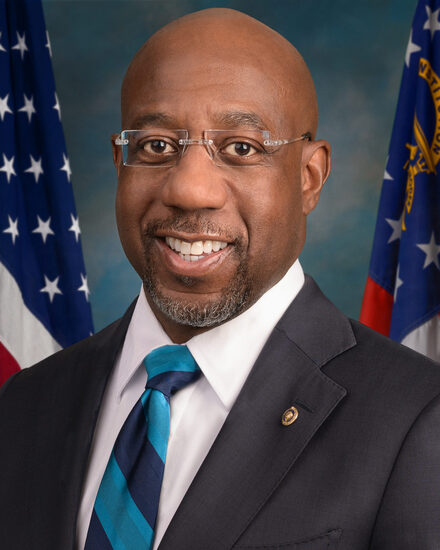
Sen. Raphael G. Warnock
Sponsored bills
Maddy summaryThe Defending Domestic Orange Juice Production Act of 2023 requires pasteurized orange juice sold in the United States to contain at least 10% natural orange solids by weight (excluding any added sweeteners). This standard directly affects domestic orange juice manufacturers, who must reformulate products to meet this minimum content requirement. The bill preserves the Secretary of Health and Human Services' authority to adjust the standard through future regulations. This change establishes a concrete minimum for orange juice content in processed products.
Maddy summaryThe Justice for Black Farmers Act of 2023 would establish a program to provide land grants to eligible Black farmers and ranchers, purchasing land to convey at no cost (up to 160 acres per grant) with priority given to those with farming experience, family history of land dispossession, or military service. It would create an independent Civil Rights Oversight Board within USDA to review discrimination complaints, establish an Equity Commission to study historical discrimination against Black farmers, and require data collection on racial and gender disparities in USDA programs. The bill would provide additional credit assistance including zero-interest operating loans for the first 7 years, establish a National Socially Disadvantaged Farmer and Rancher Bank to provide financing specifically for Black farmers, and include a foreclosure moratorium for farmers with active civil rights complaints. The legislation also includes provisions to improve access to conservation programs and reform livestock purchasing practices under the Packers and Stockyards Act.
Maddy summaryThe Better Care Better Jobs Act (S 100) aims to improve access to home and community-based services (HCBS) for Medicaid beneficiaries by providing federal funding to states for developing improvement plans and implementing an HCBS Infrastructure Improvement Program. The bill offers enhanced federal funding (a 10 percentage point increase in Medicaid matching rates) to states that meet requirements including maintaining or expanding HCBS access, improving direct care worker wages and training, and implementing quality measurement systems. States must develop detailed plans assessing current HCBS availability, workforce conditions, and barriers to access, and then report annually on progress toward specific benchmarks. The bill also makes permanent certain Medicaid provisions related to spousal impoverishment protection and extends the Money Follows the Person program, directly affecting Medicaid beneficiaries and direct care workers.
Maddy summaryThis bill changes tax treatment for certain payments received by farmers and ranchers. It excludes specific payments made under the American Rescue Plan Act (like those in sections 1006(e) and 22006) from being counted as taxable income. The law also prevents these excluded payments from reducing tax deductions, tax attributes, or basis adjustments. For partnerships and S corporations receiving such payments, the excluded amount is treated as tax-exempt income, and basis increases are tied directly to the partner's share of the payment's interest and principal components.
Maddy summaryThis bill would admit Washington, D.C. as the 51st state, officially named "State of Washington, Douglass Commonwealth," granting it full representation in Congress with two Senators and one Representative. It would establish a "Capital" area within the new state that remains under federal jurisdiction, including the White House, Capitol Building, and other key government properties. The bill would repeal the District of Columbia's congressional delegate position and the 23rd Amendment, which currently provides D.C. with electoral votes in presidential elections. It would also provide for the transition of federal properties, courts, and government functions while maintaining federal control over the Capital area.
Maddy summaryThis bill establishes a 13-member commission to study the history of slavery in the U.S. and its ongoing effects on African Americans. The commission will examine slavery from 1619 to 1865, post-emancipation discrimination (including Jim Crow, redlining, and educational inequity), and current disparities in wealth, incarceration, and health. It will compile evidence and recommend potential remedies to Congress, including educational initiatives and frameworks for compensation, but does not authorize any reparations payments. The commission must submit its findings within one year of its first meeting.
Maddy summaryThis bill would ban the sale, manufacture, transfer, and possession of most semiautomatic rifles, pistols, and shotguns meeting specific criteria defined as "assault weapons," as well as large capacity ammunition magazines holding more than 10 rounds. The ban would not apply to weapons already owned before enactment, or to certain types like bolt-action rifles, antique firearms, or weapons used by law enforcement. The bill would require identification markings on new assault weapons and magazines, require background checks for transfers of "grandfathered" weapons, and authorize federal buy-back programs for banned weapons through Byrne grants. It includes exemptions for military, law enforcement, and certain historical firearms.
Emmett Till and Mamie Till-Mobley Congressional Gold Medal Act of 2021 This act provides for the posthumous presentation of a Congressional Gold Medal in commemoration of Emmett Till and Mamie Till-Mobley. After it is awarded, the medal shall be given to the National Museum of African American History and Culture.
Law Enforcement De-Escalation Training Act of 2022 This act directs the Department of Justice (DOJ) to develop scenario-based training curricula (or identify existing curricula) that includes topics such as alternatives to the use of force, de-escalation tactics, and safely responding to an individual experiencing a mental, behavioral health, or suicidal crisis. The act also directs DOJ to make grants to states for costs associated with providing the training to law enforcement officers or mental health professionals.