

Maddy summaryS.1135, the "Ally’s Act," requires most private health insurance plans to cover hearing implants and related services for people with hearing loss. It mandates coverage for cochlear implants, bone conduction devices, maintenance, repairs, surgical procedures, hearing assessments, and rehabilitation - without separate cost-sharing or medical necessity reviews. The law applies to group health plans, individual insurance, and employer-sponsored plans, affecting insurers and individuals diagnosed with hearing loss by a physician or audiologist. Coverage must meet the same financial and treatment standards as other medical services, with full implementation required by 2025.
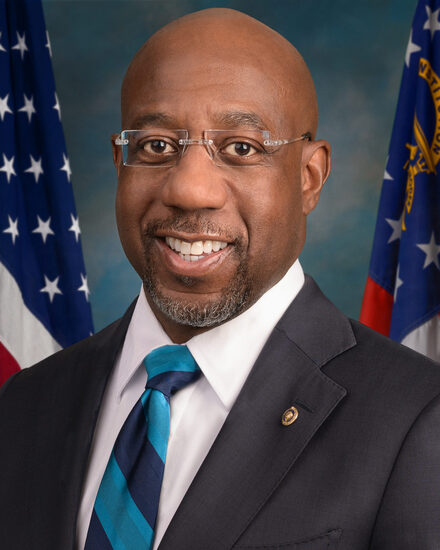
Sen. Raphael G. Warnock
Sponsored bills
Maddy summarySenate Bill 1036, the Senior Hunger Prevention Act of 2023, aims to improve nutrition assistance access for seniors (60+) and people with disabilities by amending the Food and Nutrition Act. Key provisions include extending SNAP certification periods from 24 to 36 months, establishing a standardized medical expense deduction starting at $155 for fiscal year 2024 (adjusted annually), and creating simplified application programs (ESAP and CAP) to reduce administrative barriers for eligible households. The bill also funds a pilot program for outreach and enrollment targeting older adults, kinship families, and adults with disabilities, and expands food delivery services for eligible participants. Additional provisions increase funding for the Commodity Supplemental Food Program and Seniors Farmers' Market Nutrition Program.
Maddy summaryThe Truck Parking Safety Improvement Act creates a federal grant program to fund public parking facilities for commercial trucks along highways and near freight facilities. It authorizes $175 million for fiscal year 2024, increasing to $320 million by 2026, to address parking shortages that impact driver safety and traffic flow. Eligible projects include building rest areas, expanding parking at truck stops or ports, and improving existing facilities, all requiring free public access and no fees for drivers. The program mandates stakeholder input from trucking companies and safety officials, with annual reports to Congress on project effectiveness and parking availability.
Maddy summaryThis bill establishes a federal "National Parkinson’s Project" under the Department of Health and Human Services to coordinate efforts across agencies in preventing, treating, and curing Parkinson’s disease and related conditions. It requires an integrated national plan, annual progress assessments, and a public Advisory Council - including patient advocates, researchers, and healthcare providers - to guide strategy and recommend actions. The project mandates data sharing among federal agencies and biannual reports to Congress evaluating federally funded Parkinson’s programs, aiming to improve care coordination, reduce financial burdens on Medicare and families, and advance research on environmental triggers. The law directly affects people living with Parkinson’s, their caregivers, and federal health agencies involved in research and patient services. The initiative is scheduled to sunset in 2035.
This resolution designates March 2023 as National Women's History Month. The resolution also recognizes the celebration of such month as a time to reflect on the contributions that women have made to the United States.
Maddy summaryThis bill repeals upfront origination fees for new Federal Direct student loans. It directly affects borrowers who take out these loans after March 27, 2022, by eliminating the initial fee charged when the loan is issued. The key provision removes section 455(c) of the Higher Education Act, which previously required these fees for loans under part D of title IV. The change applies to all new direct loans disbursed or consolidation applications received on or after the effective date, meaning borrowers no longer pay this specific fee.
Maddy summaryThis bill expands Medicaid coverage to people in jail awaiting trial or court proceedings, allowing states to provide medical benefits during pretrial detention. It amends federal law to remove a barrier preventing Medicaid access for incarcerated individuals while their cases are pending. States receiving $50 million in planning grants must develop strategies to recruit healthcare providers, assess inmate health needs, and build infrastructure for seamless care transitions. The policy directly affects individuals in local jails awaiting court dates who qualify for Medicaid under state programs.
Maddy summaryThis bill amends the National Quantum Initiative Act to explicitly include "quantum molecular modeling or simulation" within the definition of quantum information science and as a specific research focus for federal programs. It directly affects the federal quantum research agenda by directing the National Institute of Standards and Technology (NIST) to prioritize this specific application area. The key change is adding "modeling, simulation" to the definition and creating a new research category (H) under the program, ensuring federal funding and coordination target this emerging field.
Maddy summaryThis bill amends the federal Food and Nutrition Act to allow Puerto Rico to transition from its current nutrition assistance system to the Supplemental Nutrition Assistance Program (SNAP), which provides federal benefits to low-income households. It requires Puerto Rico to submit a transition plan to the U.S. Department of Agriculture within 60 days, with the agency having 180 days to approve it. Puerto Rico would operate under a 5-year transition period from its existing block grant system, during which the federal government must provide technical assistance and annual reporting. The bill directly affects Puerto Rico residents eligible for nutrition assistance and modifies federal funding formulas to support this transition.
Maddy summaryS 940, the Rural America Health Corps Act, creates a federal loan repayment program for health professionals working in rural areas. It directly affects eligible health professionals (such as doctors or nurses) who qualify for the existing Public Health Service Act loan program but aren't currently enrolled, requiring them to commit to five years of full-time work in designated rural health professional shortage areas. Key provisions include the Secretary of Health and Human Services paying up to $200,000 toward eligible loans over five years, with payments tied to each year of service completed. The program is funded at $50 million annually for fiscal years 2024-2028 and requires a report evaluating its impact on rural healthcare access after five years.