

Maddy summaryThe Retirement Savings for Americans Act of 2023 creates a new retirement savings program for workers who don't have access to an employer-sponsored retirement plan with automatic enrollment. The program automatically enrolls eligible workers at 3% of their pay, with the government matching up to 100% of the first 3% contributed. Workers can choose from investment options including government securities, fixed income, and stock index funds. The program is managed by a new Investment Board with fiduciary responsibilities to protect participants' savings and is funded through participant contributions and government matching credits.
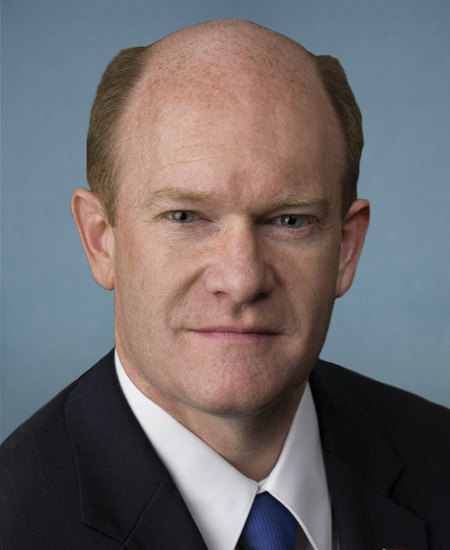
Sen. Christopher A. Coons
Sponsored bills
Maddy summaryThis resolution designates October 8, 2023, as "National Hydrogen and Fuel Cell Day" in the U.S. Senate. It is a symbolic recognition, not a law with policy changes or direct effects on any individuals or entities. The resolution cites hydrogen's abundance, historical role in space exploration, and potential for clean energy applications like transportation and grid support. It does not create new regulations, funding, or obligations. As a ceremonial resolution, it serves solely to highlight the importance of hydrogen and fuel cell technologies.
Maddy summaryS. Res. 406 is a Senate resolution honoring the late Richard Clarence Clark, a former U.S. Senator from Iowa (served 1973-1979), who died in 2023. The resolution expresses the Senate’s sorrow at his passing, requests that the House of Representatives and Clark’s family be informed, and directs the Senate to adjourn for the day as a mark of respect. This is a purely commemorative measure with no policy or legal effect, reflecting the Senate’s collective tribute to a former member.
Maddy summaryThe Fair Day in Court for Kids Act of 2023 requires the federal government to provide legal counsel at no cost to unaccompanied children (defined as children under 18 not accompanied by a parent or legal guardian) in immigration removal proceedings. It mandates that the Secretary of Health and Human Services appoint or provide counsel as soon as possible after a Notice to Appear is issued or when the child is placed in custody, and ensures children receive their immigration file within 7 days with at least 10 days to review it before court. The bill also requires the development of model guidelines for legal representation and annual reports tracking the number of children represented, including details on the stage of proceedings and demographics. These provisions apply to all unaccompanied children in immigration cases, including those in detention facilities.
Maddy summaryThis is a ceremonial Senate resolution honoring the late Senator Dianne Feinstein of California. It expresses the Senate's respect for her legacy through a formal statement and calls for the chamber to adjourn as a mark of tribute following her passing. The resolution details her historic milestones, including being the first woman to represent California in the Senate, chair multiple key committees, and advocate on issues like gun safety and conservation. It has no policy impact or direct effect on constituents, as it is purely commemorative.
Maddy summarySRES 398 is a Senate resolution designating September 25-29, 2023, as "National Clean Energy Week." It symbolically recognizes the growth of clean energy jobs (citing a 2022 report showing ~8.1 million U.S. energy sector workers) and encourages public and private support for affordable, low-emission energy solutions. The resolution has no legal force and does not create new policies or directly affect specific groups - it serves as a formal acknowledgment of clean energy’s economic and environmental role.
Maddy summarySRES 404 is a ceremonial resolution designating October 4, 2023, as "Energy Efficiency Day" to recognize the economic and environmental benefits of existing energy efficiency policies and private sector innovation. It does not create new laws, funding, or requirements - it simply urges the public to observe the day with activities celebrating achievements like $800 billion in annual energy cost savings and a 50% reduction in energy use in federal facilities since the 1970s. The resolution references bipartisan energy efficiency policies enacted since the 1970s (e.g., the Energy Policy Act of 1992 and the Energy Act of 2020) but does not alter them. As a non-binding observance, it directly affects no individuals or entities and serves only to acknowledge past progress.
Maddy summarySRES 394 is a Senate resolution introduced on October 3, 2023, honoring the late James L. Buckley, a former U.S. Senator from New York (1971-1977) who died in 2023. The resolution expresses the Senate's sorrow at his passing and directs the Senate to communicate the resolution to the House of Representatives and Buckley's family, while calling for an immediate adjournment in his memory. This ceremonial resolution does not create new laws or affect any policies, as it solely serves to commemorate Buckley's life and legacy.
Maddy summaryThe PREEMIE Reauthorization Act of 2023 extends federal funding for research and care related to preterm births and low birthweight infants through fiscal years 2024-2028, replacing previous funding periods. It updates existing programs to include screening for and treatment of chronic conditions in infant care and requires the Health and Human Services Secretary to establish an interagency working group within 18 months. The bill mandates a National Academies study to assess financial costs of preterm birth (including neonatal ICU stays and long-term family expenses), factors influencing birth rates, gaps in public health support, and research strategies for prevention, with a final report due within 24 months. This legislation directly affects federal health agencies, healthcare providers, and families caring for preterm infants by advancing evidence-based improvements in care.
Maddy summaryThis bill modifies the U.S. International Development Finance Corporation's (DFC) authority to enhance its role in global development and U.S. strategic interests. It expands the DFC's ability to provide equity financing (not just loans or insurance) for projects, adjusts budgetary treatment to avoid federal credit reform rules, and increases the maximum contingent liability cap from $60 billion to $100 billion. The changes directly affect DFC-funded projects, particularly those involving private sector investments in developing countries, including fragile or conflict-affected states. It also requires the DFC to submit a 180-day plan detailing how it will expand financing for U.S. national security and development priorities.