

Maddy summaryThis is a ceremonial Senate resolution (SRES 492) honoring the late First Lady Rosalynn Carter. It expresses the Senate's condolences for her passing and recognizes her lifetime of humanitarian work, including her advocacy for mental health care, founding of caregiver support programs, and service with The Carter Center. The resolution does not create new laws or policies; it is purely a commemorative statement. It was introduced by a bipartisan group of senators and adopted by the Senate on December 7, 2023.
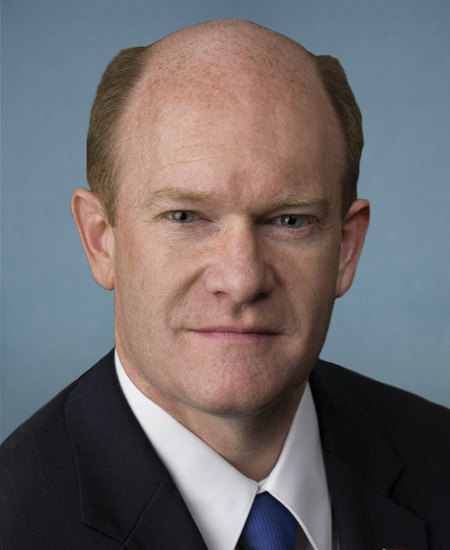
Sen. Christopher A. Coons
Sponsored bills
Maddy summaryThis resolution commends NATO's 2023 Vilnius Summit adoption of comprehensive regional defense plans and urges all NATO allies to align their defense spending with these plans, specifically maintaining or exceeding the 2% of GDP defense spending target. It supports allies meeting this target (with 11 members doing so as of 2023), encourages continued resource allocation for new equipment, and calls for swift ratification of Sweden's NATO membership. The resolution is a non-binding expression of support from the U.S. Senate, not a policy change affecting specific groups or requiring new funding.
Maddy summaryThis bill allows the Department of Veterans Affairs (VA) to use alternative evidence to determine eligibility for benefits when a veteran's military or medical records are lost or damaged after being held by the federal government. It directly affects veterans whose service records are incomplete due to federal record loss, enabling the VA to consider sources like medical exams soon after discharge, the veteran's own account of injuries, or credible buddy statements. The VA must create rules for this process within one year of the bill's passage, and benefits awarded under this provision will follow standard dating rules without delays based on claim submission timing. The law clarifies that veterans can use these alternative methods to prove service-connected disabilities or other benefits when official records are unavailable.
Maddy summaryThe Concrete and Asphalt Innovation Act of 2023 establishes a federal research program to develop low-emissions cement, concrete, asphalt binder, and asphalt mixtures, with the goal of reducing greenhouse gas emissions in construction materials. The bill authorizes $200 million for demonstration projects, creates Manufacturing USA institutes to develop testing standards, and establishes advance purchase commitments to incentivize government adoption of these materials. It also creates an Interagency Task Force to coordinate federal efforts across agencies and update construction codes to support low-emission materials. The legislation primarily affects cement and asphalt producers, government contractors, and the construction industry, aiming to make low-emission materials more competitive and widely used.
Maddy summaryThe YouthBuild for the Future Act increases annual funding for the YouthBuild program from $159.5 million in 2024 to $203.6 million by 2029, reserving 20% of funds above $125 million for rural programs and initiatives serving tribal communities, Native Hawaiians, and Alaska Natives. It expands allowable uses of funds to include meal assistance, help applying for federal benefits like SNAP, and disability support services, while updating program definitions to better serve justice-involved youth and those with foundational skill needs. The bill also requires annual consultation with program providers on performance metrics and allows grantees to use funds to meet matching requirements under the National and Community Service Act.
Maddy summaryThe SAFER Banking Act provides legal protections for banks and financial institutions that serve state-legal marijuana businesses and related service providers. It creates a "safe harbor" preventing federal banking regulators from penalizing institutions for offering services to these businesses, even though marijuana remains illegal under federal law. The bill also allows income from state-legal marijuana businesses to be considered "legal income" for mortgage qualification purposes and establishes guidance for suspicious activity reporting related to these businesses. Similar protections are extended to hemp-related businesses and service providers, without requiring banks to serve these businesses.
Maddy summaryS 2644 (American Law Enforcement SAVER Act) establishes federal standards for trauma kits used by law enforcement agencies receiving grant funds. It defines trauma kits to include specific bleeding control items (like tourniquets, bandages, and training materials) and requires all kits purchased with federal funds to meet performance standards developed by the Bureau of Justice Assistance within 180 days. The bill also mandates that agencies develop best practices for training officers, deploying kits in vehicles, and maintaining kits at facilities. This directly affects state, local, and tribal law enforcement agencies that use federal grants to purchase trauma response equipment.
Maddy summaryThe Federal Cybersecurity Workforce Expansion Act creates two pilot programs to address cybersecurity workforce shortages. The first establishes a cybersecurity apprenticeship program within the Department of Homeland Security, allowing up to 25 new participants annually to train for cyber workforce positions while requiring them to work in federal cybersecurity roles for a period equal to their training time. The second program provides free cybersecurity training for veterans and military spouses, incorporating virtual learning, hands-on training, and work-based learning opportunities to prepare participants for federal cybersecurity careers. Both programs will operate for five years and require annual reporting to Congress on outcomes including participant demographics, completion rates, and employment outcomes.
Maddy summaryThis Senate resolution designates November 2023 as "National Homeless Children and Youth Awareness Month" to highlight the issue of homelessness among children and youth. It cites statistics including 1.2 million homeless children identified in U.S. schools during the 2021-2022 school year and higher risks of health issues, school disruption, and suicide among homeless youth. The resolution encourages businesses, governments, schools, and organizations to raise awareness, share information about causes and solutions, and support efforts to prevent homelessness during that month. As a symbolic resolution, it does not create new laws or funding but aims to foster voluntary community action.
Maddy summaryS 3356, the Postal Police Reform Act of 2023, clarifies the duties of U.S. Postal Service (USPS) police officers. It specifies that these officers protect mail, USPS-owned or controlled property, people on that property, and USPS employees on duty anywhere in the U.S. The bill revises existing law to explicitly state that officers may act beyond USPS property when necessary to fulfill these protective duties. It also corrects a minor typo in the legal reference. This bill directly affects USPS police officers by defining their scope of responsibility more precisely.