

Maddy summaryThis bill adjusts tax credit rules for health insurance under the Affordable Care Act to make coverage more affordable for lower-income households. It replaces a flat income threshold with a sliding scale, reducing the percentage of income people pay for premiums based on their household income relative to the poverty line (e.g., 0% for incomes up to 150% of poverty, rising to 8.5% at 400%+). The change directly affects individuals buying insurance through health insurance marketplaces who qualify for tax credits. It takes effect for tax years beginning after 2025, modifying how the IRS calculates subsidy eligibility.
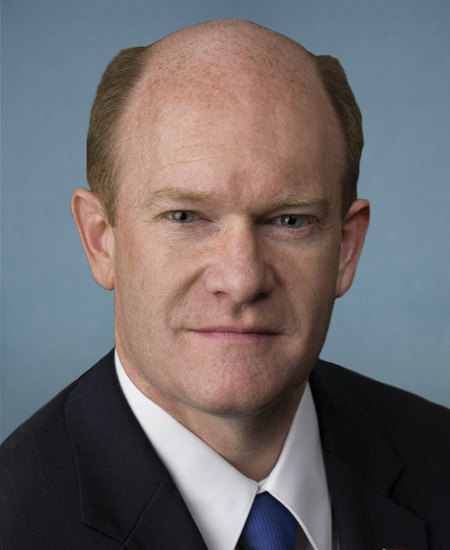
Sen. Christopher A. Coons
Sponsored bills
Maddy summaryThis bill establishes a 13-member Commission to study the historical and ongoing impacts of slavery and discrimination on African Americans, and to develop reparation proposals. The Commission will examine the institution of slavery from 1619-1865, discriminatory practices like redlining and Jim Crow, and current disparities in wealth, incarceration, and employment. It will identify evidence of these harms, study their lingering effects, and recommend educational approaches and potential remedies, including compensation calculations and eligibility. The Commission must submit its findings and recommendations to Congress within one year of its first meeting. The bill authorizes $12 million for the Commission's work and requires it to terminate 90 days after submitting its report.
Maddy summaryThe Washington, D.C. Admission Act would admit Washington, D.C. as a new state called "Washington, Douglass Commonwealth," granting it full representation with two U.S. Senators and one U.S. Representative. The bill would establish the new state's boundaries, with the area serving as the seat of government (the "Capital") remaining under federal jurisdiction for specific purposes. It would repeal the District of Columbia's congressional delegate position and its participation in presidential elections, while providing for a transition period overseen by a Statehood Transition Commission to handle the shift from district to state governance.
Maddy summaryThis bill adds new federal district court judgeships to address growing case backlogs. It authorizes 66 permanent judgeships to be appointed starting in 2025 (with an additional 34 in 2029) across specific districts in Arizona, California, Texas, Florida, Georgia, New York, and others, based on current caseload data. It also creates temporary judgeships for Oklahoma districts (Eastern and Northern) that expire after five years if vacancies occur. The bill aims to reduce the average of 491 cases per judgeship by increasing staffing in overburdened courts, as identified by the Judicial Conference.
Maddy summary# Summary of Veterans' Affairs Legislative Bill This comprehensive bill contains numerous provisions to improve veterans' healthcare, benefits, and educational assistance programs. Key components include: ## Healthcare Provisions - **Dental Care Expansion**: Pilot program to provide dental care to veterans with ischemic heart disease using community care, mobile clinics, and portable dental units - **Suicide Prevention**: Mandates annual National Veteran Suicide Prevention Reports with detailed analysis of suicide rates, engagement with VA healthcare, and benefits usage - **Appointment Scheduling**: Requires a plan to enable same-day scheduling for veterans requesting appointments by phone - **Infrastructure Assessment**: Requires a report on physical infrastructure needed for dental care services at VA medical facilities - **Staffing Models**: Directs development of staffing models and performance metrics for VA healthcare employees focused on timely access to care ## Mental Health & Support Services - **Mental Health Support for Caregivers**: Mandates GAO report on mental health support availability and accessibility for caregivers - **Centralized Website**: Requires development of a centralized website for information on home- and community-based services - **Respite Care Review**: Directs review of respite care services availability, cost, and effectiveness ## Educational Assistance - **Fry Scholarship Expansion**: Temporarily expands eligibility for Marine Gunnery Sergeant John David Fry Scholarship to children/spouses of veterans who die from service-connected disabilities within 120 days of discharge - **Housing Stipend**: Ensures full monthly housing stipend for veterans in final semester using Post-9/11 educational assistance - **Digital Transcripts**: Requires educational institutions approved for VA benefits to provide digital official transcripts - **Commercial Driver Education**: Modifies rules for approval of commercial driver education programs for veterans' education benefits ## Administrative & Reporting Requirements - **Quarterly Referral Reports**: Requires quarterly reports on referral processing times between VA facilities - **Pay Modifications**: Amends pay limitations for physicians, podiatrists, optometrists, and dentists - **Documentation of Preferences**: Directs development of mechanism to document veterans' scheduling preferences - **VA Infrastructure Assessment**: Requires report on physical infrastructure required for dental care services The bill includes numerous deadlines (ranging from 90 days to 3 years) for implementation and reporting, and establishes new requirements for transparency, accountability, and veteran-centered care across multiple VA programs.
Maddy summaryS 223 corrects a technical error in the numbering of definitions within the Controlled Substances Act (Section 102). This procedural bill reorganizes the definition numbering - specifically moving certain paragraphs - to fix a misplaced reference, without altering any legal definitions or requirements. It directly affects how the law's definitions are structured but does not change substance or policy. The bill was passed by Congress in December 2024 and signed into law.
Maddy summaryThis bill expands a tax credit for manufacturers by redefining "advanced manufacturing facility" to specifically include facilities producing semiconductors, semiconductor manufacturing equipment, or essential materials for those products. It directly affects semiconductor manufacturers and related suppliers by making them eligible for the expanded investment tax credit under the Internal Revenue Code. The key provision amends existing tax code language to clarify this scope, aligning with the CHIPS Act of 2022. The changes take effect as if they were part of the CHIPS Act.
Maddy summaryThis bill restores a legal presumption that courts should grant permanent injunctions to stop ongoing or willful patent infringement, directly benefiting small patent owners like individual inventors, startups, and universities. It requires courts to assume an injunction is warranted after a final finding of infringement, shifting the burden to defendants to prove why an injunction shouldn’t issue. The key change reverses recent court practices that made it harder for smaller entities to secure injunctions against large companies. This aims to strengthen patent enforcement by returning to a historical standard for equitable remedies. The bill does not alter patent validity or licensing terms, focusing solely on injunction procedures.
Maddy summaryThe Invest to Protect Act of 2023 establishes a Department of Justice grant program to support local law enforcement agencies with fewer than 200 officers, including counties, municipalities, and tribal governments. It provides funding for de-escalation training, mental health resources, and recruitment/retention bonuses (like signing bonuses up to $10,000 or retention bonuses up to 20% of salary for officers with 5+ years of service). Grants may cover specific training on domestic violence, active shooter scenarios, and interactions with vulnerable populations (e.g., individuals with mental health needs or veterans), as well as mental health services for officers. The program includes accountability measures like mandatory audits, public disclosure of bonuses, and restrictions on duplicate funding, with $50 million allocated annually from existing DOJ funds for fiscal years 2024-2028.
Maddy summaryThis bill amends the Fair Credit Reporting Act to protect U.S. citizens unlawfully detained or held hostage abroad. It requires credit bureaus to remove negative credit information reported during the period of detention or captivity if they verify official documentation. Covered consumers must provide authentication from the Special Presidential Envoy for Hostage Affairs or the Hostage Recovery Fusion Cell to trigger this protection. The law directly affects Americans wrongfully detained overseas by ensuring their credit reports reflect the time they were held, not the financial consequences of their captivity. This creates a concrete policy change in credit reporting practices for victims of international hostage situations.