

This resolution designates the week beginning on October 16, 2022, as National Chemistry Week. The resolution also recognizes the need to promote the fields of science, including chemistry, technology, engineering, and mathematics, and to encourage youth, including from underrepresented groups, to pursue careers in these fields.
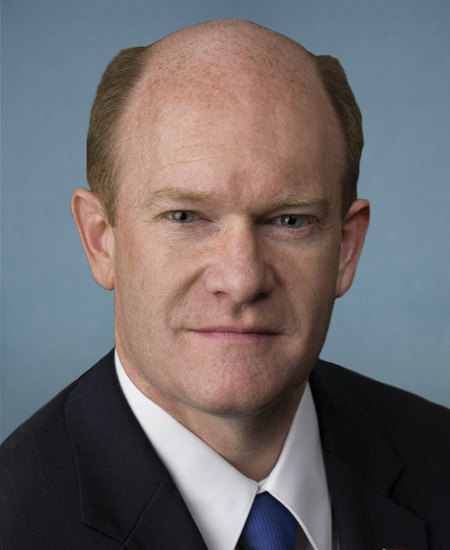
Sen. Christopher A. Coons
Sponsored bills
This resolution supports the designation of October 2-October 8, 2022, as National 4-H Week. It also (1) recognizes the important role of 4-H in youth development and education, and (2) encourages all citizens to recognize 4-H for the significant impact the organization and members have made and continue to make by empowering young people with the skills needed to lead for a lifetime.
Maddy summarySRES 774 is a non-binding Senate resolution designating September 2022 as "National Democracy Month." It encourages the U.S. government, states, and local communities to observe this month through ceremonies and activities that reflect on the U.S. system of government and its global contributions to democracy. The resolution emphasizes educating citizens about democratic principles and honoring historical sacrifices that preserved U.S. freedoms. It does not create new laws or affect specific groups, as it is a symbolic, ceremonial designation.
Fair Hiring in Banking Act This bill generally exempts certain individuals convicted of a crime from requirements related to employment by an insured depository institution or an insured credit union. Specifically, written consent from the Federal Deposit Insurance Corporation or the National Credit Union Administration is not required for an institution to hire an individual convicted of a criminal offense involving dishonesty, a breach of trust, or money laundering 7 years after the individual meets sentencing requirements; for an individual who committed the offense while under the age of 21, 30 months after the individual meets sentencing requirements; or if the conviction was pardoned, sealed, or expunged. However, written consent is required for specified financial crimes (including theft by a bank employee) or for any person seeking to become a director or senior executive officer.
Solitary Confinement Reform Act This bill establishes standards for the use of solitary confinement at federal prisons. It generally limits the use of solitary confinement to situations that meet certain criteria, including confinement for the briefest term and under the least restrictive conditions practicable. It also limits the use of solitary confinement for certain categories of inmates, including pregnant women and individuals with serious mental illness. The bill requires the Bureau of Prisons (BOP) to establish a transitional process for inmates in solitary confinement, provide comprehensive mental health evaluations for inmates in solitary confinement, train employees on mental illness and the psychological effects of solitary confinement, and report annually on the use of solitary confinement. It establishes, within the BOP, an Office of the Civil Rights Ombudsman. Finally, it establishes a solitary confinement resource center within the Department of Justice's Bureau of Justice Assistance.
504 Loan Availability Act This bill temporarily combines the funding authorization for loans and refinancing loans under the Small Business Administration 504 loan program. The 504 loan program provides financing for major fixed assets through community-based Certified Development Companies (CDCs).
Safer Supervision Act of 2022 This bill modifies provisions relating to the terms of supervised release after imprisonment, including by (1) requiring individualized assessments and written explanations by the court as to whether supervised release is appropriate, and (2) providing a presumption of early termination of supervised release if the individual has served half of the term and meets certain other criteria.
Investing in State Energy Act of 2022 This bill revises requirements concerning the distribution of funds under the Weatherization Assistance Program (WAP) and the State Energy Program (SEP) to state agencies and local partners that implement energy initiatives. Under WAP, the Department of Energy (DOE) reduces energy costs for low-income households by increasing the energy efficiency of their homes. Under SEP, DOE supports state energy conservation plans and energy security. This bill requires DOE, upon receiving state or area plans under WAP or SEP, to distribute funds to the recipients of the funding as quickly as practicable. Within 60 days of Congress making the funds available for WAP and SEP, DOE must (1) provide application guidance for financial assistance, and (2) publish the allocation of financial assistance to be provided to states under the programs.
SBIC Advisory Committee Act of 202 2 This bill requires the Small Business Administration (SBA) to establish an advisory committee to develop recommendations for expanding SBA assistance provided through Small Business Investment Companies (SBICs). SBICs are privately owned companies, licensed and regulated by the SBA, which invest in small businesses through debt and equity. Composed in part of representatives of and partners with small businesses in low-income communities and rural areas, the advisory committee must make recommendations for SBICs to invest in (1) underlicensed and underfinanced states; and (2) small businesses owned by socially or economically disadvantaged individuals, veterans, and women.
This resolution condemns the death and detention of Mahsa Amini (an Iranian woman who died in the custody of the Morality Policy of Iran after being detained for purportedly wearing her hijab improperly). It also calls on Iran to end its systemic persecution of women.