

Maddy summaryThe FUTURES Act (S 3855) establishes a formal U.S.-Israel Defense Technology Cooperation Initiative to accelerate joint development and integration of defense technologies. It directs the U.S. Secretary of Defense to identify Israeli-origin technologies for rapid adoption into American military systems, focusing on areas like counter-drone systems, missile defense, AI, cyber security, and directed energy. The bill authorizes $150 million annually (2027-2029) for this initiative, requiring regular reports to Congress on progress, technology transitions, and industry partnerships. This policy directly affects U.S. defense contractors, Israeli defense firms, and military acquisition programs by creating new pathways to incorporate Israeli innovations into U.S. systems.
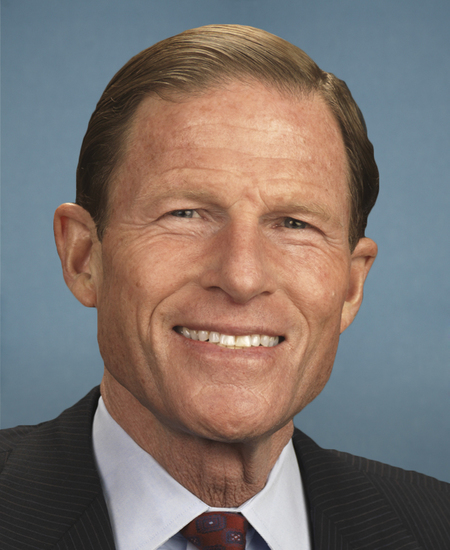
Sen. Richard Blumenthal
Sponsored bills
Maddy summarySRES 605 is a Senate resolution formally rejecting former President Donald Trump's public statements suggesting he could "nationalize" or "commandeer" federal elections. It states that the Constitution grants primary authority over elections to state and local officials (per Article I, Section 4), not the president, and declares any attempt to override this would be unconstitutional. The resolution explicitly rejects the idea that the president has lawful power to take direct control of elections and warns such actions would undermine federalism and the rule of law. As a symbolic measure, it does not create new law but affirms the Senate's position on constitutional boundaries.
Maddy summaryThis bill updates financial disclosure reporting thresholds for federal employees under Title 5, U.S. Code. It revises the dollar amounts requiring disclosure for certain financial interests (like dividends, rents, interest, and capital gains) by adding new higher-value brackets, ranging from $5 million to $1 billion. The bill also modifies asset value reporting categories, introducing new tiers from $50 million up to $1 billion. These changes apply to financial disclosure reports filed on or after the bill's enactment date. The bill directly affects federal employees required to submit financial disclosure reports under Chapter 131 of Title 5.
Maddy summaryThis bill protects communications between incarcerated people in federal custody (Bureau of Prisons or U.S. Marshals Service) and their attorneys by requiring a new system to block monitoring of protected messages. It mandates that all electronic messages stay private unless authorities obtain a court warrant approved by a U.S. attorney, with strict rules preventing prosecutors from using accessed information in related cases. The system must retain all messages until release, and the government can only access them for system maintenance or with a warrant. It applies only to federal facilities, not state prisons, and does not affect non-protected communications.
Maddy summaryThis bill creates new criminal and civil penalties for corporate entities whose actions contribute to patient harm in healthcare settings. It targets "covered parties" including executives, directors, shareholders, and private equity firms that receive "covered compensation" (such as salaries, bonuses, or equity) from a healthcare organization experiencing a "triggering event" like financial distress leading to patient harm. The bill establishes a clawback mechanism allowing the Attorney General or state attorneys general to recover compensation received by these entities during the 10 years before or after the triggering event, with recovered funds to be used for employee benefits or community health services. It also requires healthcare entities to report ownership information and mandates a study on profit-driven practices in healthcare delivery.
Maddy summaryThe GRID Act requires new data centers (20+ megawatts) to power all operations - including backup energy - from off-grid sources like captive power plants or on-site generation, effective 180 days after enactment. Existing data centers can continue using the grid for 10 years if they obtain a "Zero Rate Effect Certificate" from the Secretary of Energy, which requires studying whether the data center raises electricity rates for ratepayers - prioritizing residential rates in the analysis. Covered entities must also publicly report utility usage, property acquisitions, and financial agreements with utilities (including Rate Effect Credits) within 90 days of enactment. Violations carry $1 million daily penalties, and all power sources must comply with environmental and labor laws.
Maddy summaryThis bill amends U.S. tax law to prevent corporations from avoiding U.S. taxes through "inversions," where a foreign company acquires a U.S. business and moves its tax residence abroad. It treats certain foreign corporations as domestic for tax purposes if they acquire a U.S. entity after May 8, 2014, and either have over 50% of their stock held by former U.S. shareholders or maintain significant U.S. operations (at least 25% of employees, compensation, assets, or income in the U.S.). Exceptions apply if the corporation has substantial business activities in its original foreign country. The changes apply to taxable years ending after May 8, 2014, targeting tax avoidance strategies rather than affecting most standard multinational businesses.
Maddy summaryThis Senate resolution designates January 1 to February 1, 2026, as "National Trafficking and Modern Slavery Prevention Month" to raise public awareness about human trafficking and modern slavery. It does not create new laws or policies but formally supports observance through educational programs and community activities during this period. The resolution emphasizes collaboration between government agencies, victim advocates, and nonprofits to address trafficking, linking the timeframe to the Emancipation Proclamation anniversary (January 1) and National Freedom Day (February 1). It is a symbolic, non-binding measure intended to highlight ongoing efforts to combat trafficking, referencing existing federal anti-trafficking laws like the Trafficking Victims Protection Act.
Maddy summaryThis bill, S 3823 (FAIR Act), sets specific pay adjustments for federal employees in calendar year 2027. It mandates a 3.1% increase in base pay for employees covered by statutory pay systems (most federal workers) and prevailing rate employees (those paid based on local private-sector wages), and a 1% increase in locality pay adjustments. These changes directly affect all federal employees whose pay is determined under the specified systems outlined in Title 5 of the U.S. Code. The bill is procedural, establishing concrete pay rate adjustments without altering broader employment policies.
Maddy summaryThe SHADOW Fleet Sanctions Act of 2026 imposes sanctions on vessels and foreign entities supporting Russia's shadow fleet - vessels used to circumvent sanctions on Russian oil exports. It targets foreign vessels engaging in unsafe maritime behavior, lacking proper insurance, or evading the crude oil price cap, as well as foreign persons facilitating such activities through ship-to-ship transfers, insurance, or port services. The bill requires sanctions on port terminals in China or India accepting oil from sanctioned vessels and establishes a public database of vessels suspected of sabotage activities. It also creates reporting requirements and a strategy to counter China's role in evading sanctions on Russian energy products.