

K2 Veterans Care Act of 2021 This bill establishes a presumption of service-connection for certain diseases becoming manifest in a veteran who served on active duty at Karshi-Khanabad (K2) Air Base in Uzbekistan between January 1, 2001, and December 31, 2005. Specifically, there must be a presumption of service-connection for veterans who manifest illnesses that have a positive association with exposure to jet fuel, volatile organic compounds, high levels of particulate matter, depleted uranium, asbestos, or lead-based paint, as determined by the National Academies of Sciences, Engineering, and Medicine (NASEM). Under a presumption of service-connection, specific conditions diagnosed in certain veterans are presumed to have been caused by the circumstances of their military service. Health care benefits and disability compensation may then be awarded. Veterans who served at K2 Air Base during the specified period are eligible for Department of Veterans Affairs hospital care, medical services, and nursing home care for an illness that has been determined by NASEM to have a positive association with exposure to jet fuel, volatile organic compounds, high levels of particulate matter, depleted uranium, asbestos, or lead-based paint.
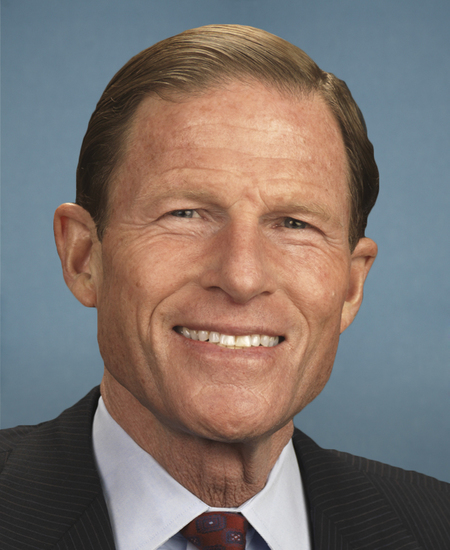
Sen. Richard Blumenthal
Sponsored bills
Advancing Uniform Transportation Opportunities for Veterans Act or the AUTO for Veterans Act This bill authorizes the Department of Veterans Affairs (VA) to provide (or assist in providing) an eligible veteran or service member with an additional automobile or other conveyance under the VA automobile allowance and adaptive equipment program. Currently, a veteran or service member with a specified service-connected disability or impairment may not receive more than one automobile or other conveyance under the program. The bill authorizes the additional benefit for such veterans and service members if 10 years have passed since the person last received such benefit.
Veterans Burn Pits Exposure Recognition Act of 2021 This bill requires the Department of Veterans Affairs (VA) to concede, for the purposes of health care benefits and wartime disability compensation, that a veteran was exposed to certain toxic substances, chemicals, and hazards from burn pits if such veteran served on active duty in a covered location during a specified time frame (unless there is affirmative evidence to establish that the veteran was not exposed during such service). A burn pit is an area used for burning solid waste in open air without equipment. Specifically, the bill covers the following locations and corresponding time periods: Iraq between August 2, 1990, and February 28, 1991, as well as from March 19, 2003, until burn pits are no longer used in this location; Southwest Asia (including Kuwait, Saudi Arabia, Oman, and Qatar) from August 2, 1990, until burn pits are no longer used in these locations; and Afghanistan, Syria, Jordan, Egypt, Lebanon, Yemen, and Djibouti from September 11, 2001, until burn pits are no longer used in these locations. Under the bill, if an exposed veteran submits insufficient evidence to establish a service-connection for purposes of disability compensation, the VA shall provide a medical examination and request a medical opinion regarding a causal link between the disability and a toxin, chemical, or hazard.
Puppy Protection Act of 2021 This bill requires the Department of Agriculture to expand standards that govern the humane handling, care, treatment, and transportation of animals to include new requirements for commercial dog dealers. Specifically, the standards must require dog dealers to provide to dogs adequate housing, exercise, and veterinary care; appropriate and nutritious food; continuous access to potable water; and meaningful socialization with humans and compatible dogs for at least 30 minutes each day. The standards must also include requirements for breeders to use safe breeding practices and make all reasonable efforts to find humane placement for retired breeding dogs.
Families Belong Together Act This bill provides various immigration benefits for eligible alien parents (or legal guardians) and minor children who were separated by the Department of Homeland Security (DHS) between January 20, 2017, and January 20, 2021. Generally, to be an eligible parent or minor child under this bill, the alien must not be inadmissible for certain crime- or security-related grounds, though DHS may waive certain grounds for humanitarian or public interest reasons. Furthermore, an eligible child who was separated as a minor remains eligible for the immigration benefits after reaching majority. DHS must grant humanitarian parole into the United States to an eligible alien who requests such parole, regardless of whether the alien is physically present in the United States. An eligible alien in the United States may apply for lawful permanent resident status. U.S. Citizenship and Immigration Services shall grant a qualifying alien's lawful permanent resident status within 30 days of receiving the alien's application. An alien who receives lawful permanent resident status under this bill shall be eligible for benefits and services that are available to an alien who is admitted as a refugee. Certain annual numerical limitations shall not apply to aliens who receive lawful permanent resident status under this bill. If an alien seeks judicial review of a denial of an application for lawful permanent resident status under this bill, the Department of Justice shall appoint counsel to represent that alien upon request.
Combating Sexual Harassment in Science Act This bill addresses sexual harassment in the science, technology, engineering, and mathematics (STEM) fields by supporting research regarding sexual harassment and efforts to prevent and respond to sexual harassment. This bill directs the National Science Foundation (NSF) to award grants to institutions of higher education or nonprofit organizations (or their consortia) to expand research into the factors contributing to, and consequences of, sexual harassment affecting individuals in the STEM workforce, including students and trainees; and examine interventions for reducing the incidence and negative consequences of sexual harassment. The NSF must convene a working group to gather national data on the prevalence, nature, and implications of such harassment in institutions of higher education. The NSF shall enter into agreements with the National Academies of Sciences, Engineering, and Medicine to (1) update a responsible conduct guide issued by the National Academies to include, among other things, evidence-based practices for fostering a climate that is intolerant of sexual harassment; and (2) study the influence of sexual harassment in institutions of higher education on the career advancement of individuals in the STEM workforce. The National Science and Technology Council shall establish an interagency working group to coordinate the federal science agencies' efforts to reduce the prevalence of sexual harassment involving grant personnel. The Office of Science and Technology Policy must develop policy guidelines for such agencies to prevent and respond to reports of sexual harassment and gender harassment.
National Climate Bank Act This bill establishes and capitalizes a National Climate Bank. The independent, nonprofit bank must invest in clean energy technologies and infrastructure to reduce greenhouse gas emissions. The national bank's investments and procurements division must seek to facilitate affordable investment and procurement, including in low-income communities and communities of color, in key project areas (e.g., renewable energy or climate resiliency measures). The national bank's start-up division must support the creation of new green banks by states or other political subdivisions. The new banks must be public or nonprofit specialized finance entities that use finance tools to mitigate climate change. The national bank may provide financing for such entities. In addition, the bank must explore the establishment of a cash for carbon program to remove greenhouse gas emissions from the power system. The program may use market mechanisms to expedite the retirement of carbon-intensive power generation facilities (e.g., coal-fired power generation facilities), acquire carbon assets for the purpose of reducing emissions, and invest in communities negatively affected by the loss of those facilities or assets.
Food Allergy Safety, Treatment, Education, and Research Act of 2021 or the FASTER Act of 2021 This bill expands the definition of major food allergen for purposes of certain food-labeling requirements to specifically include sesame. In addition, the Department of Health and Human Services must report on certain information related to food allergy research and data collection activities.
This resolution declares racism a public health crisis and supports efforts to address health disparities and inequities across all sectors.
Sunshine in Product Safety Act This bill repeals the limitation on the Federal Trade Commission from disclosing information about a consumer product that may reveal the identity of the product's manufacturer without first taking reasonable steps to ensure that the information is accurate and that releasing the information to the public serves the purposes of the laws administered by the commission.