

Extinction Prevention Act of 2021 This bill requires the Department of the Interior to provide financial assistance for the conservation of butterflies and moths in North America; plant species in Hawaii, Guam, American Samoa, and the Northern Mariana Islands; freshwater mussels in the United States; and bony fish found in desert ecosystems in Arizona, California, Colorado, Nevada, New Mexico, Oregon, and Utah. Among other things, the bill establishes the North America Butterfly Conservation Fund, the Pacific Islands Plant Conservation Fund, the Freshwater Mussel Conservation Fund, and the Southwest Desert Fish Conservation Fund. In selecting projects for assistance, Interior must prioritize projects that conserve threatened and endangered species.
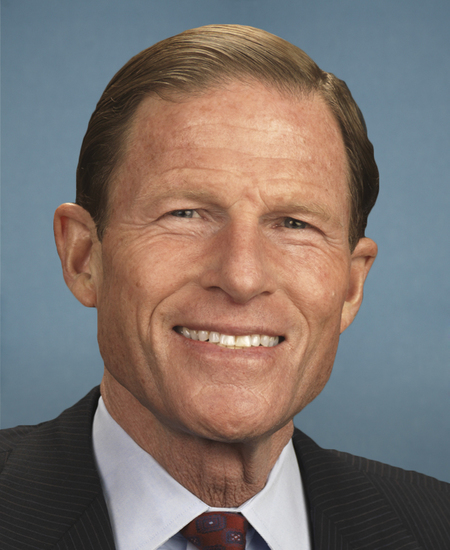
Sen. Richard Blumenthal
Sponsored bills
Surviving Widow(er) Income Fair Treatment Act of 2021 or the SWIFT Act This bill modifies eligibility requirements and increases Social Security survivor benefits for widows, widowers, and surviving divorced spouses of a deceased worker. Specifically, the bill makes widow and widower's benefits available to disabled individuals at any age, whereas currently the benefits are limited to such individuals between ages 50 to 60. In addition, provisions reducing benefits in various instances, such as when a beneficiary is entitled to multiple types of benefits, shall not apply to widow and widower's benefits for individuals with disabilities. Additionally, the bill raises the upper age limit for determining whether a beneficiary has a child in his or her care from 16 to 18 years (or 19, if the child is a full-time elementary or secondary school student). An individual with a child in care may receive increased benefits in specified instances. The bill also increases various limits on widow and widower's benefits in certain instances and modifies the calculation for increased benefits for individuals who choose to delay receiving such benefits. For current beneficiaries, increases in Social Security benefits under this bill shall not affect the beneficiary's eligibility or benefit amount for any federal assistance program.
End Transfers of Detained Immigrants Act This bill imposes requirements related to individuals in U.S. Immigration and Customs Enforcement (ICE) custody during the COVID-19 public health emergency declared by the Department of Health and Human Services. ICE may not transfer an individual between ICE facilities until the COVID-19 transmission rate in the United States meets or drops below a certain threshold. In addition, ICE may not apprehend or transfer an individual between an ICE detention facility and a facility operated by an outside entity, such as a state or local prison, unless the individual is tested for COVID-19 and placed in quarantine (1) for 14 consecutive days, or (2) until the test comes back negative. These two requirements shall not prohibit the transfer of (1) an individual solely to process that individual's release from custody, or (2) a minor from ICE custody to the custody of the Office of Refugee Resettlement. If ICE cannot ensure compliance with Centers for Disease Control and Prevention guidelines for mitigating the spread of COVID-19 (including maintaining social distancing requirements at all times) in any ICE facility, ICE shall (1) immediately review the custody of all detained individuals in that facility, and (2) release individuals found eligible for release.
COVID - 19 Hate Crimes Act This bill requires a designated officer or employee of the Department of Justice (DOJ) to facilitate the expedited review of hate crimes and reports of hate crimes. DOJ must issue guidance for state, local, and tribal law enforcement agencies on establishing online hate crime reporting processes, collecting data disaggregated by protected characteristic (e.g., race or national origin), and expanding education campaigns. Additionally, DOJ and the Department of Health and Human Services must issue guidance aimed at raising awareness of hate crimes during the COVID-19 (i.e., coronavirus disease 2019) pandemic. The bill establishes grants for states to create state-run hate crimes reporting hotlines. It also authorizes grants for states and local governments to implement the National Incident-Based Reporting System and to conduct law enforcement activities or crime reduction programs to prevent, address, or respond to hate crimes. Finally, in the case of an individual convicted of a hate crime offense and placed on supervised release, the bill allows a court to order that the individual participate in educational classes or community service as a condition of supervised release.
Census Improving Data and Enhanced Accuracy Act or the Census IDEA Act This bill prohibits the Department of Commerce, in the 2030 decennial census of population and each decennial census thereafter, from (1) implementing any major operational design element that has not been researched, studied, and tested for a period of at least three years before the decennial census date; or (2) including on the questionnaire for the census any subject, type of information, or question that was not submitted to Congress. The Government Accountability Office shall determine and report to Congress on whether the subjects, types of information, and questions to be included in that decennial census have been adequately researched, studied, and tested to the same degree as in previous decennial censuses.
Climate Change Health Protection and Promotion Act of 2021 This bill requires the Department of Health and Human Services (HHS) to take a series of actions to address the potential impacts of climate change on public health. Specifically, HHS must develop a strategic action plan and a climate and health program to ensure the public health and health care systems in the United States and other nations are prepared for, and can respond to, the impacts of climate change on health. HHS must revise the plan periodically to reflect new scientific developments and information. Additionally, HHS must establish a permanent science advisory board to provide (1) scientific and technical recommendations on the impacts of climate change on public health, and (2) advice for purposes of issuing the plan and conducting the program.
Filipino Veterans Family Reunification Act of 2021 This bill exempts from worldwide or numerical limitations certain family-sponsored immigrant visas for the sons and daughters of Filipino World War II veterans who were naturalized under certain laws providing for naturalization for service during World War II.
Concentrating on High-value Alzheimer's Needs to Get to an End (CHANGE) Act of 2021 This bill modifies the requirements under Medicare for diagnosing and treating Alzheimer's disease and other cognitive impairments in older adults. Specifically, the bill expands the cognitive impairment detection benefit during annual wellness visits to require the use of validated detection tools and documentation of the results in the patient's medical record. Further, when a cognitive impairment is detected, the patient must be referred to an appropriate diagnostic service provider and other specified supports. Additionally, the Centers for Medicare & Medicaid Services must implement Medicare policies that increase the identification and response to patients' Alzheimer's disease risk factors and incentivize providers to utilize high-quality cognitive impairment diagnosis practices.
This resolution expresses the sense of the Senate that the United States must (1) accelerate the electrification of households, buildings, and businesses; (2) modernize the electricity grid; and (3) continue on the path towards decarbonizing electricity generation by 2035.
This resolution expresses support for the goals and ideals of National Sexual Assault Awareness and Prevention Month.