

Expanding Health Care Options for Early Retirees Act This bill establishes a Medicare buy-in option for certain qualifying first responders. Specifically, the bill allows first responders aged 50 to 64 to enroll in Medicare if they are retired or otherwise separated from service due to a disability. The Centers for Medicare & Medicaid Services (CMS) must determine enrollment periods and set premiums for the buy-in option established under the bill, in accordance with specified requirements. The CMS must also award grants to states and nonprofit organizations for outreach and enrollment activities relating to the buy-in option.
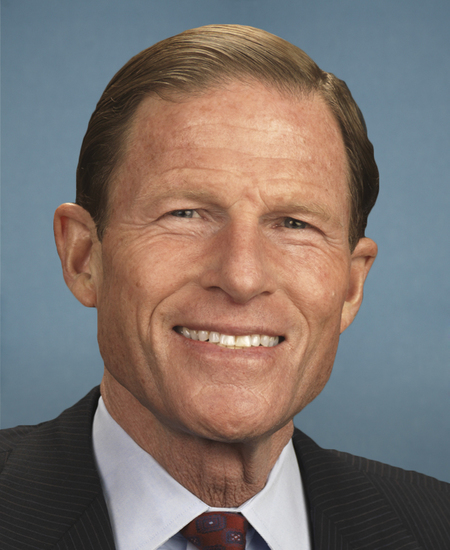
Sen. Richard Blumenthal
Sponsored bills
Prevent All Soring Tactics Act of 2021 or the PAST Act of 2021 This bill addresses the practice of soring horses. The soring of horses includes various actions taken on horses' limbs to produce higher gaits that may cause pain, distress, inflammation, or lameness. Specifically, the bill expands soring regulation and enforcement at horse shows, exhibitions, sales, and auctions, including by establishing a new system for inspecting horses for soring. In addition, the bill increases penalties for violations.
Therapeutic Fraud Prevention Act of 20 21 This bill prohibits commercial conversion therapy, which is a practice or treatment designed to change a person's sexual orientation or gender identity or otherwise change behaviors, thoughts, or expressions related to gender or sexual attraction. This prohibition does not apply to treatment that assists an individual undergoing a gender transition or facilitates identity exploration and development.
Minor League Baseball Relief Act This bill establishes a program for the relief of certain minor league baseball clubs and independent professional baseball clubs that experienced large business losses. The bill provides funding for the Small Business Administration to make grants to such clubs that experienced decreases in gross revenue in 2020 of at least 75%, as measured against revenues in 2019 (or, if revenues were negatively affected by a natural disaster or weather disruption in 2019, by the average of revenues over the prior three-year period). The source of funding for the grants shall be funds appropriated under enacted COVID-19 relief legislation that have not been obligated and are no longer being used to carry out activities authorized under those laws. Grant amounts provided to any club may not exceed $10 million.
STEM Opportunities Act This bill provides for guidance, data collection, and grants for groups historically underrepresented in science, technology, engineering, and mathematics (STEM) education at institutions of higher education (IHEs) and at federal science agencies. Specifically, the bill requires the Office of Science and Technology Policy (OSTP) to provide specified guidance related to such groups to federal science agencies and IHEs. Each federal science agency must collect comprehensive demographic data on recipients of merit-reviewed research and development grants given to IHEs and federal laboratories supported by that agency. Each agency must also implement recommendations from the OSTP report titled Reducing the Impact of Bias in the STEM Workforce . In addition, each agency must carry out a pilot program and implement evidence-based policies and practices to minimize the effect of implicit bias in the grant review process. The National Science Foundation (NSF) must carry out and publish a survey to collect data on the demographics of STEM faculty, by broad fields of STEM, at different types of IHEs. The NSF must also carry out a variety of grant programs, including grants for increasing (1) the recruitment, retention, and advancement of individuals from underrepresented minority groups in STEM careers; (2) the recruitment and retention of minority students who are underrepresented in STEM fields; and (3) student participation in computer science and computational thinking education programs at tribal colleges and universities.
Global Respect Act of 2021 This bill imposes visa-blocking sanctions on foreign persons responsible for or complicit in violating the human rights of individuals due to actual or perceived sexual orientation, gender identity, or sex characteristics. The President shall report and periodically update a list of foreign persons responsible for such human rights violations and apply sanctions accordingly. The Department of State shall designate at least one senior officer who shall be responsible for tracking violence and discrimination against individuals based on actual or perceived sexual orientation or gender identity in foreign countries.
LGBTQ Data Inclusion Act This bill requires federal agencies that collect information through a survey that includes demographic data (where subjects self-report information or a proxy provides information about the subject or responds for all persons in a household) to review existing data sets to determine in which data sets information about sexual orientation and gender identity is not included, and to assess needed changes in survey methods related to asking questions on sexual orientation and gender identity. Agencies that publish reports relying on survey demographic data must include information on sexual orientation and gender identity.
College Equity Act of 2021 This bill requires the Department of Education (ED) to establish grant programs for reviewing and addressing inequities in student recruitment, admissions, and support at institutions of higher education (IHEs). Specifically, ED must award grants to IHEs to conduct equity audits that review IHEs' policies, practices, and resources (e.g., admission policies, financial aid, and faculty diversity) to identify areas that might produce gaps in access and outcomes by certain factors. These factors include, among others, gender, race, ethnicity, national origin, and age. In addition, ED must award grants to IHEs for executing improvement plans that address inequities. Finally, higher education accrediting agencies and associations must assess the findings from the audits and assist IHEs in addressing inequities.
Economic Inclusion Civil Rights Act of 2021 This bill modifies the prohibition against intentional racial discrimination in the context of economic activity such as employment, contracts, or other commercial transactions. Specifically, the bill makes an action that has a discriminatory effect a violation of section 1977 of the Revised Statutes. It also states that all non-White persons within U.S. jurisdiction shall have the same right in every state and territory as is enjoyed by White citizens in certain respects. No person shall use a criterion, method of administration, practice, or policy that has a disparate impact in violation of that provision. Further, a plaintiff may prove intentional discrimination by showing only that the discriminatory intent was a motivating factor in the alleged violation. Under current law, a plaintiff must prove that the harm would not have occurred but for the defendant's unlawful conduct. Additionally, standing shall not be limited to victims who were parties to, or third-party beneficiaries of, a contract with the defendant. The bill provides for a right to jury trial and no joint-action waiver or pre-dispute arbitration agreement shall be enforceable with respect to any alleged violation. The bill provides for a four-year statute of limitations.
Veterans Visa and Protection Act of 2021 This bill provides permanent resident status and citizenship eligibility to certain noncitizen veterans and addresses related issues. The Department of Homeland Security (DHS) must establish a program that allows (1) eligible noncitizen veterans outside of the United States to be admitted as permanent residents, and (2) eligible noncitizen veterans in the United States to obtain permanent resident status. Generally, an eligible noncitizen veteran under this bill is one who was not removed from the United States for certain crimes related to violence or national security. DHS may waive these eligibility requirements for humanitarian, family unity, public interest, or exceptional military service reasons. A noncitizen veteran who obtains permanent resident status under this bill shall be eligible for (1) naturalization through service in the Armed Forces, and (2) military and veterans benefits as if they had not been removed (or ordered removed) from the United States. For a noncitizen veteran in removal proceedings or subject to a final removal order, the Department of Justice (DOJ) must determine whether the veteran is eligible for permanent resident status under this bill. If the veteran is eligible, DOJ must adjust the veteran's status. The bill also protects noncitizen veterans or service members from being removed from the United States unless the veteran has been convicted of a crime of violence.