This resolution recognizes (1) the celebration of Hispanic Heritage Month from September 15 - October 15, 2021; and (2) the integral role of Latinos and their manifold heritage in the economy, culture, and identity of the United States.
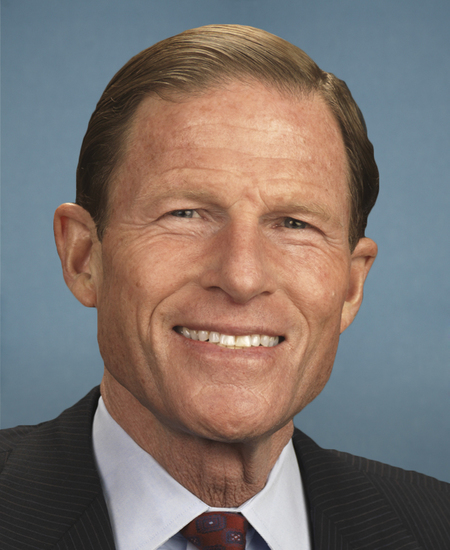
Sen. Richard Blumenthal
Sponsored bills
Helping American Victims Afflicted by Neurological Attacks Act of 2021 or the HAVANA Act of 2021 This bill specifically authorizes the Central Intelligence Agency, the Department of State, and other agencies to provide payments to agency personnel who incur brain injuries from hostilities while on assignment. Specifically, the bill allows agency personnel and their families to receive payments for brain injuries that are incurred (1) during a period of assignment to a foreign or domestic duty station; (2) in connection with war, insurgency, hostile acts, terrorist activity, or other agency-designated incidents; and (3) not as the result of willful misconduct. The bill's authority applies to injuries incurred before, on, or after the date of the bill's enactment. Agencies must submit classified reports on the bill's implementation, including the number of payments made and the amount of each payment. Since 2016, some intelligence, diplomatic, and other governmental personnel have reported experiencing unusual cognitive and neurological impairments while on assignment (particularly abroad), the source of which is currently under investigation. Symptoms were first reported by personnel stationed in Cuba and have since been collectively referred to as Havana Syndrome .

This bill requires the Department of Veterans Affairs (VA) to designate one week each year as Buddy Check Week for the purposes of organizing outreach events and educating veterans on how to conduct peer wellness checks. The VA shall ensure that the Veterans Crisis Line has a plan for handling the potential increase in calls that may occur during such week.
Veterans' Compensation Cost-of-Living Adjustment Act of 2021 This bill requires the Department of Veterans Affairs (VA) to increase the amounts payable for wartime disability compensation, additional compensation for dependents, the clothing allowance for certain disabled veterans, and dependency and indemnity compensation for surviving spouses and children. Specifically, the VA must increase the amounts by the same percentage as the cost-of-living increase in benefits for Social Security recipients that is effective on December 1, 2021. The bill requires the VA to publish the amounts payable, as increased, in the Federal Register. The VA is authorized to make a similar adjustment to the rates of disability compensation payable to persons who have not received compensation for service-connected disability or death.
This joint resolution proposes a constitutional amendment prohibiting the United States or any state from denying or abridging equal rights under the law on account of sex.
Maddy summarySRES 411 designates October 6, 2021, as "Energy Efficiency Day" to celebrate the economic and environmental benefits of energy efficiency policies and private sector innovation. The resolution calls on the American public to observe the day with programs and activities highlighting how these efforts have saved consumers billions annually in energy costs and reduced energy waste. It references decades of bipartisan support for energy efficiency, including federal policies that have driven significant energy savings and job growth in the sector. The bill does not create new regulations but serves as a symbolic recognition of existing achievements in energy conservation.
Maddy summaryThis resolution designates October 8, 2021, as "National Hydrogen and Fuel Cell Day" to recognize the importance of hydrogen and fuel cell technologies. It does not create new laws, regulations, or funding, serving solely as a symbolic observance. The bill references hydrogen's role in energy, transportation, and space programs but contains no concrete policy changes. It directly affects no individuals or entities, as it is purely a ceremonial designation by the Senate.
Fair Adjudications for Immigrants Act This bill narrows the scope of certain crime-based grounds for barring or removing an alien from the United States. (Generally, a conviction for certain crimes, such as a crime that carries a term of incarceration of a certain length, may constitute grounds for denying an individual certain immigration benefits.) The bill redefines the term conviction to exclude convictions that have been dismissed, expunged, deferred, annulled, invalidated, withheld, vacated, or pardoned. The term must also exclude adjudications where a court issued a recommendation against removal, an order of probation without entry of judgment, or a similar disposition. In addition, any reference to a term of imprisonment or sentence must, unless otherwise provided (1) only consider the period of incarceration ordered by a court, and (2) exclude any suspended portion of a sentence. Currently, for immigration purposes, a term of incarceration includes any part of the sentence that was suspended. These provisions pertaining to the definition of conviction and terms of imprisonment shall apply to convictions and judgments entered either before or after this bill's enactment. Furthermore, certain crime-based grounds for barring or removing an alien shall not apply if the sentencing court issues a recommendation that the alien not be removed on the basis of the conviction.
Global Malnutrition Prevention and Treatment Act of 2021 This bill sets out programs and otherwise directs the U.S. Agency for International Development (USAID) to carry out activities to prevent and treat malnutrition globally. In coordination with relevant federal agencies, bilateral and multilateral donors, partner countries, and other stakeholders, the USAID may scale up programs for preventing and treating malnutrition globally. This includes focusing on interventions for the populations most susceptible to severe malnutrition (e.g., pregnant and lactating women and children younger than five years of age). The USAID must select countries based on specified malnutrition-related indicators for purposes of targeting malnutrition prevention and treatment programs and update the selection within five years. To support these programs, the USAID must leverage additional private sector resources in priority countries, including by considering opportunities within the Development Finance Corporation's impact framework for supporting improved nutrition outcomes. The USAID must provide Congress with an implementation plan and annual reports concerning its programs for preventing and treating malnutrition. The bill also establishes the Nutrition Leadership Council, comprised of various USAID bureaus and offices, to coordinate agency activities to prevent and treat malnutrition. The bill's provisions terminate seven years after its enactment.
Homes for Every Local Protector, Educator, and Responder Act of 2021 or the HELPER Act of 2021 This bill establishes a program administered by the Department of Housing and Urban Development to provide mortgage assistance to law enforcement officers, elementary and secondary school teachers, firefighters, or other first responders. Specifically, these individuals may be eligible for a one-time mortgage on a primary family residence with no down payment and no monthly mortgage insurance premium.