This bill requires the Government Accountability Office (GAO) to conduct a study to assess whether there are disparities associated with race and ethnicity with respect to (1) compensation benefits administered by the Department of Veterans Affairs (VA), (2) disability ratings determined by the VA, and (3) the rejection of fully developed claims for VA benefits. The GAO must also develop recommendations to facilitate better data collection on such disparities associated with race and ethnicity. Within one year, the GAO must brief Congress on the initial results of the study. The GAO must also submit a final report on the study following the briefing.
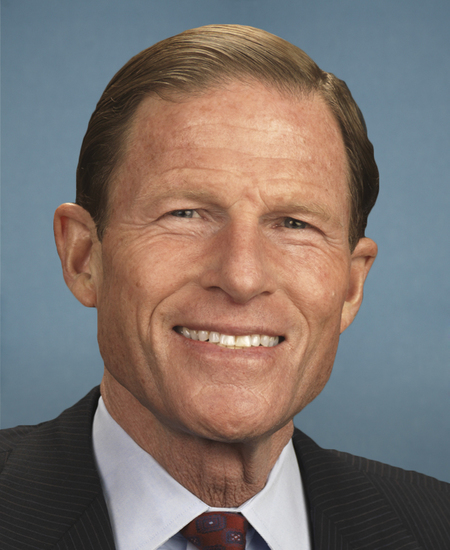
Sen. Richard Blumenthal
Sponsored bills
Protecting Moms Who Served Act of 2021 This bill requires the Department of Veterans Affairs (VA) to implement the maternity care coordination program. The VA must provide community maternity care providers (i.e., non-VA maternity care providers) with training and support with respect to the unique needs of pregnant and postpartum veterans, particularly regarding mental and behavioral health conditions in relation to the service of the veterans in the Armed Forces. Additionally, the Government Accountability Office must report on maternal mortality and severe maternal morbidity among pregnant and postpartum veterans, with a focus on racial and ethnic disparities in maternal health outcomes for veterans.
Healthy Maternity and Obstetric Medicine Act or the Healthy MOM Act This bill expands health insurance coverage availability for pregnant individuals. It requires health insurers, health insurance exchanges, and group health plans to offer a special enrollment period to pregnant individuals. The special enrollment period offered by an insurer or exchange must begin when the pregnancy is reported to the insurer or exchange. The special enrollment period offered by a group health plan must begin when the pregnancy is reported to the plan or is confirmed by a health care provider. The bill also makes pregnancy a qualifying life event for the purpose of enrolling in a federal employee health benefit plan. Additionally, a group health plan or health insurer that covers dependents must provide coverage for maternity care to all covered individuals. Any individual who is eligible for Medicaid and is, or becomes, pregnant maintains such eligibility for one year after the end of the pregnancy. The bill revises the range in which a state must establish a maximum level of family income for pregnant women and infants to be eligible for Medicaid. The upper limit of the range is eliminated and the lower limit is set to the level in place on January 1, 2014.
Court Legal Access and Student Support Act of 2021 or the CLASS Act of 2021 This bill prohibits institutions of higher education (IHEs) that participate in federal student-aid programs from restricting students' ability to pursue claims against IHEs in court. In addition, the bill makes mandatory arbitration agreements inapplicable to enrollment agreements between students and IHEs.
Flu Vaccine Act This bill requires the National Institute of Allergy and Infectious Diseases, which is part of the National Institutes of Health, to conduct or support research regarding the development of a universal influenza vaccine.
Smaller Class Sizes for Students and Educators Act of 2021 This bill directs the Department of Education to award grants for local educational agencies to reduce class sizes in the early elementary grades (grades K-3) in targeted public elementary schools by recruiting, hiring, and supporting qualified teachers.
Responsible Education Mitigating Options and Technical Extensions Act of 2021 or the REMOTE Act of 2021 This bill addresses the administration of certain Department of Veterans Affairs (VA) educational assistance benefits, including by authorizing the VA to waive certain enrollment verifications, exempting foreign educational institutions from certain requirements, and extending the time limitations on the use of educational assistance benefits.
Consolidation Prevention and Competition Promotion Act of 2021 This bill revises antitrust laws applicable to mergers and anticompetitive conduct. Specifically, the bill applies a stricter standard for permissible mergers by prohibiting mergers that (1) create an appreciable risk of materially lessening competition, or (2) unfairly lower the prices of goods or wages because of a lack of competition among buyers or employers (i.e., a monopsony). Under current law, mergers that substantially lessen competition are prohibited. Additionally, for some large mergers or mergers that concentrate markets beyond a certain threshold, the bill shifts the burden of proof to the merging parties to prove that the merger does not violate the law. The bill also establishes within the Federal Trade Commission (FTC) the Office of the Competition Advocate. The Government Accountability Office must report on (1) the success of merger remedies required by the Department of Justice or the FTC in recent consent decrees; and (2) the impact of mergers and acquisitions on wages, employment, innovation, and new business formation.
Blue Carbon for Our Planet Act This bill establishes the Interagency Working Group on Coastal Blue Carbon to (1) assess the impediments to the conservation and restoration of coastal blue carbon ecosystems, and (2) establish national conservation and restoration priorities regarding these areas. Coastal blue carbon ecosystems are vegetated coastal habitats and include mangroves, tidal marshes, and other tidal, freshwater, or saltwater wetlands that have the ability to sequester and store carbon.
Protecting America's First Responders Act of 2021 This bill makes changes to the Public Safety Officers' Benefits (PSOB) program. The PSOB program provides death, disability, and education benefits to public safety officers and survivors of public safety officers who are killed in the line of duty or permanently disabled as a result of catastrophic injuries sustained in the line of duty. Among the changes, the bill expands the public safety officers eligible for coverage under the PSOB program to include firefighters whose primary duty during an emergency response is to secure the scene or manage traffic and cadets or trainees in candidate-officer training; extends coverage under the PSOB program to certain public safety officers responding outside their jurisdiction; increases the interim benefit amount payable on a claim for death benefits and requires the interim amount to be adjusted annually for inflation; increases the benefit amount payable on a death or disability claim that has been pending for more than 365 days on the date of the final determination; allows the Department of Justice (DOJ) to use investigative tools, including subpoenas, to expedite the processing of claims and obtain information or documentation from third parties (e.g., public agencies); specifies that an injury resulting from a neurocognitive disorder qualifies as a catastrophic injury for the purposes of disability benefits; requires (currently, authorizes) DOJ to provide retroactive education benefits to qualifying children and spouses; specifies that hearing officers appointed to review claims are special government employees (i.e., employees who perform temporary duties for a limited period of time) and are authorized to conduct examinations; allows responders to the World Trade Center or their surviving family members to file claims for death or disability benefits in certain circumstances; and extends the period during which public safety officers who die or become injured as a result of COVID-19 are eligible for benefits.