

Maddy summaryThis resolution (SRES 557) designates March 20-26, 2022, as "National Poison Prevention Week" and encourages U.S. communities to raise awareness about poisoning risks and promote prevention. It does not create new laws or requirements but serves as a symbolic recognition of ongoing poison control efforts. The resolution highlights statistics on poisoning incidents (e.g., 420+ children treated daily for poisoning) and acknowledges the work of poison control centers and health partners. It urges the public and healthcare providers to educate families about poison safety, particularly for children and during the pandemic. As a procedural resolution, it has no legal force but aims to support existing prevention initiatives.
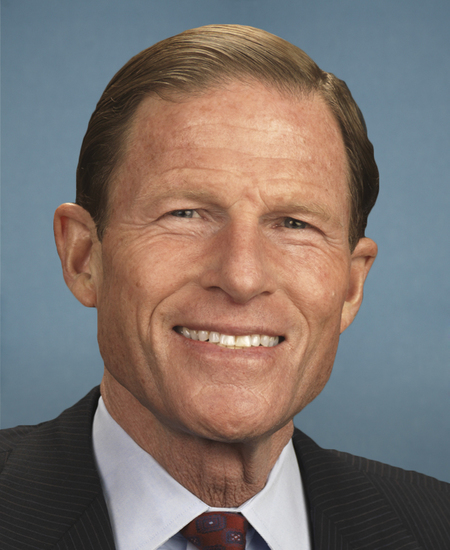
Sen. Richard Blumenthal
Sponsored bills
Gas Price Gouging Prevention Act This bill prohibits any person from selling, during a proclaimed international crisis affecting the oil markets, gasoline at a price that (1) is unconscionably excessive, and (2) indicates that the seller is taking unfair advantage of the crisis to increase prices unreasonably. The President may issue a proclamation of such a crisis that specifies the geographic area covered and how long the proclamation applies. The bill provides for enforcement by the Federal Trade Commission and imposes enhanced civil penalties and criminal fines. It also authorizes state attorneys general to bring a civil action to enforce the prohibitions of this bill.
Safe Cribs Act This bill makes it unlawful to manufacture, sell, or distribute crib bumpers. Crib bumpers generally are padded materials inserted around the inside of a crib and intended to prevent the crib occupant from becoming trapped in any part of the crib's openings; they do not include unpadded, mesh crib liners.
Safe Connections Act of 2022 This bill establishes requirements concerning access to communication services for survivors of domestic violence, human trafficking, and related harms. At a survivor's request, a mobile service provider must separate from a shared mobile service contract the survivor's line (and the line of any individual in the survivor's care) from the abuser's line unless separation is operationally or technologically infeasible. A survivor requesting this must (1) verify through appropriate documentation that an individual under the contract committed or allegedly committed an act of domestic violence, trafficking, or a related criminal act against the survivor; and (2) assume financial responsibility for services after a line separation. A provider may not charge fees or impose other requirements on such requests. Additionally, a provider must separate the line within two business days of receiving a request; allow requests to be made remotely (if feasible); meet conditions related to confidentiality of, disposal of, and other matters concerning communications about requests; and make information about the process for requests available through consumer-facing communications (e.g., websites). The bill (1) provides liability protection for providers' acts or omissions undertaken to comply with such requests, and (2) requires the Federal Communications Commission (FCC) to adopt rules for these requests. Additionally, the FCC must (1) expand access to federally subsidized communication services for survivors facing financial hardship, and (2) evaluate this expanded access. The FCC must also consider rules requiring communication service providers to omit from consumer-facing logs calls and texts to hotlines for domestic violence and similar issues while retaining internal records.
Military Spouse Hiring Act This bill expands the Work Opportunity Tax Credit (WOTC) to include the hiring of a qualified military spouse. (The WOTC permits employers who hire individuals who are members of a targeted group such as qualified veterans, ex-felons, or long-term unemployment recipients to claim a tax credit equal to a portion of the wages paid to those individuals.) A qualified military spouse is any individual who is certified by the designated local agency as being (as of the hiring date) a spouse of a member of the Armed Forces.
This resolution celebrates the successes of American Indian, Alaska Native, and Native Hawaiian women and the contributions they have made in the United States. The resolution also recognizes the importance of supporting equity, providing safety, and upholding the interests of these women.
Maddy summarySRES 548 is a non-binding Senate resolution expressing the Senate's support for removing Russian financial institutions from specialized financial messaging systems like SWIFT. It specifically urges the President to work with U.S. allies to cut off access for major Russian banks, including Sberbank, VTB, Gazprombank, and others listed in the resolution. The resolution emphasizes that this action must be taken multilaterally and maintained to address Russia's actions in Ukraine. It does not impose new sanctions but calls for coordinated international efforts to isolate Russian financial institutions.
Elizabeth Dole Home and Community Based Services for Veterans and Caregivers Act of 2022 or the Elizabeth Dole Home Care Act This bill addresses home care and caregiver programs for veterans.
Prohibiting Anticompetitive Mergers Act of 2022 This bill prohibits certain business mergers, modifies the procedures for reviewing mergers, and establishes procedures for reversing certain mergers. Specifically, the bill prohibits mergers that (1) are valued at more than $5 billion in total assets, (2) result in the acquiring entity having a market share of greater than 33% (or a share of a labor market as an employer of greater than 25%), or (3) result in market concentration levels that exceed specified thresholds. The bill also expands the authority of the Federal Trade Commission (FTC) and the Antitrust Division of the Department of Justice (DOJ) to review pending mergers, including whether a merger is likely to harm the competitive process and the effect of a merger on relevant labor markets. Finally, the bill authorizes the FTC and the Antitrust Division of the DOJ to retroactively unwind mergers that are prohibited under the bill or that meet certain other anticompetitive criteria such as a merger that results in a greater than 50% share of a relevant market.
Magnet Schools Accessibility, Growth, and Nonexclusionary Enrollment Transformation Act of 2022 or the MAGNET Act of 2022 This bill reauthorizes through FY2025 and expands the Magnet Schools Assistance Program (MSAP), which provides grants to eligible local educational agencies (LEAs) to establish and operate magnet schools that are operated under a court-ordered or federally approved voluntary desegregation plan. The bill authorizes a new grant program under MSAP to award grants to LEAs and state educational agencies for increasing diversity in magnet schools.