

Assessing Health Evaluations to Advance Decision-making Act of 2022 or the AHEAD Act of 2022 This bill requires the Department of Health and Human Services to enter into an agreement with the National Academies of Sciences, Engineering, and Medicine (National Academies) to study, and make certain recommendations concerning, the use of health impact assessments or other tools to evaluate the effect of proposed federal legislation on health and health disparities. When developing recommendations to incorporate these tools into the federal legislative process, the National Academies must consult with the Government Accountability Office, the Congressional Budget Office, and the Congressional Research Service.
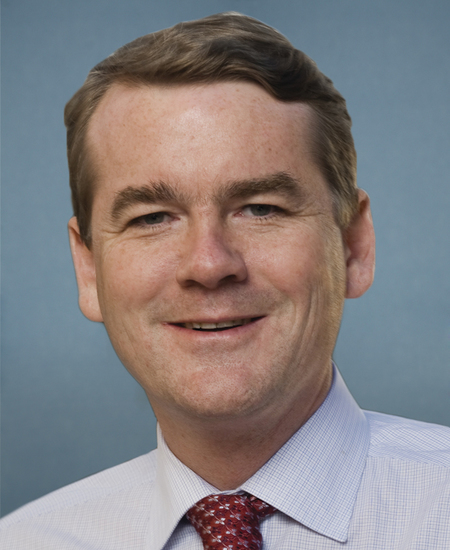
Sen. Michael F. Bennet
Sponsored bills
Colorado River Basin Conservation Act This bill reauthorizes the Department of the Interior to fund or participate in pilot projects to increase Colorado River System water in Lake Mead and the Colorado River Storage Project reservoirs through FY2026. Interior administers these pilot projects to address the effects of drought conditions on the Colorado River Basin, which includes the Upper Basin states (Colorado, New Mexico, Utah, and Wyoming) and Lower Basin states (Arizona, California, and Nevada). The bill also requires Interior to submit an updated report to Congress by the end of FY2027 on the effectiveness of the pilot projects and a recommendation on whether to continue the program.
Dolores River National Conservation Area and Special Management Area Act This bill establishes the Dolores River National Conservation Area and the Dolores River Special Management Area in Colorado. A management plan must be developed for each area. The bill allows for the continued use of the areas by members of Indian tribes for traditional ceremonies and as a source of traditional plants and other materials. The Department of the Interior shall establish the Dolores River National Conservation Area Advisory Council. The bill releases the areas from further study for designation for potential addition to the Wild and Scenic Rivers System.
Maddy summaryThis bill grants a federal charter to the National American Indian Veterans, Incorporated, establishing it as a legally recognized nonprofit organization. It directly affects American Indian veterans by creating a formal entity to unite them, advocate for their needs with government agencies, and support tribal veterans services through outreach and training. Key provisions include requiring the organization to maintain tax-exempt status, prohibiting stock or dividends, mandating annual congressional reports on its activities, and granting exclusive rights to its name and emblems. The charter imposes strict governance rules to ensure the organization remains focused on veteran advocacy without distributing assets to members.
This resolution recognizes November 2022 as National Native American Heritage Month and the Friday after Thanksgiving as Native American Heritage Day.
Mental and Physical Health Care Comorbidities Act of 2022 This bill establishes a demonstration program to test hospital innovations that support low-income or uninsured individuals with serious mental and physical health comorbidities and to identify appropriate payment reforms under Medicare and Medicaid. Participating hospitals must (1) have a proportionally high number of Medicare or Medicaid patients, and (2) develop a plan and related quality metrics for innovations to provide coordinated care and address social determinants of health for individuals with serious mental illness or emotional disturbance and physical comorbidities (e.g., chronic conditions).
Governing Unaccredited Representatives Defrauding VA Benefits Act or the GUARD VA Benefits Act This bill imposes criminal penalties and/or fines on individuals for directly or indirectly soliciting, contracting for, charging, or receiving any unauthorized fee or compensation with respect to the preparation, presentation, or prosecution of any claim for Department of Veterans Affairs benefits. The attempted commission of such offenses is also punishable by fine or imprisonment.
Electoral Count Reform and Presidential Transition Improvement Act of 2022 This bill revises the process of casting and counting electoral votes for presidential elections. The bill also revises provisions related to the presidential transition process. The bill specifies that the choice of electors must occur in accordance with the laws of the state enacted prior to election day. Additionally, the bill identifies each state's governor (unless otherwise identified in the laws or constitution of a state in effect on election day) as responsible for submitting the certificate of ascertainment identifying the state's electors. Further, the bill provides for expedited judicial review for any action brought by an aggrieved presidential or vice-presidential candidate arising under the U.S. Constitution or U.S. laws with respect to the issuance or transmission of such a certificate. The bill revises the framework for the joint session of Congress to count electoral votes and make a formal declaration of which candidates have been elected President and Vice President. Among other changes, the bill (1) specifies that the role of the Vice President during the joint session shall be ministerial in nature, and (2) raises the objection threshold in Congress to at least one-fifth of the duly chosen and sworn members of both the House of Representatives and the Senate. The bill also revises the presidential transition process, including to (1) allow more than one candidate to receive federal transition resources under certain circumstances, and (2) require additional reporting by the General Services Administration.
This resolution recognizes the long history and positive economic effects of the Social Security programs. It also expresses the belief that the Social Security and Supplemental Security Income programs should continue to be funded through mandatory spending.
This resolution supports the designation of October 2-October 8, 2022, as National 4-H Week. It also (1) recognizes the important role of 4-H in youth development and education, and (2) encourages all citizens to recognize 4-H for the significant impact the organization and members have made and continue to make by empowering young people with the skills needed to lead for a lifetime.