Maddy summaryS 3342, the Colorado Judgeship Act, adds three new federal district judgeships for Colorado. It directs the President to appoint these judges with Senate confirmation, increasing Colorado's total district judgeships from 9 to 10 as reflected in federal law. This change directly affects Colorado's federal court system by expanding judicial capacity for handling cases in the district. The bill is procedural, updating the official count in Title 28 of the U.S. Code without altering substantive law.
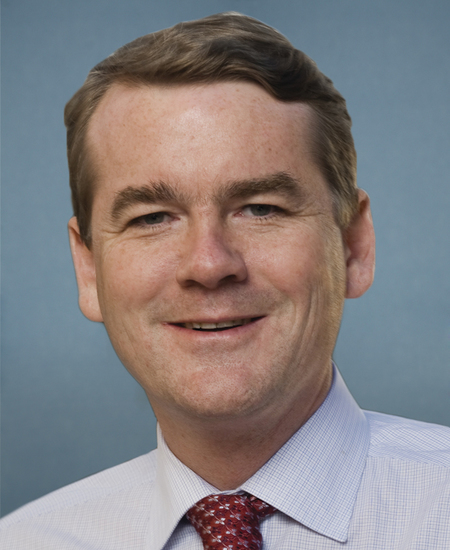
Sen. Michael F. Bennet
Sponsored bills
High Rise Fire Sprinkler Incentive Act of 2021 This bill classifies any automatic fire sprinkler system retrofit property as 15-year property for purposes of accelerated depreciation.
Simplifying Outdoor Access for Recreation Act or the SOAR Act This bill sets forth and revises provisions regarding special recreation permits for use by individuals and groups to engage in recreational activities on federal recreational lands and waters.
Maddy summaryThis Senate resolution (SRES 464) expresses symbolic support for National Adoption Month (November) and National Adoption Day (November 20), encouraging public awareness of children awaiting adoption. It does not create new laws or allocate funding but urges U.S. citizens to consider adoption and support efforts to provide safety and permanency for children in foster care. The resolution highlights challenges like the pandemic's impact on foster care systems while affirming that every child deserves a permanent family. It directly affects no specific group through policy changes - it is a non-binding statement of support endorsed by 30+ senators.
This bill redesignates the Geospatial Learning Center in the Next NGA West facility in St. Louis, Missouri, as the Senator Roy Blunt Geospatial Learning Center.
Reforming Broadband Connectivity Act of 2021 This bill requires the Federal Communications Commission (FCC) to make changes to the financing of the Universal Service Fund. This fund, which is financed by fees contributed by telecommunications carriers, supports programs to expand the availability of and access to telecommunications services. Specifically, the bill directs the FCC to (1) study the need for expanding the fund's contribution base to ensure fairness and equity in applicable contribution requirements, and (2) reform the fund's contribution system through rulemaking. In carrying out the rulemaking, the FCC must consider the findings and recommendations of its study and the impact of changes on consumers, businesses, and seniors.
Maddy summarySRES 451 is a commemorative Senate resolution honoring the late Senator Max Cleland (D-GA), who died November 9, 2021. The resolution recognizes his service as a Vietnam War veteran (losing both legs and an arm in combat), his 50+ years of public service including roles as Georgia State Senator, Secretary of State, U.S. Senator, and Administrator of the Veterans Administration, and his advocacy for veterans. It formally expresses the Senate’s "profound sorrow" and "deep regret" over his death, commemorates his legacy of service to Georgia and veterans, and requests the Secretary of the Senate transmit the resolution to his family. This is a ceremonial resolution with no policy changes or legal effect.
Maddy summarySRES 441 designates November 6, 2021, as National Bison Day to recognize the historical, cultural, and economic significance of bison in the United States. The resolution encourages the American public to observe the day with ceremonies and activities, building on an annual tradition that began in 2012. It highlights bison's role in Native American heritage, conservation efforts, and contributions to rural economies, without creating new legal requirements or funding.
Zeroing Out Money for Buying Influence after Elections (ZOMBIE) Act This bill establishes certain requirements for disbursing unused funds after a federal election. The bill also requires former candidates serving as registered lobbyists or foreign agents to comply with disbursement requirements. Specifically, the bill requires each authorized committee or leadership political action committee (PAC) of a candidate to disburse all unused funds within a specified time period beginning after an election or before the candidate registers as a lobbyist or foreign agent, unless the candidate files to run for office again before the disbursement period begins. A committee or PAC disbursing unspent funds shall first pay any obligations incurred. If funds are left over, the committee or PAC may only disburse the remaining funds for the following purposes: (1) returning funds to donors; and (2) making contributions to nonprofit organizations. The bill generally prohibits disbursements to relatives of the candidate or certain nonprofit organizations related to the candidate. A former candidate must, in order to register as a lobbyist or foreign agent, comply with the disbursement requirements outlined by this bill.
John R. Lewis Voting Rights Advancement Act of 2021 This bill establishes new criteria for determining which states and political subdivisions must obtain preclearance before changes to voting practices may take effect. Preclearance is the process of receiving preapproval from the Department of Justice (DOJ) or the U.S. District Court for the District of Columbia before making legal changes that would affect voting rights. The bill also includes provisions related to federally protected activities at polling places and voting access on tribal lands. A state and all of its political subdivisions shall be subject to preclearance of voting practice changes for a 10-year period if 15 or more voting rights violations occurred in the state during the previous 25 years; or 10 or more violations occurred during the previous 25 years, at least 1 of which was committed by the state itself. A political subdivision as a separate unit shall also be subject to preclearance for a 10-year period if three or more voting rights violations occurred there during the previous 25 years. States and political subdivisions that meet certain thresholds regarding minority groups must preclear covered practices before implementation, such as changes to methods of election and redistricting. Further, states and political subdivisions must notify the public of changes to voting practices. Next, the bill authorizes DOJ to require states or political subdivisions to provide certain documents or answers to questions for enforcing voting rights. The bill also outlines factors courts must consider when hearing challenges to voting practices, such as the history of official voting discrimination in the state or political subdivision. In addition, the bill (1) includes certain protections for election workers, polling places, and election infrastructure; and (2) expands voting access on tribal lands.